Chiara’s slave
Well-Known Member
Once it’s dark, it’s hard to trim anyway, so more conservative is a good idea unless you have a rail full of sailing gods.


Same for dinghy cruising, in my opinion. Those long tracks dead downwind are a real headache for the tiller pilot (me), with the rolling we get in any significant seaway and being constantly on guard for the unscheduled gybe, or the Wayfarer's dreaded downwind "death roll".While going downwind with white sails (main+genoa) I d give some thoughts to the sailing ''comfort'' too, in particular during longer runs. Personally I am more than happy to avoid dead downwind and give up some VMG in favour of a boat which is rolling a lot less, it heels on a predominant side rather than playing the metronome and throwing people and stuff all over the place, needs less constant attention to the wind angle (risk of accidental gybes, banging sails etc), also when the wind is light the increase in apparent wind immediately benefits the wind steering and -despite hardly ever using it- I see the electric autopilot working a lot less when 20-30 degrees off the wind than DDW, the boat seems happier overall. When DDW was almost unavoidable, say specific coastlines etc, I usually have memories of rather miserable sailing, if at all possible I d always prefer broad reaching and jibing, happier sail for a longer time what s not to like

We almost never hand steer on passage. The autopilot does it all. Every possible sail plan and direction. A good powerful autopilot and course computer is worth it's weight in goldFWIW Allan, we came round Lands End one season heading up the bristol channel in my Starlight. We were Goose winged with the main held by a jibe preventer and the genoa fully unrolled and poled out. The boat is so controllable that we were on autopilot ( below deck Simrad hydraulic) and busily doing anything but paying notice to what was happening. The wind steadily built, the boat trundled on, until suddenly the bow have was above the guard rails and the log briefly flashed up to 14kn. Panic stations and the fastest reef down I have ever seen! Not an approach ever to be tried deliberately but the really surprising thing was that the autopilot held the course as it always did.
They are fabulous all round boats.
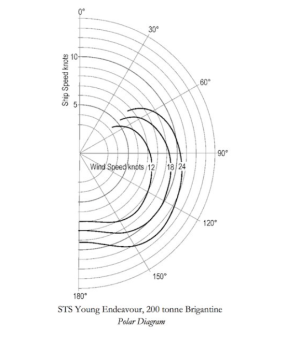
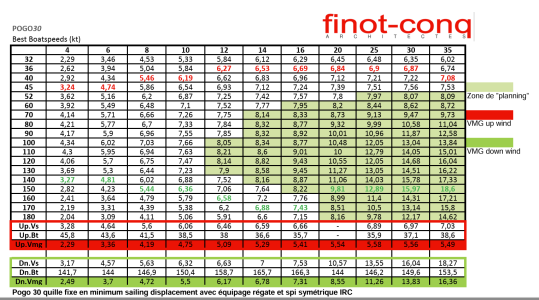
Those make interesting reading for us. I don’t know of any for Dragonflys, but if they existed they would be quite different. Especially in how much wind is needed for Vmax, that really jumps out. The angles really don’t work for them to nearly the same extent either. In fact they’re little different to those for a heavy displacement boat. We do occasionally get sucked in by the Pogo hype, and think maybe we’d be better off. But no, we’ll just carry on whipping their asses, unless the course is a dead run. Useful to know just how deep you have to sail a mono, even on a planing boat.Here is the design data for the Pogo 30 with a symmetrical spinnaker.
The green box at the bottom indicates the best true wind angle and the corresponding VMG and speed through the water for the best VMG directly downwind.
View attachment 201873

Indeed, I was surprised not to find speeds greater than wind speed and also how relatively little was to be gained by gybing downwind, rather than running straight. Of course, if you are racing, that difference is significant.Those make interesting reading for us. I don’t know of any for Dragonflys, but if they existed they would be quite different. Especially in how much wind is needed for Vmax, that really jumps out. The angles really don’t work for them to nearly the same extent either. In fact they’re little different to those for a heavy displacement boat. We do occasionally get sucked in by the Pogo hype, and think maybe we’d be better off. But no, we’ll just carry on whipping their asses, unless the course is a dead run. Useful to know just how deep you have to sail a mono, even on a planing boat.
My experience of sailing a cat across the pond is that they are way more comfortable in following seas and wind than any monohull. You can leave the teapot on the table in 35kts of breeze and it stays there. I would like a monohull for upwind and a cat for downwindWhen racing in a mixed handicap class of cruiser racers in sheltered waters very few if any would tack downwind. We once had a J class in our fleet which tacked downwind and would win every race despite not gaining on handicap on the beats. So if you can get beyond hull speed its an advantage.
When cruising in a heavy displacement boat then twin jibs poled or poled jib and main work well. Rolling can be a problem and where I sail its often caused by a swell running at a 45-90 degree angle to the wind - like having a quartering sea but without the wind pressure in the sails to damp the rolling.
I wouldn't alter course for boat speed but I have done for comfort. I would like to experience a cruising multihull running in cross swell conditions - I imagine more comfort but possibly some spray over the corners.

And a Westerly Fulmar for berthing!My experience of sailing a cat across the pond is that they are way more comfortable in following seas and wind than any monohull. You can leave the teapot on the table in 35kts of breeze and it stays there. I would like a monohull for upwind and a cat for downwind
Clearly, the vessel you seek is the sum of their parts. We have the cat advantage downwind, but will comfortably see off that Pogo upwind. In 16kn true, we’d reckon on 9kn TWS, at 40 deg true. With the teapot on the table, unless theres a short sharp sea, like the western solent on wind over tide. A bit short on space on a 30 footer mind youMy experience of sailing a cat across the pond is that they are way more comfortable in following seas and wind than any monohull. You can leave the teapot on the table in 35kts of breeze and it stays there. I would like a monohull for upwind and a cat for downwind


Those make interesting reading for us. I don’t know of any for Dragonflys, but if they existed they would be quite different.
 Occasionally it’s the other end too.
One the nicest point of sail for us is a broad reach in 9kts and fairly flat seas. We can carry the 130% genoa, mainsail and mizzen staysail. This saves us the bother of hoisting the asymmetric. We can often make 6 knts in 9kts T as the wind comes all the way around to the beam. We often have to point a little higher initially to get the hull speed up, then bare away and adjust the sail accordingly. With this set up we carry over 1500sqft of sail without a kite.Clearly, the vessel you seek is the sum of their parts. We have the cat advantage downwind, but will comfortably see off that Pogo upwind. In 16kn true, we’d reckon on 9kn TWS, at 40 deg true. With the teapot on the table, unless theres a short sharp sea, like the western solent on wind over tide. A bit short on space on a 30 footer mind you
.....In 10kn at anything more than 120 deg ideally we’d use the asymmetric. Dunno if you got to try that, it’s over twice the size of the code 0.....
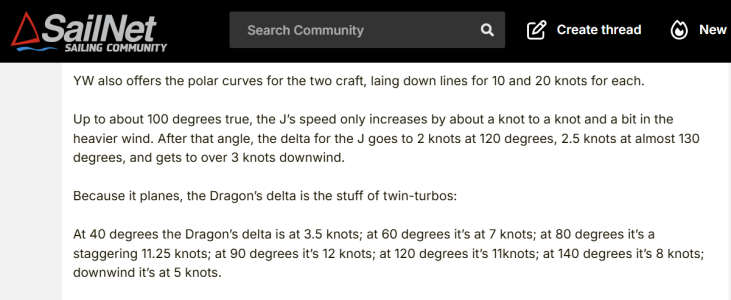
I assume by delta, they mean the difference in the speed through the water between 10knots wind and 20knots wind when pointing (going??) in the same direction relative to the true wind.AI assisted Google says that some Dragonfly 35 polars were published by YW back in an April 2007 test. Before the dawn of digital - so its not available in YW app archive or as a web search (that I've been able to find, leastways). BUT Ragnar, on SailNet, was sufficiently struck, by the difference in the DF35's performance profile and that of a J/122 (displacement cruiser/racer), tested at the same time, to verbally describe their two polar diagrams:
View attachment 201891
The ride can be challenging if it’s really short and steep. But then, so it would be in a similar length mono. We have been known to put a few rolls on the jib in order to brew up. In just big swell, it’s exciting, not challenging. You’ve seen the Adriatic charter boat? They’ll sting you a couple of days tuition before letting you loose.Al (DF agent) wanted to. But, seeing as we were already making 20kts, under single reefed main & jib , (pedestrian to experienced tri types I know, but balistically fast to me!), I asked to try out gybing instead. Which actually surprised me more than the outright speed. In 20, gusting 25kts, true the helm was light, the boat was flat (as it was on the beat out). Main flipped over sweet as can be, every time, even for a tri novice.
Still wondering about handling in a seaway. Quorning not keen on chartering their Danish demo DF28 to a solo tri novice.
Exactly. 11 knots faster at 120 deg. The reason we don’t see that is that we’re already fast, with a Code 0. The poor little girl simply won’t move any faster through the water come 20kn. Up around 20kn of boat speed, there’s just no more to come.I assume by delta, they mean the difference in the speed through the water between 10knots wind and 20knots wind when pointing (going??) in the same direction relative to the true wind.

These are very similar to mine.Here is the design data for the Pogo 30 with a symmetrical spinnaker.
The green box at the bottom indicates the best true wind angle and the corresponding VMG and speed through the water for the best VMG directly downwind.
View attachment 201873