GNSS Single point of failure

Why? I don't have the emergency kit to deal with asteroid impact at home, nor do I have a gas mask in case a mega volcano erupts. I don't even have the kit to deal with a whale attack. I would consider it a fail for anyone who plans for such unreasonably unlikely events. I also don't carry a spare alternator or starter motor, and that's infinitely more likely than the sun taking out all of our GNSS systems. Even if I were mid atlantic when this highly unlikely event occured, sailing downwind will very likely get me to safety. I think I'd probably survive even without a compass if my sails were still working, which they would be.
Downwind might also take you round the Azores high :ROFLMAO:
But I agree that heading west which can be easily done without a compass thanks to all those bright things in the sky would be a perfectly suitable contingency for the once in two lifetimes event which took out satellites on both sides of the globe simultaneously.
 
Be careful following bright things in the sky. I once aimed at the moon on passage to the Isle of Man and after a few hours was pointing at Dublin ?
 
I don't think that I'd be worried on an ocean crossing passage! After all, if you head west you'll hit America, and if you head East you'll hit Europe or Africa. And even without any instruments, I reckon I could estimate latitude to a few degrees! Just for example, this would work: mark a rope at equal, known intervals. Hoist it up the mast. Steer north, and sight on Polaris from a point a known distance from the mast; note the height up the mast of Polaris, using the marked rope as a measuring stick. Then latitude = atan(height up mast/distance from mast). Of course it's approximate - but it should be good to a degree. Or simply knock up a Kamal for the latitude you're aiming for; it would be simple to do that.
I wouldn't call it a once in two lifetimes event, either. Events CAPABLE of damaging satellites have occurred twice this century already. The fact that they haven't is mainly good fortune. And there is no shielding effect of the Earth; the charged particles that cause the damage are guided around the Earth by the magnetic field, so even satellites on the side of Earth away from the sun can be damaged.
 
Events CAPABLE of damaging satellites have occurred twice this century already
That's just it though, from a risk perspective those events need to happen (low risk) x those events need to hit the earth (very low risk) x you have to be out sailing when this happens (extremely low risk) x you have to be lost enough to need nav aids (well, that's on you!).

If you do this calculation the risk is small enough to be written off as probably won't happen. On the other hand, if you're sailing Biscay your chance of getting an orca up the bum is pretty high. I'd rather carry a rudder replacement kit than a sextant and current almanac from a risk perspective, but in reality I carry neither as they're just not likly enough to be a problem worth solving.
 
Thanks for that, interesting to see what can be done. I wonder if that could be done in the heat of the moment?

Depends on how much you practice, I suppose. If someone has the habit of verifying their satellite fixes via visual/radar/celestial methods then satellites going down should be largely a non-issue. I'm reminded of when the stories broke about GPS spoofing in the Black Sea; the ships affected simply used other means of navigation and ignored or switched off the GPS when it happened. It's also useful should you find yourself in the few remaining parts of the world where the charts warn against using satellite-derived positions, or other places where the charts are simply off a bit.

(On the other hand, it'd be rather inconvenient if the plotter simply threw up its hands and started bleating an alarm.)
 
Isn't Radar to obvious back?
Assuming you have DC power, and you should have at least DC battery power for a little while, then a radar will show you the land, and if it's any good the local navigation buoys. That should enable you to navigate safely, even to the point of getting you into a harbor in poor visibility.
When I started sailing offshore in 1957/58, our new Dell Quay Shearwater 22, we regularly sail from Abersoch to Ireland, usually to Dun Laoghaire (Dublin), we sailed with basic charts, an ex war department compass, a reasonable pair of binoculars, and my fathers Douglas protractor, from his time in the RAF, which I still have and use.
The basic philosophy was to work out the course to steer, more or less ignore the tides, aim a little bit up wind of the destination and sail. When we sighted the Irish Coast, we'd use the binoculars to identify land marks and decide to turn north or south. We'd trail a walker log, and draw lines on the chart. I never had the feeling that we were lost, no concept of knowing our position to the nearest meter, just confidence that we would find Ireland, it just too big to miss, and we'd work our way from there.
Later, in the very early 1970's, working on survey boats in the North Sea, the boats had DECCA and radar, DECCA positions were marked on charts and position lines drawn, using the radar range and bearing of headlands and the like.
I guess what I'm really saying is that I don't see the need to know where the boat is to the nearest meter, all you really need to know is roughly where you are, that you are going is approximately the right direction, when you get there, or get closer you can make fine adjustments, and if you have a half decent radar you don't really need GPS. Paper charts certainly help, but if you sail regularly in the same area, you'll have good idea of the general "lie of the land" and either visually or with a radar you can pilot your way around quite safely.
 
I retired in 2007 and also resigned from the RIN. At that time there was significant professional concern and discussion regarding what to do when GPS and the other newer systems failed as it was, even then, deeply embedded in much more than navigational infrastructure.

Isn't Radar to obvious back?

For a few years up to retirement I was running STCW radar and navigation simulator courses for MN deck officers. Candidates were required to cross check a GPS position with a radar range. Those that did not had their GPS accuracy progressively degraded until they realised something was wrong. At least a grounding on the simulator did not do any environmental damage but could be a source of embarrassment for the remaining duration of the course..

However, perhaps the best option is simply to have an awareness of which way is safe.

I was a YM practical instructor in the (pre GPS) 80's. From time to time a student would be asked to show the boat's approximate position on the chart. No time to take bearings or look around, just go below and put your finger on the chart.
 
I retired in 2007 and also resigned from the RIN. At that time there was significant professional concern and discussion regarding what to do when GPS and the other newer systems failed as it was, even then, deeply embedded in much more than navigational infrastructure.


For a few years up to retirement I was running STCW radar and navigation simulator courses for MN deck officers. Candidates were required to cross check a GPS position with a radar range. Those that did not had their GPS accuracy progressively degraded until they realised something was wrong. At least a grounding on the simulator did not do any environmental damage but could be a source of embarrassment for the remaining duration of the course..


I was a YM practical instructor in the (pre GPS) 80's. From time to time a student would be asked to show the boat's approximate position on the chart. No time to take bearings or look around, just go below and put your finger on the chart.
In my YM course and exam the plotter was off except for the radar nav exercise. It was all chart or pilotage from notes .
 
Depends on how much you practice, I suppose. If someone has the habit of verifying their satellite fixes via visual/radar/celestial methods then satellites going down should be largely a non-issue. I'm reminded of when the stories broke about GPS spoofing in the Black Sea; the ships affected simply used other means of navigation and ignored or switched off the GPS when it happened. It's also useful should you find yourself in the few remaining parts of the world where the charts warn against using satellite-derived positions, or other places where the charts are simply off a bit.

(On the other hand, it'd be rather inconvenient if the plotter simply threw up its hands and started bleating an alarm.)
Very true, I've very old school and work up a EP then verify it against the GPS, I even get the sextant out from time to time for a noon sight.

As an ex-member of the RIN and having an interest in the maths of GPS before I retired I attended a RIN meeting with a lot of GPS boffins. They were a bit surprised when I said if they looked at many charts they were last surveyed in 18 something. Could they guarantee that my wee boat might not be stuck on a mud bank? Indecently, according to my chartplotter I am sat on a mudbank some 200 meters SE of the boat on the hard.
 
Very true, I've very old school and work up a EP then verify it against the GPS, I even get the sextant out from time to time for a noon sight.

As an ex-member of the RIN and having an interest in the maths of GPS before I retired I attended a RIN meeting with a lot of GPS boffins. They were a bit surprised when I said if they looked at many charts they were last surveyed in 18 something. Could they guarantee that my wee boat might not be stuck on a mud bank? Indecently, according to my chartplotter I am sat on a mudbank some 200 meters SE of the boat on the hard.
I think part of the issue is that now UKHO has abandoned its affordable Small Craft Folios of paper charts (with the single sheet print on demand “replacement” unlikely to be available over the counter and at much higher cost), increasingly yachts will be sailing with no paper chart backup. So very difficult to go back to old school methods, unless very rich to be able to afford lots Of paper charts at higher prices.

Most boats will have multiple devices with electronic charts on them. And a cheap battery backup device could keep a phone live to daily fixes all the way across the Atlantic. So single device or power loss not a huge issue.
BUT if GNSS / GOS were to be blocked then all these devices would fail. And with many chart plotters and/navigation apps they can go into a sulk if no GPS signal. Hence could be very difficult to do traditional navigation on electronic chart that cannot write on.

This thread is a good prompt for thought though - eg
- Use waypoints on plotter as way to record EPs?
- Take screenshots on tablet - and draw on the photos?
Plotting a cocked hat from three objects might be trickier though

PS. I gather that current RIN bods are very aware of this issue. And very aware of the issue of old survey sources - indeed I think they have flagged this issue of the lack of CATZOC information on any electronic leisure charts in their recommendations accompanying their recent paper on electronic navigation. https://rin.org.uk/page/ENavRec
 
Would it not be possible, given a reasonably accurate departure point (maybe the last logged position before the nav systems all failed) to work out a course to a suitable way point given in Reeds for safe entry to your chosen harbour.

Even if you didn't have a chart maybe you could draw one for plotting purposes.

Not sure how to scale though, minutes of latitude won't be the same as longitude. Is there a simple mathematical relationship?
 
I think part of the issue is that now UKHO has abandoned its affordable Small Craft Folios of paper charts
To be clear though, GNSS failure would not affect your electronic charts or your plotter aside from its ability to know your position automatically. You can absolutely plot your position manually on a plotter if you need to.
The reason they stopped the folios is because people are not buying them. The reason people are not buying them is because people don't need them. Same as a road atlas, it's definitely worth that risk in 2022 to not carry one, you'll be fine.
 
Would it not be possible, given a reasonably accurate departure point (maybe the last logged position before the nav systems all failed) to work out a course to a suitable way point given in Reeds for safe entry to your chosen harbour.
....
Not sure how to scale though, minutes of latitude won't be the same as longitude. Is there a simple mathematical relationship?

Mid-latitude sailing would address this. A quick copy and paste from Bowditch:

Example 1: A vessel steams 1,253 nm on course 070° from lat. 15° 17.0' N, λ 151° 37.0' E.

Required: Latitude and longitude of the point of arrival by
(1) computation and (2) traverse table.

Solution:
(1) Solution by computation:


D = 1253.0 nm
Cn = 070° Τ = N 070° Ε
l = (1,253.0) (cos 070°) = 428.6' N = 7° 08.6' N
p = (1,253.0) (sin 070°) = 1,177.4 nm E
L1 = 15° 17.0' N
+l = 7° 08.6' N
L2 = 22° 25.6' N
Lm = 18° 51.3' N = 18.855°
DLo = p / (cos Lm) = 1,177.4 / cos 18.855° = 1,244.2'
DLo = 1,244.2' E = 20° 44.2' E
λ1 = 151° 37.0' E
+ DLo 20° 44.2' E
λ2 = 172° 21.2' E
Answer:
L2 = 22° 25.6' N
λ2 = 172° 21.2' E
 
The ECDIS systems for big ships partially solve the "the GPS has died!!!" problem - things like visual and radar bearings can be inputted easily, and it will even run its own DR plot automatically based on compass and log inputs.
One system I've trained on (but not used in anger) could even use a defined point on the radar as a position reference, a sort of automatic radar position fixing.
Though there are also features that are on yacht plotters but not seriously expensive commercial systems.

Our tug doesn't have an ECDIS though, but a (admittedly very good) chartplotter with c-map charts. And proper paper charts of course!


(We don't have a gyrocompass, but have a GPS compass. We also don't have a STW log, only SOG from gps so in many ways we are more vulnerable to a GPS failure than a big ship that only has electronic charts!! )
 
I think part of the issue is that now UKHO has abandoned its affordable Small Craft Folios of paper charts (with the single sheet print on demand “replacement” unlikely to be available over the counter and at much higher cost), increasingly yachts will be sailing with no paper chart backup. So very difficult to go back to old school methods, unless very rich to be able to afford lots Of paper charts at higher prices.
I've made the move away from UKHO Small Craft Folios, at least in the south of England, and am using NV Charts as I like their 'atlas' style of paper charts and their electronic charts on up to five devices. Sadly, as they are a German company, they have abandoned plans to chart the entire British Isles since we left the union.

I use the amazing Sea Chest in Plymouth and will need to talk to them, the idea of getting a chart with exactly the area you what at the scale you like does appeal. I'm thinking about visiting Cork in the summer and being able to specify one or two charts would be fantastic.
 
I think part of the issue is that now UKHO has abandoned its affordable Small Craft Folios of paper charts (with the single sheet print on demand “replacement” unlikely to be available over the counter and at much higher cost), increasingly yachts will be sailing with no paper chart backup. So very difficult to go back to old school methods, unless very rich to be able to afford lots Of paper charts at higher prices.

....

PS. I gather that current RIN bods are very aware of this issue. And very aware of the issue of old survey sources - indeed I think they have flagged this issue of the lack of CATZOC information on any electronic leisure charts in their recommendations accompanying their recent paper on electronic navigation. https://rin.org.uk/page/ENavRec

I was glad to see the recommendations from the RIN in this area. One of my standard rants is about how the migration to electronic navigation drives a split between leisure and professional methods, as it provides paper-equivalent tools via ECDIS but effectively abandons the leisure crowd to 3rd party charts and basic plotters. Perhaps the thinking was a market solution would arise, but market solutions tend to be focused on dumbing down products and stripping little-used features rather than the opposite.

On the other hand, ENCs seem to be at least priced similarly to their paper counterparts; so to me the issue is what options might be available to segment the market and provide the electronic equivalent of leisure folios at a more accessible cost.
 
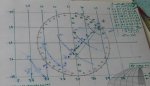
I sometimes used an adaption from the astro plotting sheets, you choose latitude/scale then draw your own canvas latitude longitude, it can cover up to a few hundred miles.
This one was made with a strong storm arriving, helped in deciding between heading to the original destination, slow down, or divert to a shelter. Quite useful, a chart would not withstand all those signs being traced and erased, a plotter errr..

Also, with one of these sheets and a volume of sailing directions, you can land basically everywhere along shipping routes.


plotting sheet.jpg


Even if you didn't have a chart maybe you could draw one for plotting purposes.

Not sure how to scale though, minutes of latitude won't be the same as longitude. Is there a simple mathematical relationship?
 
It may be my petty fear, but apart from satellites burning, I think the risk of being hit by lightning and wiping away every electronics is a lot more common.
Maybe less so in Iceland, but in tropical or equatorial waters, nights spent threading between lightning bolts leave frightful memories :(
 
It may be my petty fear, but apart from satellites burning, I think the risk of being hit by lightning and wiping away every electronics is a lot more common.
Maybe less so in Iceland, but in tropical or equatorial waters, nights spent threading between lightning bolts leave frightful memories :(
Just don’t forget you have put you backup technology - iPad, phone and PLB - in the oven and light the burners for dinner :cool:
 
...Not sure how to scale though, minutes of latitude won't be the same as longitude. Is there a simple mathematical relationship?

Yes: longitude scale on Mercator projection(1) = Lat scale * cos(lat).

So, at 50 degrees North (or S) for instance, cos(lat) = cos(50) = 0.6428, and if you choose a scale of 1 minute of lat = 1cm, then 1 minute of long = 6.4mm.

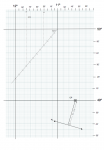
This is easily accurate enough for DR (or astro-nav ). No tables of cosines? Construct it like this:
page5image4245478640
(1) On a small section anyway you can keep the lat and long scale fixed
 
Last edited:
Top