
Global warming in the Sunday Times mag

It's a small scale on the chart (100,000 years) so it's difficult to see but co2 lags temp by about 800 years.

You can see it a little clearer here.
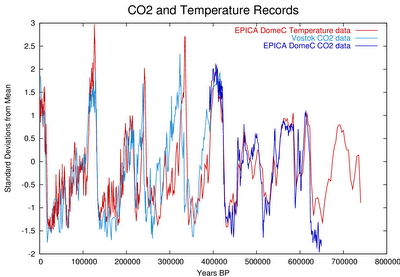
Co2-temperature-plot.png


I'm not sure this fact is disputed?
 
The claim that only a tiny fraction of the CO2 is man made is clearly ridiculous. Probably between 25% and 50% of the CO2 in the atmosphere is a direct result of man burning fossil fuels or deforrestation
 
[ QUOTE ]
It's a small scale on the chart (100,000 years) so it's difficult to see but co2 lags temp by about 800 years.

You can see it a little clearer here.

I'm not sure this fact is disputed?

[/ QUOTE ]
O come off it - that chart has a horizontal scale of 800000 years - the effect you claim it demonstrates is a 800 year lag - or 1/1000th of the horizontal axis.

Now the picture only has a horizontal size of 400 pixels - so you are claiming that you can see a difference of less than half a pixel.

Now there may or may not be an 800 year lag (whatever it means) but the graph clearly cannot demonstrate any such thing.

This is what I mean about people being gullible - they just repeat parrot fashion impossible arguments without understanding!
 
Sorry, I may be thick as a whale omlette, and I know nothing about the sources of data, but just looking at the plots and taking them at face value, this one:

CO2GlobTemp.gif


Shows temp lagging behind CO2 as expected and this one:

Co2-temperature-plot.png


Shows temp and CO2 overlying each other perfectly, except for the one peak at about 330,000 years BP where indeed temp does appear to lag CO2. The two plots seem to agree pretty well with each other but I don’t see that shift on the top one. Also the lower plot changes sources of CO2 data along the way, and the older data CO2 data matches the older temp much better (Note for the unwary, the X-axes are reversed on the two graphs!)

There is obvioulsy a very highly significant correlation between CO2 and temp. That does not mean one causes the other of course, but that would be an obvious hypothesis.
 
So instead of slagging off the graphs above show me your own which say different.

I am saying this as fact:

The earth warms up about 800 years before co2 levels rise NOT the other way round (as in the past).

Man mad co2 only accounts for a small percentage of co2 in the atmosphere (less than 6%). Nothing like the silly amounts of 30%-50% you quote.

If I'm wrong prove it and I'll eat humble pie.
 
[ QUOTE ]
So instead of slagging off the graphs above show me your own which say different.

I am saying this as fact:

The earth warms up about 800 years before co2 levels rise NOT the other way round (as in the past).

Man mad co2 only accounts for a small percentage of co2 in the atmosphere (less than 6%). Nothing like the silly amounts of 30%-50% you quote.

If I'm wrong prove it and I'll eat humble pie.

[/ QUOTE ]

They are lovely graphs!

It's just that you said that they showed that the recent warming started about 800 years before the coresponding co2 levels rise. You were challenged on it and appear to have abandoned that claim, but say it is so anyway.

I know absolutely nothing about the subject! I am just looking critically at your interpretation of the data you present. You may be right that there is an 800 year lag before CO2 'responds', but you did not show any data to support the claim.

Again, on the levels of man-made CO2, I have absolutely no idea what the values are, although I suppose I could easily enough find out. But how does the difference between 30% and 6% affect the price of fish ? The graphs do show fluctuations in CO2 that match temp fluctuations, and they show a recent spike of CO2 together with a matching temp spike. Are you saying human CO2 cannot account for that spike?
 
Could you give a reference for that 6% figure? No I thought you couldn't because it simply isn't true.

CO2 levels in the atmosphere have risen by 37% since the industrial revolution 200 years ago - that is vastly steeper than any other rise seen in history. That is almost exclusively down to the burning of fossil fuels and deforrestation. More worrying it has increased 20% in the last 50 years.

Without knowing where you got that 6% from I can't point out what mistake you are making - at a guess I would say that you are confusing net and gross production figures.
 
[ QUOTE ]
This is what I mean about people being gullible - they just repeat parrot fashion impossible arguments without understanding!

[/ QUOTE ]

/forums/images/graemlins/grin.gif /forums/images/graemlins/grin.gif Kettle....
 
[ QUOTE ]
/forums/images/graemlins/grin.gif /forums/images/graemlins/grin.gif Kettle....

[/ QUOTE ]
That is a nice positive input that really advances the debate.

It should be clear from my postings that I have a good grasp of the scientific concepts - I don't know all the answers but I have a good enough understanding of the issues to detect Bull**** on either side of the argument.
 
[ QUOTE ]
I have a good enough understanding of the issues to detect Bull****

[/ QUOTE ] /forums/images/graemlins/grin.gif /forums/images/graemlins/wink.gif

I'll post some references when I find them.
 
Ok, to advance the debate.....

Carbon Facts (NASA)

Carbon Holdings

1) Atmosphere = 760 PgC
2) Land (Plant & Soil) = 2,000 PgC
3) Ocean (Surface) = 800 PgC
4) Ocean (Depths) = 38,000 PgC
5) Fossil Fuels = 5,000 PgC

Flows

2) -> 1) = 118.5 PgC/Year
1) -> 2) = 120 PgC/Year
3) -> 1) = 97 PgC/Year
1) -> 3) = 100 PgC/Year
5) -> 1) = 6.5 PgC/Year

Current Net Gain in Atmosphere of about 2PgC/Year or c. 0.26%

One of the big benefits to me of these threads, is that it has caused me the question some understandings and to investigate statements people have made. I have learnt that:-

1) There aren't enough professional statisticians involved with the IPCC who can validate the stats rather than the science.
2) CO2 like Water Vapour absorbs Heat, once there is enough to absorb the available heat, it doesn't matter how much more CO2 or Water Vapour there is, it won't get any hotter.
3) We had the Great Global Cooling Scare until the Early 1980's and now the same scientists who insisted on Global Cooling insist on Global Warming.
4) Global Warming is big business and is keeping thousands of people employed.
5) The Data used for all the arguments is extrapolated to death, often measured at second and third hand, by impact on other thing and has many caveats and assumptions.

I don't know the answers either, I do know that Graphical Analysis can produce spurious correlations between factors that are in fact both dependant on one or more other factors.

A statement has been made and you slag that person off for "repeating impossible arguments". Not really a scientific approach. Show them why what they say is wrong and why you are not "repeating impossible arguments".

P.S. Once Trees are grown, they have very little impact on Atmospheric CO2, if you chop them down (Don't burn them) and grow new ones, that takes CO2 out of the atmosphere.
 
[ QUOTE ]

Man mad co2 only accounts for a small percentage of co2 in the atmosphere (less than 6%). Nothing like the silly amounts of 30%-50% you quote.


[/ QUOTE ]

With respect, that is irrelevent. The issue has nothing to do with where total atmospheric CO2 comes from (obviously natural processes such as respiration and vulcanism account for huge amounts). The critical difference, however, is that these are balanced by corresponding natural processes (i.e. photosynthesis and subduction). In other words, the critical issue is what proportion of the increase in atmospheric CO2 is due to human CO2. This is pretty easy to get a handle on; after all, we know how much oil and coal we pull out of the ground, and how much CO2 burning it releases.
 
Now we can see why the global warming truth-deniers loudly insist ‘the debate is over’. When they are forced to take part in a proper debate, they lose.
On Wednesday night, reason scored a great victory over the forces of obscurantism when, at an Intelligence Squared debate in New York, climate sceptics persuaded an audience of several hundred that ‘Global warming is not a crisis’. What’s more, it was the arguments they used — or maybe the inadequacy of the arguments on the other side — which persuaded a part of the audience to change its mind. When the audience arrived, 57 per cent thought it was a crisis and 30 percent thought it was not. After the debate, 42 per cent thought it was a crisis and 46 percent thought it was not. The undecideds moved from 13 to 12.

For the motion were the best-selling author Michael Crichton, whose novel State of Fear challenged global warming, and who also happens to be a postdoctoral fellow at the Salk Institute for Biological Studies; Richard Lindzen, the Alfred P. Sloan Professor of Atmospheric Sciences at MIT; and Philip Stott, an emeritus professor and biogeographer from London University. Against them were Brenda Ekwurzel from the national climate programme at the Union of Concerned Scientists; Gavin Schmidt, a climate scientist at the NASA Goddard Institute for Space Studies in New York; and Richard Somerville, a Professor of meteorology at Scripps Institution of Oceanography, University of California, San Diego.

So how did the global warmers react to the fact that the audience did not find their arguments convincing? According to Gavin Schmidt on RealClimate, it had nothing to do with any facts the other side had produced — good heavens, no. It was simply that they had been more entertaining. The audience was gulled by celebrity, you see, and a bit of ‘revivalist’ fervour. It just didn’t have the intellectual stamina to fully appreciate the manifest superiority of his own side. He concluded:

<<<So are such debates worthwhile? On balance, I’d probably answer no (regardless of the outcome). The time constraints preclude serious examination of any points of controversy and the number of spurious talking points can seriously overwhelm the ability of others to rebut them. Taking a ‘meta’ approach (as I attempted) is certainly not a guaranteed solution. However, this live audience were a rather select bunch, and so maybe this will go over differently on the radio. There it might not matter that Crichton is so tall…>>>

You don’t say?! The full transcript of the debate is here. Read, and decide. http://ff.org/centers/csspp/pdf/20070316_notcrisis.pdf

Sorry Ken.... but the above is taken from your favourite entertainer: http://www.melaniephillips.com/diary/?p=1473 /forums/images/graemlins/grin.gif
 
Thanks - those are useful figures - that shows that the burning of fossil fuels accounts for all the increase at present - and that things would be a lot worse if the oceans and land wasn't compensating by absorbing more. Which is a rather different proposition to the "Human activity is 6%" argument.

Although climate change is not my area I do work with statistics professionally so I get very frustrated with some of the ridiculous figures quoted by both sides of the argument which clearly have no basis in the raw data.

What is clear to me from the research is that we do have what is potentially a major problem but that there simply isn't enough information to say what is going to happen. All the predictions you see are based on extrapolating the current models well beyond what the data justifies.

It seems clear that the people who say "there is no problem" are wrong - and the people who are predicting mass starvation are almost probably wrong (on the grounds that there will be some compensating factor that comes into play)

I'm trusting in God and Le Chatelier to see us right /forums/images/graemlins/smile.gif
 
[ QUOTE ]
When they are forced to take part in a proper debate, they lose.

[/ QUOTE ]

Though when forced to take part in scientific debate they seem to win (as a quick trawl though a few journals would tell you). Oh well what do they know, I guess an entire career worth of study and research doesn't count for much next to an hour or two in a debating chamber. Still, at least we've found a good way of solving scientific controversies. Perhaps next, we can settle the issue of string theory via a live phone-in show on ITV.
 
[ QUOTE ]
[ QUOTE ]
When they are forced to take part in a proper debate, they lose.

[/ QUOTE ]

Though when forced to take part in scientific debate they seem to win (as a quick trawl though a few journals would tell you). Oh well what do they know, I guess an entire career worth of study and research doesn't count for much next to an hour or two in a debating chamber. Still, at least we've found a good way of solving scientific controversies. Perhaps next, we can settle the issue of string theory via a live phone-in show on ITV.

[/ QUOTE ]


That's your opinion and for every journal in favour of man made climate change there is one against.

I did find a diagram accredited to the IPCC which showed the amount of co2 in the atmosphere attributed to man but I'll be damned if I can find it now. Monday is another day so you'll have to wait till then.

If you get bored have a look HERE /forums/images/graemlins/cool.gif
 
[ QUOTE ]
[That's your opinion and for every journal in favour of man made climate change there is one against.


[/ QUOTE ]

It isn't and there aren't.

Look at the various meta analyses of peer reviewed articles. Here's one for you (to save you the trouble of having to do research yourself).

Oreskes (2004)The Scientific Consensus on Climate Change. Science 306: p1686

Have a read through that, the conclusions are pretty clear:
Not one of the 928 articles sampled argued against anthropogenic climate change. Why do you thing articles are divided 50:50?

Here's the URL: http://www.sciencemag.org/cgi/content/full/306/5702/1686
I think that you may need a subscription, but you can purchase one off articles if you really are interested.
 
[ QUOTE ]
Have a read through that, the conclusions are pretty clear:
Not one of the 928 articles sampled argued against anthropogenic climate change. Why do you thing articles are divided 50:50?

[/ QUOTE ]
That just proves that there is a conspiracy /forums/images/graemlins/smile.gif
 
[ QUOTE ]
That's your opinion and for every journal in favour of man made climate change there is one against.

[/ QUOTE ]


What do you mean -'every journal'?

Do you think scientific journals are like Now magazine with an editorial policy they will defend to the death ?!!

If you meant articles in refereed scientific journals, then you are plain wrong.
 
Top