
Gelcoat over Sikaflex?

This is my propshaft, ravaged by crevice corrosion under the prop hub.
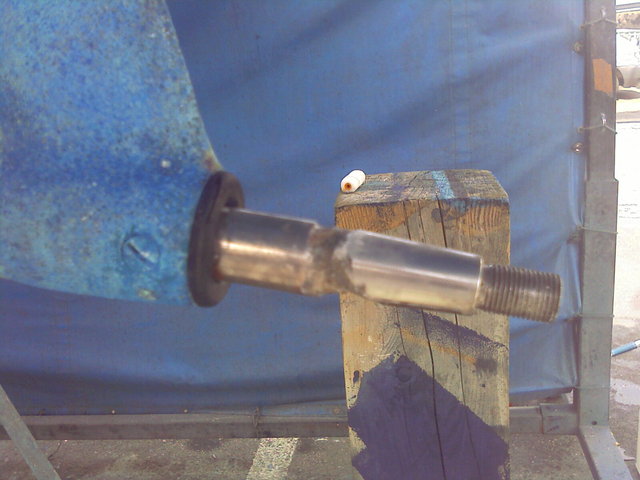
I had something similar, also showing under the cutless bearing and under spots of antifoul, there are pics of it on Vyv Cox's website. However the shaft material is quite strongly magnetic and Vyv guesses it's made from 4 series rather than 316. Jeanneau penny pinching presumably.
The keel bolts and nuts are galvanised steel and i think i would rather that than the poor stainless! Admittedly they were rather ugly when i got the boatView attachment 27408 but they were not set in gungy Sika and showed no sign of leakage. The dealer (Burton Waters, Ipswich - very satisfied with them) replaced all the nuts and washers, cleaned the stud ends and Flowcoated over and there is no trace of rust showing after 2 years.

PS You posted quite a while back about possible keel attachment damage after a severe collision with something, apparently in the same boat unless you've had two of them! Is this related? Were the keel bolts disturbed after that incident? As mentioned above my 2003 Jeanneau does not exhibit copious Sikaflex.
 
Last edited:
It is indeed the same boat. The reason I stripped back all the gel coat was to have a good look at the bolts and bedding. Pleased to find that there is absolutely no damage, and no leaking at all. Jeanneau construction does seem very robust. The surveyor commented that the bolts were very large for the size of boat. My marine neighbour has a Beneteau 323 and he split the hull when he ran aground recently.

I have now cold galvanised the bolts and sealed them over with clear epoxy resin. I have also fitted tubes to drain fridge, calorifier, stern gland and retractable log directly to the bilge sump instead of draining via the bolts, so they should stay dry now.

My old prop shaft was 304 stainless. I have put it to good use - I bent it into a U and fitted it to the bow roller as a point to fit my cruising chute - pic here:
http://picturepush.com/public/11452999
 
Last edited:
304 (for me A2, this is 18/8 alloy) is used wherever high strength, or better weldability, is required. It may suffer from corrosion in seawater, so mainly used above water; but is better for shaft then 316 (18/10 stainless). Not much to wonder, prop shaft will in most cases be 304.
 
A propshaft in 316 can still suffer from crevice corrosion. Moreover, as Rossynant remarks, 304 is easier to machine and weld than 316, and is stronger, hence why it is normally used for propshafts.
 
The only difference between 304 and 316 is the addition of 2% molybdenum to the latter, to improve pitting resistance (and crevice corrosion, which occurs by the same mechanism). I am not aware of any differences between them so far as welding and machining is concerned. When welding either for a duty in seawater it is necessary to select the weld filler very carefully to avoid carbide deposition in the weld region: ideally the L grade (low carbon) should be used to reduce this likelihood, 304L and 316L being available.
 
When I was replacing my prop shaft every supplier I spoke to offered 316 as standard, sometimes with an option of duplex.
I would rather have the better corrosion resistance (not suggesting it is immune, just more resistant) even at the expense of a little strength - I think most/all yacht shafts will have their size determined by avoiding whipping rather than on a strength basis.
Anyway my original was neither 304 nor 316!
 
Well, there is something like 10 different types (alloys) of steel under the symbols of 304 or 316 SAE numbers, IIRC, and tables of properties in EU system doesn't even show those 3xx symbols, hard to identify sometimes what is what. Many more 'stainless' (austenitic) steels there are and may be used. 316 is not most corrosion resistant, nor is it especially strong.
For such use as prop shaft duplex is better, it may have twice the strength of normal austenitic and also be more corrosion resistant then normal 316, especially very much more resistant to stress and crevice corrosion.
For example 316 may have chromium, nickel and molibden as CrNiMo 18-10-2 (%); marine duplex may be CrNiMo 25-6-3, higher chromium giving better resistance.
 
Yes duplex would be better, I meant I would rather have 316 than 304.
I used 316 instead of duplex because I chanced on a brand new shaft in 316 that had been wrongly made, I bought that at material cost and had it cut a bit shorter and the ends machined at the university where I was working, saved me a lot of time and money.
 
Well, there is something like 10 different types (alloys) of steel under the symbols of 304 or 316 SAE numbers, IIRC, and tables of properties in EU system doesn't even show those 3xx symbols, hard to identify sometimes what is what. Many more 'stainless' (austenitic) steels there are and may be used. 316 is not most corrosion resistant, nor is it especially strong.
For such use as prop shaft duplex is better, it may have twice the strength of normal austenitic and also be more corrosion resistant then normal 316, especially very much more resistant to stress and crevice corrosion.
For example 316 may have chromium, nickel and molibden as CrNiMo 18-10-2 (%); marine duplex may be CrNiMo 25-6-3, higher chromium giving better resistance.

In UK up to now it is far more usual to quote BS 970 specs (e.g. 304/316) than European ones, although I was surprised recently to see how many UK companies still quote En numbers for alloy steels, BS 970 replaced this old system almost 40 years ago.

Duplex stainless steels are hardenable by heat treatment and may have better corrosion resistance, but they are considerably more expensive than 316, which is perfectly adequate for most applications.
 

Other threads that may be of interest

Top