Gelcoat over Sikaflex?

Ric

Well-Known Member
Joined
8 Dec 2003
Messages
1,723
Visit site
The tops of my keel bolts were a rusty flaky mess, so I have been stripping them back.

When Jeanneau built the boat in 2001 they used mild-steel bolts, bedded the nuts and washers into copious amounts of Sikaflex, then painted over the lot in white gelcoat.

I have chipped off and wire-brushed off most of the gelcoat from the bolts and all from the washers. Also I have stripped out the sikaflex from around the washers. So now I have fully exposed all of the nuts and washers and most of the bolts (the tops of some of the bolts still have some hard to shift gelcoat). I'm pleased to find that there is absolutely no seepage from around the bolts, having left the exposed bolts dusted in talc for a few days. The rust would appear to be just caused by bilge water.

So how best to now protect the exposed bolts? I'm planning on at a minimum treating the exposed mild steel with a cold-galvanising zinc paint. But should I then reapply sikaflex and gelcoat? Or just build back up to the tops of the washers with gelcoat and leave the rest of the bolts exposed?
 
None of the above. Have you any reason for covering the bolts, as such? Better looks? :D
Get them really well cleaned of corrosion, greases, and sika, gelcoat, whatever. Clean. Solid portion of cold galvanizing follows, as you said. Solid. As much as producer allows (so it won't crack), then elastic kind of paint that will shed water from it. You may use VC-tar (coal tar epoxy), vinyl kind anticorrosive (lead), or just good alkyd paint. Check what will stick to this zinc primer.
And then keep bilges dry and bolts inspected. The easier they are to see, the less problems. You may cover them with anything that keeps water off, but not so permanent, as they will probably rust again - covered will do it faster, 'cause they cannot dry. You may use grease even.
Naturally the other way around is to use some cover that will not allow any water in - personally haven't seen such yet.
Also they may be connected to anode (unless designer has something against), or the anode connected to them, by way of the keel itself. I don't know those boats.

And if any doubt about how they look down there, below - should be taken off and inspected, a few at least for a sample, or may be X-rayed. Sometime it's better to get rid of such a cheap throw-away kind of product and get well galvanized or bronze new ones put in place. Unless it's so cheap that the bolts cannot be even taken off, which I once have seen, but can't believe.

But since the keel still stays put at the moment - this may be for next time :)
 
Last edited:
Most of what you suggest is perfectly OK. It used to be very common for builders to apply flow-coat over keel bolts but I believe this is rarely done now. My preference would be simply to paint them and leave them available for inspection, particularly for any signs of rusty seepage into the boat. I would apply zinc-rich primer but then simply overcoat with a good quality paint.
 
I've sprayed the bolts and washers with three coats of cold-galvanising paint. However, how should I now repair the area surrounding the bolts? This was previously sikkaflex with gelcoat painted over the top, but cleaning up the bolts with a wire brush has left this rather messy (see picture). Should I just paint around the bolts with gelcoat? Will the gelcoat be thick enough to fill all the rough finish around the bolts or should I do some more preparation? Never painted with gelcoat before, so unsure how well it will act as filler.
[img=http://www4.picturepush.com/photo/a/11981287/640/11981287.jpg]
 
It does look a bit of a mess! You will need to degrease thoroughly with a light solvent or maybe one of the water based ones based on distilled orange juice, or something similar. Then I would abrade and patch up with flowcoat, which is gelcoat with a bit of wax added to allow it to cure in air. Most of the grp suppliers will make it up for you. You could then revert to coating the bolts, as they were originally, but I think I would just do up to the washers.

Alternatively, as it is only cosmetic, you could fill the holes with Plastic Padding and then paint the same as the bolts, masking up a circle or rectangle around them.
 
I would say similar as vyv_cox - scrape off what is not sticking to laminate (as some gelcoat maybe has sika under still), sand, paint. I would not use topcoat though, unless you have it handy, since better protection to laminate is from epoxy paints, and these are used also for anticorrosive protection of steel - over the zinc primer. So you may paint it all, laminate and bolts, generously. Epoxy will glue itself to laminate better than anything. They can be put in thick coat, so will 'level out' irregularities in surface.

Coal tar epoxies were best for it, now out of fashion for health reasons (don't breathe it ;) ) more modern epoxy paints are on market, said to be as durable.
Blakes paint of this kind (VC-tar) I have on hull, underwater, for over 10 years. Keeps like a dream.

Two examples - only to illustrate what these are, if you are not familiar with corrosion protection. Take any brand.
http://www.corrosioncoatings.com/catalog/pdf/Carboline/Bitumastic-300M.pdf
http://www.international-pc.com/PDS/4507+P+eng-usa+LTR.pdf
 
IMHO I would caution against rushing in to cover it all up with whatever. Why not see how the galv you have applied gets on for the next season and then take a view on your next course of action.
I use a product called Vactan ( google it...) Just a rust converter in a primer type water based primer.
Its waterproof once applied-just make sure there is no salt before you apply it - wash the parts in fresh water. Can be applied on damp metal. It sorted the rust on my swing keel many years ago. No connection - just a satisfied customer.
 
Mild steel bolts on something fairly important like the keel, at the lowest part of the boat to collect water of any kind, would make me nervous...

Surely better to bite the bullet and replace the bolts with something like stainless ?!
 
On the contrary, mild steel is better for keel bolts as it cracks less easily.

If you're happy with corrosion and a very finite life for your keel bolts, spiffing.

I know a certain type of boat where one mild steel bolt was used to attach the forestay, the bolt being ' encapsualted ' in grp.

Rain water runs down the stay and corrodes the bolt to mush; several dismastings later, fortunately in benign places and no-one hurt, the class has modified it to stainless.

There's no reason why substantial 316 stainless bolts should crack, for the bolts to be fatigued the keel would have to be loose !
 
It really makes no difference whether the bolts are carbon or stainless steel, so long as water is excluded from the joint between keel and hull. As far as I know Moody yachts have always had carbon steel keel bolts, without significant problems.

Stainless steel ones suffer crevice corrosion, there's a great example on my website. Carbon steel ones can rust away completely. Keep the water out and neither will happen.
 
If you're happy with corrosion and a very finite life for your keel bolts, spiffing.

I know a certain type of boat where one mild steel bolt was used to attach the forestay, the bolt being ' encapsualted ' in grp.

Rain water runs down the stay and corrodes the bolt to mush; several dismastings later, fortunately in benign places and no-one hurt, the class has modified it to stainless.

There's no reason why substantial 316 stainless bolts should crack, for the bolts to be fatigued the keel would have to be loose !

316 stainless bolts can suffer from crevice corrosion when encapsulated.
http://en.wikipedia.org/wiki/Crevice_corrosion

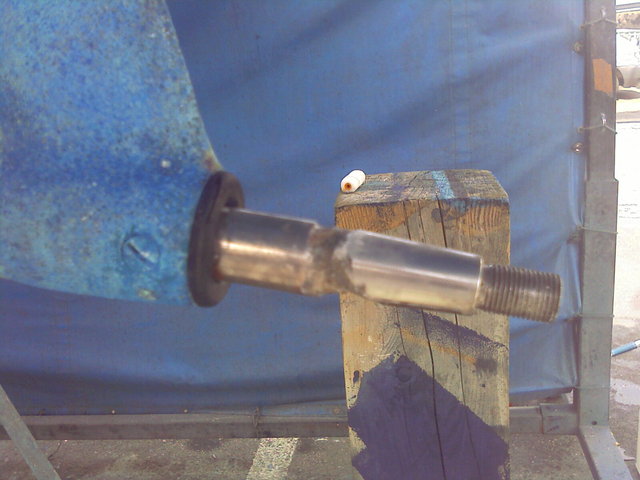
This is my propshaft, ravaged by crevice corrosion under the prop hub.
 
Last edited:
Another Seajetian classic!

...for the bolts to be fatigued the keel would have to be loose !

Oh another classic Seajet statement from the school of made up engineering for drongoes! To save you a trip to Wikipedia, fatigue is damage caused by varying or cyclical stress, as experienced by properly tightened keel bolts in everyday use. It's got nothing to do with anything being loose.
 
Oh another classic Seajet statement from the school of made up engineering for drongoes! To save you a trip to Wikipedia, fatigue is damage caused by varying or cyclical stress, as experienced by properly tightened keel bolts in everyday use. It's got nothing to do with anything being loose.

Angus,

I'll happilly compare my engineering quals and experience with yours; admit it, you've never forgiven me for mentioning the truth about your catamaran, that she has a very limited safety margin re windspeeds !

Get over it and grow up, if you don't like the truth maybe that's some buried sense of self preservation kicking in.

As for the keel bolts, if a keel is loose it waggles and fatigues the bolts. Next lesson, how to build a Saturn 5...:rolleyes:
 
Angus,

I'll happilly compare my engineering quals and experience with yours; admit it, you've never forgiven me for mentioning the truth about your catamaran, that she has a very limited safety margin re windspeeds !

Get over it and grow up, if you don't like the truth maybe that's some buried sense of self preservation kicking in.

As for the keel bolts, if a keel is loose it waggles and fatigues the bolts. Next lesson, how to build a Saturn 5...:rolleyes:

So are you agreeing that a properly tightened keel bolt could experience fatigue failure, or still claiming that it can only happen when it's loose and waggling about? I'm not quite sure from your post. Perhaps you could clarify.

Never owned a catamaran in my life. You seem to be confused again. Perhaps you are muddling me with someone else.
 

Other threads that may be of interest

Top