Gelcoat Cracks and Warranty

Gludy

Well-Known Member
Joined
19 Aug 2001
Messages
7,171
Location
Brecon, Wales
www.sailingvideos4us.com
I have had some cracks in my blue hull grlocat since leaving Emsworth last year. They were noted in the survey report. Trader are fixing them but this is what they wrote today and I would like comments on what they say.

[ QUOTE ]
Gelcoat, being an un-reinforced layer of organic resin, has a much lower
strain to failure than the underlying layers of consolidated fiberglass
reinforcement. Add to this the fact that gelcoat is on the outside of
the laminate and as such the maximum distance from the neutral axis,
gelcoat cracks are inevitable in fiberglass boats which as you know are
subject to random loading. It is for this reason that some of the
largest boat builders in the world (such as Azimut), expressly exclude
gelcoat cracks from their hull warranty. Although we could have followed
the lead of such companies, we have not, and have already demonstrated a
willingness to deal with gelcoat cracks whilst we undertake other work
on the boat.

However we have to be realistic and the subsequent appearance of minor
(non-structural) gelcoat cracks, especially once the boat is away from
Emsworth, will not be considered as warranty. However with regards to
the very small crack (approx 20mm) in way of the stainless steel rubbing
strip just above the stbd waterline, as we are having to repair and
repaint the join line between the transom mouldings we will deal with
this crack at the same time. Although it is far less noticeable, I have
also instructed that the port side join line should be repaired, as if
this subsequently became more obvious (very possible when dark hulls are
exposed to sunshine) this would be valid warranty and would be far more
expensive for us to deal with remotely.

Although it could be repaired afloat, as the boat is ashore I have put
our repairer onto the job today, so that it can be completed prior to
re-launch.


[/ QUOTE ]

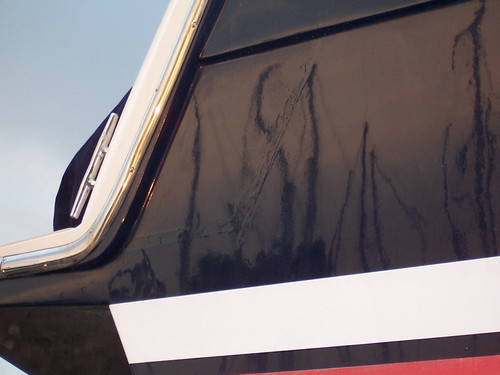
Here are some images of the cracks:-
a43614aaa41c8581c5e19c27474160c0.jpg


00b7785f635045399522ac08b9fdeb7b.jpg


The cracks are opening up outwards and lay on a seam where one part of the boat is attached to the other. They say it is caused by the filler used to smooth the seam.

I would like opinions - I paid over $40,000 for the blue hull option.
 
Thats disgraceful! my boat is a 20 year old Birchwood 37 and although some people don't have a good word to say about Birchwoods, I do not have a crack of any size anywhere on the boat! and she has been out in some pretty rough waters!
I can say this with absolute certainty because I clean and polish the boat myself, absolutely no cracks even around stauntion fittings! I used to like Traders, but I wouldn't get one now!

Barry
 
from the pics it is hard to visualise where they are can you back out a bit and show the area? our Aquabell is 22 years old but we got nothing like that, a few star cracks around screw holes and they were self inflicted.
 
I know very little about gelcoat, but that doesn't look good. More alarmingly, won't it just crack again after they've repaired it? And if it cracks, won't you have a handy ingress for water? Presumably this could lead to another Trader First - osmosis above the waterline!

Sorry Paul; not making fun of you but you have to laugh, or else......

The only place where I have crazing on my (admittedly much smaller) boat is round the mountings of the transom ladder, which some fat b*****d has used to haul himself onboard when the boat's out of the water /forums/images/graemlins/blush.gif.
 
Bloody hell, gludy, this never ends. Have you offended a gypsy or something?
FWIW, I can tell you categorically that the Azimut hull warranty does include the gel coat because I made a claim against Azimut for some minor blistering of the gelcoat on the hull of my previous boat, an AZ46. Azimut dealt with it efficiently and promptly and even extended the warranty by a further 6 months after the standard 5yr period had ended as a gesture of good will
Having said that, you could expect some hairline gelcoat cracks after some years around stress points eg around stanchion bases or davit mountings but not on a boat which has done as little work as yours. But what concerns me is that you say that your crack is at a hull joint. IMHO, that is potentially more serious as that might indicate that the hull is flexing excessively at that point although from your picture, the line of the crack is more horizontal rather than vertical which you might expect. It could be that the crack is caused by the step in the hull at that point which is a potential stress point but for this to happen at this early stage is a bit worrying
Either way, I think you should get a surveyor to give an opinion
 
It looks like the plane of the hull is not the same on the two sides of the crack. It also doesn't look like a hairline crack - the two sides have separated. I suspect it will propagate further.

Not really relevant, but if you wanted to nitpick, assuming that the basic GRP is approximately homogeneous, the neutral axis will be moved over by the gelcoat layer and the maximum distance from the neutral axis will be on the opposing side.

Totally unacceptable. I would give that a black mark on a second-hand boat, let alone a new one.
 
[ QUOTE ]
Either way, I think you should get a surveyor to give an opinion

[/ QUOTE ]

Definitely need to get a structural surveyor back to view this.

Once repaired it will reopen until the back is strengthened.

I would agree gel coat cracks are inevitable in a bad designed or poorly built boat.

My Fairline corniche was almost 20 years old and had seen a wave or two and didnt have any cracks anything like yours.

There was an odd small area of crazing where a stanchion rail had been forced the wrong way (collision damage).

I know of a Birchwood 35 that was a 33 extended in a similar fashion to your build, it too suffered similar stress cracks to yours but after 12 years, once found the boat stern was almost rebuilt.

Your crack is such a size there has to have been significant movement in the fibreglass, there shouldnt be.
A well designed hull can flex like a balloon ie/ in a uniform manner.
If you place a bit of selotape on a balloon and then inflate it , it will pop as your boat has.

I know you had the surveyor look at it a year or so ago, has anyone looked at it since the crack opened up ?

Major structural weaknesses would be covered under a Hull warranty even if the cosmetic gel coat isnt ie/ what has happened to cause the crack !
 
My "non expert" view is that cracks in the gelcoat could only be caused by flexing in the underlying laminate. I have owned several sailboats and none have had gelcoat cracks in the hull. How solid is the hull in the area of the cracks ?
This sounds like more bull from Tarquin to me but I am no expert, just been around boats for 30 years. My wife has a saying "What goes around, comes around". In your situation Paul, I hope it comes true.
 
Paul, haven't commented before and not my place really do so, however just on a matter of the bonding of the after sections to the main tub of the hull, I would have thought the way that section has been assembled is always going to be prone to cracking. Most boats of this size with after quarters incorporating built in swim platform or certainly open after sections have the aft section built in this way. Normally if so the joint is not gel'd over but bonded together with two radius edges on the outer sections and filled with a flexible jointing material, with the best will in the world a big hull bonded in two sections in a vertical radius will be subject to movement although not invisable to the eye and perhaps only fractions of a millimetre under severe load however the gel will not flex / move in the same percentages so ultimately will crack..

Apologies for the pic but this how many do it, you can see the joint is exposed and is a feature of the after section so no matter what loads are placed on the joint there is no weak spot in the gel.

56aftquarter.jpg
 
Apologies, just looked at your pics again and it seams the joint is running horizontal, can't figure why they would build like that, more worrying if the hull is flexing in that plane rather than vertical.

edit, er hang on I can't figure which way the crack is running, is that cleat on the vertical on the aft section or is it horizontal on the deck, reflection suggest its on the vertical?.
 
overall pic


439869561_fe1c7767eb.jpg


the larger cracks Gludy showed are at the top of this image - one runs through the turn in the moulding. There's one right by the bend in the s/steel trim too, and another likely not visible here, has just started opening up part way down the near upright part of the "printed through" area that shows the line of the err join.
 
IMHO let them fix what there is, then add any further issues to the legal case. You have got to get your boat away from Emsworth for your own sanity, if nothing else.
 
I'd be concerned about the condition of the overall hull structure. If there's movement between the different layers or the core is soft allowing the hull to flex locally, possibly hard spots not allowing flex.These faults wont be fixed by making it look pretty, their idea is to waffle and hope the customer goes away !!

You dont have to be clever to know when some ones feeding you bull

mick
 
Those are not normal gel cracks as far as I can see, they appear to be a flowcoat over a joint.
As the others have said I think you need to get a structual guy in. The fault looks a lot deeper and serious.
 
Gelcoat, being an un-reinforced layer of organic resin, has a much lower strain to failure than the underlying layers of consolidated fiberglass reinforcement. <span style="color:blue"> - True, but that's not what its there for. The underlying fibreglass is supposed to provide the strength, and not flex. </span>

Add to this the fact that gelcoat is on the outside of the laminate and as such the maximum distance from the neutral axis <span style="color:blue"> - Partially relevant. </span>

gelcoat cracks are inevitable in fiberglass boats <span style="color:blue"> - Wrong. If the fibreglass isn't flexing, the gelcoat won't crack. You might expect some small odd cracks in decks, where there has been a minor error in the layup, or a stress point around a stanchion or something, but the cracks on your boat are an unacceptable symptom of a design flaw in that area, imho. </span>

dv.
 
Gludy

His response proves he is a deceitful and intrinsically dishonest man, and you will be doing everyone who ever thought of buying a Trader a great service by putting him out of business. Good luck.
 
i don't have anything else to say but the cracks i was expecting to see where not like the ones in your photograph gludy

i was expecting 'crazing' or spidering...my boat is 25yrs old now and has a little crazing around one or two places where it looks like it got a knock. nothing like that in your pics though

it does look like something is bulging under that gelcoat there in the photos

i have been reading your posts etc...and hats off to you for finding the energy to keep the momentum up
 
Top