gas again

From Consumer Guide Sheet number 37 published by Liquid Gas UK...


Even selling the adapters can be a prosecutable offence (from HVP Magazine)...
He was selling adaptors that were potentially dangerous.
I still haven't seen a law that says it is unlawful to refill containers. Companys and associations can write what they like but it isn't law.
 
As you say a company selling for profit which is different from an individual doing it for themselves. Stupid of them not to weigh the amount of gas though.

I expect that no private individual has ever, or will ever, be prosecuted for it unless there's an accident causing a death where the cause was found likely to be self refilling. For example, you overfill a cylinder, it ruptures and kills some one, and in the investigation it's found at your home that you have the equipment for self refilling and another identical cylinder that is dangerously over-filled. What do you think the chances are of your barrister arguing your way out of the requirements of this piece of legislation in court?

The Carriage of Dangerous Goods and Use of Transportable Pressure Equipment Regulations 2004​

  • the transportable pressure equipment is used as intended,
  • it is filled in appropriate filling centres,
  • any maintenance work or repairs are carried out,
  • the periodic inspections necessary are carried out.

I suspect that a self-refiller would be found to have fallen foul of all 4 of those requirements. The legislation doesn't distinguish between a company or private individual.
 
Last edited:
I think periodic testing is the main one for me. No way to get it tested properly so eventually it will fail because an issue was missed. I wouldn't use a dive cylinder past it's test just because I had a compressor. Well, not long after anyway ;)
 
Thanks to AngusMcDoon for the suggestion of using the disposable gas cartridges.
There is a cheaper way of doing this though. Buy an adaptor to EN417 screw thread for about £10, then an EN417 regulator for another £7.

Regarding refilling cylinders, AIUI, CampingGaz cylinders are sold to the consumer, so they are yours to do as you please with, while others are rented and belong to the gas co.
Refilling with butane is one thing, Autogas is different. Much higher pressure!
 
There is a cheaper way of doing this though. Buy an adaptor to EN417 screw thread for about £10, then an EN417 regulator for another £7.

Good suggestion. I didn't know that EN417 regulators were available but I can see that they are...

Go System EN417 Gas Cartridge Regulator & Hose Kit - Buy Online at QD Stores

It's a cheap enough solution to avoid 907 cylinders for now. Hopefully in the future Flogas will have small cylinders available for new rentals again and increase their locations.

Using disposable cartridges has the disadvantage of single use waste, but at least it's metal waste which is fully recyclable, and probably not much more metal than the tin holding the Fray Bentos pie the gas is used to cook. And avoids giving any money to Calor Gas.
 
Last edited:
  • Like
Reactions: Aja
They THOUGHT they knew.

They understood their costs and economics, costs of providing and refilling a 4.5Kg are (nearly) the same as a 7Kg except for the minimal cost of 2.5Kg of gas.

Therefore, more profit on bigger cylinders. No Brainer.

Unfortunately, it appears as usual with British management and not understanding their market, they hadn't realised that a major sector of the market, Motorhomes, Caravans and Yachts can only accomodate the 4.5Kg Cylinder.

Their arrogance will not allow them to admit their mistake.

I would like to think that the motor home, caravan and yacht market is a substantial part of their business, but doubt it.

Off grid, hotel/restaurant market is much much bigger.
 
Thanks to AngusMcDoon for the suggestion of using the disposable gas cartridges.
There is a cheaper way of doing this though. Buy an adaptor to EN417 screw thread for about £10, then an EN417 regulator for another £7.

Even Campingaz, who supply the 907 cylinders to Calor for distribution, have a cheaper way of buying gas in their disposable cartridges rather than £40 for a refill (and Socal in Southampton charge £47). The CV470 cannisters have 450g of gas in them and can be bought for £6.50 each, free postage if you buy enough in one go...

Campingaz CV470 Super Butane/Propane Gas Cartridge (4 Pack)

and Campingaz sell the a fitting with a regulator for connection to the type of appliances we have on boats...

https://www.campingaz.co.uk/gas/gas...connection-cvr-regulator-kit/SAP_2186508.html
 
I use the small gas canisters for cooking on board. The problem is that they cool down quite quickly, dropping the pressure and in effect turns the gas down. I gather that camper vans are moving away from cylinders and have a refillable space saver tank built in, filled from an auto gas pump.
 
I use the small gas canisters for cooking on board. The problem is that they cool down quite quickly, dropping the pressure and in effect turns the gas down. I gather that camper vans are moving away from cylinders and have a refillable space saver tank built in, filled from an auto gas pump.
My friend drives an Autogas car and has done for many years... he has noticed that it's getting more difficult to find Autogas.... garages advertise they do it, but when he gets there, the sign says none available. He thinks Autogas is on the way out.
 
. The legislation doesn't distinguish between a company or private individual.
It is complex legislation and I have not read it all or worked out how it all fits together but often the 'application' provisions are interesting and they include this:

(9) These Regulations shall not apply to or in relation to the carriage of dangerous goods by road by private individuals in the circumstances set out in sub-section 1.1.3.1(a) of ADR where—
(a) the net mass of explosive substance in a transport unit does not exceed in the case of—
(i) fireworks, 50 kilograms; and
(ii) other explosives or a combination of fireworks and other explosives, 30 kilograms; and
(b) the individual has taken all reasonable steps to ensure that—
(i)the manner in which the explosives are loaded, stowed, carried or unloaded will not create a significant risk or significantly increase any existing risk to the health and safety of any person; and
(ii)there is no unauthorised access to the explosives; and
(c)where the goods are being carried in a vehicle used to carry passengers for hire or reward, the conditions and limits of regulation 51 apply.
 
It is complex legislation and I have not read it all or worked out how it all fits together ...

The regulations seem to munge together two disparate areas of safety law - firstly the carriage of dangerous goods, and secondly portable pressure equipment. While they are often somewhat related they don't have to be. You can transport dangerous goods that are not pressurised gases (i.e. fireworks as it mentions in your snippet), and you can have portable pressure equipment, but never transport it anywhere. The section you quoted looks like it's talking about the carriage of dangerous goods part. Here, it does distinguish a private individual, otherwise it would be difficult to get your fireworks home from the shop legally.
 
Last edited:
My friend drives an Autogas car and has done for many years... he has noticed that it's getting more difficult to find Autogas.... garages advertise they do it, but when he gets there, the sign says none available. He thinks Autogas is on the way out.
I thought the same, but it doesn’t seem to put campervan makers off. It also adds further justification for Calor to remove the smaller cylinders from their stock.
 
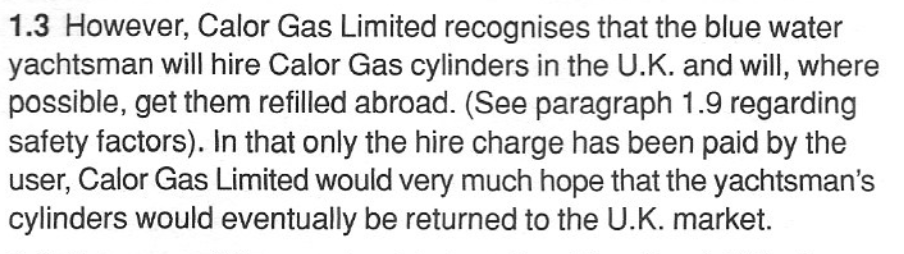
Calor Gas bottle refilling by amateurs isn't as 'forbidden' even by Calor themselves. Attached is a snippet from a Calor document, released back in the days when they were a good company, entitled 'L.P.G. (BOTTLED GAS) FOR BLUEWATER YACHSTMEN - Information and advice form Calor Gas'.

Among the good advice and information, it includes advice on re-filling, including this telling para:
Screenshot 2023-07-28 at 10.02.14.png
 
Calor Gas bottle refilling by amateurs isn't as 'forbidden' even by Calor themselves. Attached is a snippet from a Calor document, released back in the days when they were a good company, entitled 'L.P.G. (BOTTLED GAS) FOR BLUEWATER YACHSTMEN - Information and advice form Calor Gas'.

Among the good advice and information, it includes advice on re-filling, including this telling para:
View attachment 160865

I suspect that The Carriage of Dangerous Goods and Use of Transportable Pressure Equipment Regulations 2004 is difficult to enforce in the Caribbean. :)
 
Last edited:
I'm going for the EN417 adaptor and regulator, because I also have blowtorches (for plumbing and other metal-bothering) which have this fitting and normally use expensive propane/butane cylinders.
Obviously won't be so hot with butane but should do 90% of what I want them for?
 
What concerns me about small cylinders is that to work a set pressure has to be established. I have to ask how efficient a small bottle is. With only .227kg of gas ( times 3 of course if draining equally) to start with, the amount of gas available is limited. It seems to me that one would need to change the triple holder 11 times, to get the same amount of gas that one would get from a 907 cylinder. If the small cylinder loses pressure quickly,- freezing etc. one might find that it needs to be changed more frequently, resulting in more wasted gas than anticipated.
Would the cheaper price actually result in savings at the end. ie a spoiled meal due to gas running out mid way, wasted gas when changing, added cost due to postage on the cylinders. Accidental pucturing of one in a locker. This could be potentially dangerous if not in a drained position such as a proper gas locker on a boat . I do not think that I would want them rolling about in a boat.
 
What concerns me about small cylinders is that to work a set pressure has to be established. I have to ask how efficient a small bottle is. With only .227kg of gas ( times 3 of course if draining equally) to start with, the amount of gas available is limited. It seems to me that one would need to change the triple holder 11 times, to get the same amount of gas that one would get from a 907 cylinder. If the small cylinder loses pressure quickly,- freezing etc. one might find that it needs to be changed more frequently, resulting in more wasted gas than anticipated.
Would the cheaper price actually result in savings at the end. ie a spoiled meal due to gas running out mid way, wasted gas when changing, added cost due to postage on the cylinders. Accidental pucturing of one in a locker. This could be potentially dangerous if not in a drained position such as a proper gas locker on a boat . I do not think that I would want them rolling about in a boat.
I used them for 18 years & sailed over 40k miles on my Dragonfly, away for 3 months at a time, so not just weekending.

- Both of my suggestions incorporate a regulator so a set pressure is achieved.
- They don't roll around because they come in a box & can stay in the box until used.
- They don't get punctured because they stay in the box until used. They can rust but it takes a while. When did you accidentally puncture an aerosol can? Theoretically possible, but with a bit of care it doesn't happen.
- Postage is included if buying in quantity. Both of my links give free postage if doing this.
- A single cannister typically lasts 2 days so changing it is not an onerous task. A triple holder less so of course.
- My cooking on board is not sufficiently haut cuisine that it is spoiled if a gas change is required mid way through cooking. I tried making a soufflé once but the eggs were the wrong temperature & it collapsed.
- You can get an idea of how much gas is in them before starting anyway by giving them a shake. This way of supplying gas would be more appropriate to a hob/grill on a small boat rather than an oven.
- They slow down but don't stop for the last 10%. Warming them up gets the last bit out. A miser like me doesn't waste it.
- The gas price per day, despite spoiled soufflés, is way cheaper than a 907, but if you cook posh nosh or expect to do hog roasts on board then you'll have just to stump up the extra cash for bigger tinnies.

My suggestions would be a small boat solution with limited cooking facilities & not many people on board. It's those sailors who are more likely to want to save money.
 
Last edited:
Top