Fuse for solar panels?

davethedog

Well-Known Member
Joined
13 Feb 2016
Messages
847
Visit site
Afternoon all,

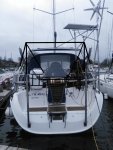
Going to wire up my 4 x 125W solar panels in the next few weeks (after I have made the solar arch first:nonchalance:).

Am running 2 of the panels to an MPPT controller (2 x MPPT controllers in total) and wonder if I should look at installing a fuse in the positive line of each PV panel ?

Thoughts?

DTD
 
Afternoon all,

Going to wire up my 4 x 125W solar panels in the next few weeks (after I have made the solar arch first:nonchalance:).

Am running 2 of the panels to an MPPT controller (2 x MPPT controllers in total) and wonder if I should look at installing a fuse in the positive line of each PV panel ?

Thoughts?

DTD

No
The wiring between the panels and the controller will be more than heavy enough to safely carry the full short circuit current from the panels if it has been correctly sized to minimize volts drop.

The important place for a fuse in a solar installation is as close as practicable to the battery positive to protect the controller and the wiring between it and the battery from the very high current that the battery could deliver in the event of a short circuit.
 
No
The wiring between the panels and the controller will be more than heavy enough to safely carry the full short circuit current from the panels if it has been correctly sized to minimize volts drop.

The important place for a fuse in a solar installation is as close as practicable to the battery positive to protect the controller and the wiring between it and the battery from the very high current that the battery could deliver in the event of a short circuit.

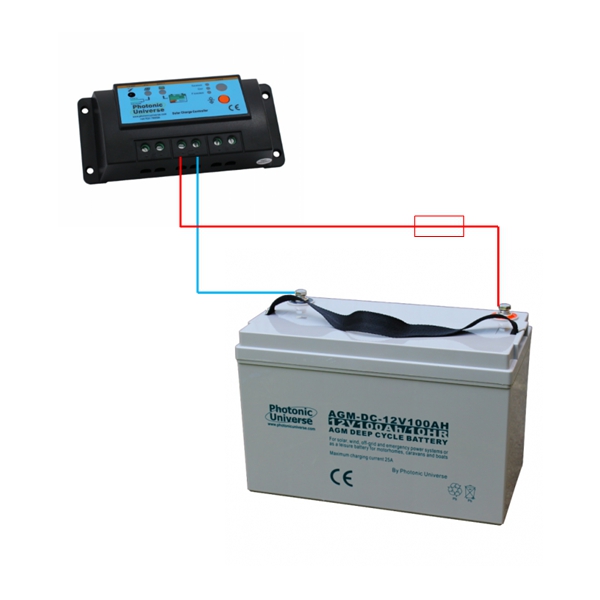
Interesting about the fuse position - I've just installed a solar panel and the controller instructions specifically say put the fuse on the NEGATIVE side close to the battery. Came as a complete kit and Purchased from Photonic Universe. Which is correct or doesn't it matter? Without instructions I would have put it on the Positive side...
 
DTD, it is nice to see someone thinking about circuit protection on the panel side. Too often in marine forums this is wrongly dismissed as unnecessary on all systems. However, if I understand your set up correctly, you only need a fuse or circuit breaker on the battery side of the solar controller.
 
Last edited:
Interesting about the fuse position - I've just installed a solar panel and the controller instructions specifically say put the fuse on the NEGATIVE side close to the battery. Came as a complete kit and Purchased from Photonic Universe. Which is correct or doesn't it matter? Without instructions I would have put it on the Positive side...
Interesting but what do I find when I visit PU's website ? ........
Article_wiring_1.jpg


I would want all the system fuses on the same side of the battery otherwise there is a possibility of an unfused positive shorting to an unfused negtive although that would be pretty unlikely to occur with the solar system wiring. If in doubt fuse both positive and negative connections.

You dont say what controller you have fitted so cannot comment on it specifically but the installation instructions that I have looked at show or say fit a fuse to the battery positive.
 
Last edited:
Interesting about the fuse position - I've just installed a solar panel and the controller instructions specifically say put the fuse on the NEGATIVE side close to the battery. Came as a complete kit and Purchased from Photonic Universe. Which is correct or doesn't it matter? Without instructions I would have put it on the Positive side...

Can't imagine why they'd say that. If the positive cable shorts to negative anywhere between the battery and the controller you risk a fire. This wire should absolutely be fused, no question.
 
You don’t “need” a fuse between panels and controller, as the power from the panels is current limited, (I.e. cannot be higher than the panels maximum), and the cable will be rated to carry it.

However, it is handy to have a switch between the panels and controller, and the most convenient I have found is actually a circuit breaker, (50A in my case).
 
Interesting about the fuse position - I've just installed a solar panel and the controller instructions specifically say put the fuse on the NEGATIVE side close to the battery. Came as a complete kit and Purchased from Photonic Universe. Which is correct or doesn't it matter? Without instructions I would have put it on the Positive side...

I think , based on what you have said previously. this must be the controller you have installed

2lvmolz.jpg


As you say the instructions say to fit fuses in the negative connections

2wnbu6x.jpg


I cannot think of any reason why there should be fuses in the negative battery connections .... Perhaps one of the forum's electricians can suggest why.
For the reasons already given there should be fuses in the positive connections.
 
I have a dual battery controller fitted, supplied by Photonic Universe. I just read the instructions that came with the controller - which of course is on the boat so can't check, and probably won't visit again till mid January.
 
Just read the instructions on the Photonic website and they say a fuse on the negative side nearest the battery. 10A dual battery controller.
 
Just read the instructions on the Photonic website and they say a fuse on the negative side nearest the battery. 10A dual battery controller.

Which is what I have quoted in #8 surely, but which for the reasons both I and PR state does not give you full protection against the effects of short circuits between the controller to battery positive connection and the boats DC negative By all means fit the fuses in the negative connections but unless the wiring between the controller and the batteries is very short , direct and well insulated for safety's sake also fit fuses in the positive connections
 
Afternoon all,

Going to wire up my 4 x 125W solar panels in the next few weeks (after I have made the solar arch first:nonchalance:).

Am running 2 of the panels to an MPPT controller (2 x MPPT controllers in total) and wonder if I should look at installing a fuse in the positive line of each PV panel ?

Thoughts?

DTD
Bit of thread drift, but I would be interested in how you are going to build the arch?
 
Some solar controllers can become damaged if connected only to the solar panels, but not to the batteries. Hence the instructions to always connect the solar controller to batteries first.

The shown solar controller is one such device.

Of course, if a fuse between the battery and the solar controller blows during operation, the solar controller will be connected to the solar panels and not to the batteries. Hence it could be damaged.

The solar controller is designed to be attached to two battery banks with a shared negative connection. In this case, a fuse blowing on the negative side of one battery bank is less likely to damage the controller than a fuse blowing on the positive side of the battery, as the positive side is not shared between the battery banks. I think this is why a fuse is recommended on the negative side and not on the positive side.

However, I agree with others that this is not ideal. Accepting controller damage if a nuisance fuse blow occurs is better than forgoing the safety considerations of fusing the positive circuit. A good compromise may be to fuse both the positive and negative side using a higher value fuse (but still within the wire rating) on the positive side.
 
This particular controller is designed to charge two banks independently, but it can also be used for a single bank. The controller requires both positive and negative to be connected to the controller. So, if it's fused on the negatives and a fuse blows it will still be fully connected to the other battery, the exact same situation would exist if the fuses were placed in the positive cables.

I see no benefit in fusing the negatives, but feel free to do so if you wish. The positives must be fused. It is usual with solar installations to be using cable with a current rating greater than the maximum controller output, to overcome voltage drop. The sole purpose of the fuse next to the battery is to protect the wiring, so it's perfectly OK to fit a fuse rated much higher than the maximum controller output, but a little lower than the cable rating.

Not sure what size cable the OP has used. 2.5mm would likely be under sized, unless it's a very short cable run (1m max), 4mm would be more suitable (2m max cable run). Either of those would be fine with 30a fuses in each positive cable. The chances of a nuisance blow would be close to zero, the chances of both blowing at the same time would be next to impossible.
 
Last edited:
I can get some details to you later ref this, but going to build it using 1inch tubing and off the shelf fittings from Baseline Marine.

Don't want to spoil your day Dave, but 1" tube is not strong enough for 4x125w panels. You're looking at about 35kg and over two square metres of surface area ! If you made the arch using bent and welded 1" tube it would be very flexible with those panels on it.

You should be using 1 1/2" tube and heavy duty fittings.
 
I understand that and hence why planning to use the existing Hunter Legend arch as a support and drill and through bolt all the fittings etc:

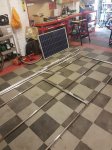
here is what my current plan should look like :

IMG_20170226_142811 copy.jpg

IMG_20170303_172550 copy.jpg

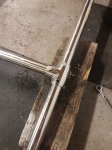
And here is the main structure I have made to add rigidity and using M6 bolts and nylocks instead of the standard grub screws.

43952053_742730676071792_8364538075560280064_n.jpg

43752131_742731332738393_3829142204002074624_n.jpg

Ultimately it is worth a try and hoping that the use of the pushpit and the Hunter Legend arch will add stiffness.
 
I understand that and hence why planning to use the existing Hunter Legend arch as a support and drill and through bolt all the fittings etc:

Ultimately it is worth a try and hoping that the use of the pushpit and the Hunter Legend arch will add stiffness.

The davits and existing arch will be fairly strong, i'd agree that they would add a lot of stiffness, you'll probably be alright with 1" tube.
 
The davits and existing arch will be fairly strong, i'd agree that they would add a lot of stiffness, you'll probably be alright with 1" tube.

Yes, I was parked next to one with 1" tubing last year and could bounce the panels up and down with a light touch. It looked like a bird flapping its wings. He had 3 panels lengthwise across the stern with almost 1m overhang from end supports. Too flexible for my liking. I have also seen wobbly supports using 30mm tubing combined with poor design.

I used 1" (25mm actually) on my own boat but it's very rigid. Oblong frame with 2 cross pieces and 2 panels bolted on top. It has 4 uprights at stern and 2 fore & aft. Sounds as if davethedog's should also be fine.
 
Yes, I was parked next to one with 1" tubing last year and could bounce the panels up and down with a light touch. It looked like a bird flapping its wings. He had 3 panels lengthwise across the stern with almost 1m overhang from end supports. Too flexible for my liking. I have also seen wobbly supports using 30mm tubing combined with poor design.

I used 1" (25mm actually) on my own boat but it's very rigid. Oblong frame with 2 cross pieces and 2 panels bolted on top. It has 4 uprights at stern and 2 fore & aft. Sounds as if davethedog's should also be fine.

Mine is also 1" tube, welded together and welded to the pushpit. It does flex a little, but well acceptable, but i only have a pair of 100w panels on it. I'm fitting one for a customer, with a pair of 250w panels and we're making it from 1.5" tube and incorporating it into the pushpit, with davits too.

This is mine ;
 

Attachments

  • 20170218_170531.jpg
    20170218_170531.jpg
    94.5 KB · Views: 4
  • 20170218_170445.jpg
    20170218_170445.jpg
    96.6 KB · Views: 4
Top