Fresh or salt

wombat88

Well-Known Member
Joined
1 Oct 2014
Messages
1,279
Visit site
There must be a simple way of testing whether the water in those hard to get to places is fresh or salt WITHOUT having to taste it?

If so, please tell, I am not licking the bottom of my cockpit lockers...
 
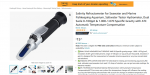
Check retailers of equipment for salt water aquarium. They have saline meter that work by refractive index, like the anti-freeze meters.

In principle, a flame test could tell what you have. The sodium in the salt should give a distinctive orange yellow colour, but I am not sure it will work with the level of salt in this water. Has any one here tried it?
 
In principle, a flame test could tell what you have. The sodium in the salt should give a distinctive orange yellow colour, but I am not sure it will work with the level of salt in this water. Has any one here tried it?
I had to check this. Dipped a clean glass rod in salt water and held it in a blue gas flame. Repeated with tap water. I could not get a clear result. Tested also if a cheap multimeter was able to tell the difference in conductivity. That clearly did not work.
 
I had to check this. Dipped a clean glass rod in salt water and held it in a blue gas flame. Repeated with tap water. I could not get a clear result. Tested also if a cheap multimeter was able to tell the difference in conductivity. That clearly did not work.

A platinum wire is what is really required not a glass rod, although a piece of nichrome wire will do. (I guess not many people have a platinum wire although i still have mine from student days). To distinguish between seawater and freshwater I'd expect to have to dilute both considerably with distilled water.

The way to do it is infact by electrical conductivity. I must have done so many times but it does need a conductance meter and cell.
 
You don't actually have to taste a mouthful of it. Neither do you have to buy expensive equipment , or travel back in time to steal school/ college laboratory equipment. Just dip your little finger in it and apply it to your tongue. You will be instantly able to confirm its level of salinity, then spit out.
 
The standard test is to add a drop of silver nitrate. A white, curdy precipitate will result, and the precipitate will turn dark on exposure to light.

PS. Sodium is too common for flame tests to be very reliable and the sodium emission lines are very strong, so even a trace of sodium will give a yellow flame. A glass rod is the very worst thing to use as the glass itself contains sodium! So a test for the chloride ion is more reliable.
 
Went to inspect a possible purchase of a yacht and asked to see the bilges.They had waterin them so I instinctively tasted it,it was salty.Theowner was amazed at my action and went on to invent a shaggy dog story about the water omittingtomentionhe had installed a new automatic bilge pump……didn’t buy the boat
 
Yesterday my memory took a hit, to day my reasoning got one. Once Vics mentioned platinum, I started wondering where the glass rod idea came from. AntarcticPilot is clearly right about sodium in the glass. The silver nitrate test is easy, as long as you have or can get the stuff.
A clean finger and a sharp tongue is clearly the simplest tool. I would not hesitate tasting water in lockers, but the soup of unknown things you find in the bilge makes me hesitate, especially if i suspect a leaking head. It would be nice to have an alternative method, involving things you normally find in a boat.
 
Yesterday my memory took a hit, to day my reasoning got one. Once Vics mentioned platinum, I started wondering where the glass rod idea came from. AntarcticPilot is clearly right about sodium in the glass. The silver nitrate test is easy, as long as you have or can get the stuff.
A clean finger and a sharp tongue is clearly the simplest tool. I would not hesitate tasting water in lockers, but the soup of unknown things you find in the bilge makes me hesitate, especially if i suspect a leaking head. It would be nice to have an alternative method, involving things you normally find in a boat.
Well, the following would work:
1) Put fresh water in a container (a cup or whatever)
2) Place the probes of a multimeter in the cup a fixed distance apart
3) Measure the resistance
4) Empty cup and place water to be tested in it
5) repeat 2 and 3

If the water is fresh it will have a similar (high) resistance to the fresh water. It may be somewhat lower than pure drinking water because it will almost certainly have a higher level of impurities, but similar. If the water is salt, it will have a MUCH lower resistance.

Silver Nitrate is readily available on eBay.
 
Well, the following would work:
1) Put fresh water in a container (a cup or whatever)
2) Place the probes of a multimeter in the cup a fixed distance apart
3) Measure the resistance
4) Empty cup and place water to be tested in it
5) repeat 2 and 3

If the water is fresh it will have a similar (high) resistance to the fresh water. It may be somewhat lower than pure drinking water because it will almost certainly have a higher level of impurities, but similar. If the water is salt, it will have a MUCH lower resistance.

Silver Nitrate is readily available on eBay.
I was about to suggest that distilled water would be a more accurate control when I dimly remembered that it does not conduct electricity:(
Perhaps rainwater contains sufficient impurities to be an electrolyte.
 
The last sample of water I was given to analyse and identify turned out to be sewage. :sick:
.
When my boat was new to me, I discovered that I had an untraceable seepage of water into the bilge. It was revealed to me soon after, that this leak had baffled the previous owners as the leak was intermittent. Much sampling of the water on the tongue ensued over many months in order to eliminate the cause. I eventually discovered that the source of the leak was the seal on a skin fitting which was quite close to the surface, so that it hardly leaked at all while the boat was on an even keel or a starboard tack, but allowed noticeable quantities of water in while on port tack. That skin fitting belonged to the heads outlet:(
 
Top