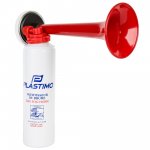
Fog horn control

andythefiddler

Well-Known Member
Joined
4 Sep 2017
Messages
87
Visit site
Has anyone here put a controller on to an electric fog horn.

Background

Having been out in fog and low viz more than once this summer an electric horn with automated time circuit would be one less job for the crew.
With COVID too this removes a further health risk from a manual horn.

Andy
 
If I recall correctly some VHF radios have a connection for a loud-hailer, and will sound. . .

Damn! Roberto beat me to it!

There is a counter health risk of the horn going off when a crew member is standing next to it. One of the advantages of an electric horn is that if you can place it well away from the cockpit you can have one much louder than is good for your hearing if you are close to it. There is also perhaps a risk falling if you are taken by surprise by the thing going off when you are next to it.
 
Has anyone here put a controller on to an electric fog horn.

Background

Having been out in fog and low viz more than once this summer an electric horn with automated time circuit would be one less job for the crew.
With COVID too this removes a further health risk from a manual horn.

Andy
My Standard Horizon has it..but then you can't use the radio!
Just fit a hooter with a button. I plan to do this.
(Health risk from a manual horn? What about the lines, tiller, etc? )
 
(Health risk from a manual horn? What about the lines, tiller, etc? )
You can do something about the lines, tiller, etc - keep 'em tidy or keep out of their way. You can't do much about noise unless you want to wear ear plugs, something I wouldn't do in fog, when hearing becomes a major source of info about what's around you.

I'm paying the price of .303 shooting in the air cadets nearly 60 years ago, when ear protection just wasn't a thing. Tinnitus is not nice
 
You can do something about the lines, tiller, etc - keep 'em tidy or keep out of their way. You can't do much about noise unless you want to wear ear plugs, something I wouldn't do in fog, when hearing becomes a major source of info about what's around you.

I'm paying the price of .303 shooting in the air cadets nearly 60 years ago, when ear protection just wasn't a thing. Tinnitus is not nice
I though he meant risk of bat flu from touching the button after somebody else! Never thought of hearing damage.
I have a PA horn on the spreaders which is connected to the SH fixed VHF, you can do fog signals, karaoke, all sorts but then it is not a radio.
So a button to push, to make a loud whistle tone, is better IMO. I think radios are better if they are solely, or mainly, radios without too many complications. If you can't push a button every couple of minutes there is something wrong, because you need a man on deck listening out anyway.
( I also did lots of .303 shooting in the air cadets, happy days. In the 70's ear muffs would have been mocked as pouffy, today I'm sure they are mandatory).
 
I though he meant risk of bat flu from touching the button after somebody else! Never thought of hearing damage.
I have a PA horn on the spreaders which is connected to the SH fixed VHF, you can do fog signals, karaoke, all sorts but then it is not a radio.
So a button to push, to make a loud whistle tone, is better IMO. I think radios are better if they are solely, or mainly, radios without too many complications. If you can't push a button every couple of minutes there is something wrong, because you need a man on deck listening out anyway.
( I also did lots of .303 shooting in the air cadets, happy days. In the 70's ear muffs would have been mocked as pouffy, today I'm sure they are mandatory).

I fired a SA80 and a Glock 9mm a couple of years ago, as a guest of the Royal Marine Commandos. They use active ear defenders, impressive bits of kit (all of them). I wouldn't call the Commandos anything unmanly ;)

I too have tinnitus. Fortunately mine is mild, but still it taints my music listening pleasure. Best avoided.
 
Has anyone here put a controller on to an electric fog horn.

Background

Having been out in fog and low viz more than once this summer an electric horn with automated time circuit would be one less job for the crew.
With COVID too this removes a further health risk from a manual horn.

Andy

A simple DIY electronics project if you're into that sort of thing.
 
I fired a SA80 and a Glock 9mm a couple of years ago, as a guest of the Royal Marine Commandos. They use active ear defenders, impressive bits of kit (all of them). I wouldn't call the Commandos anything unmanly ;)

I too have tinnitus. Fortunately mine is mild, but still it taints my music listening pleasure. Best avoided.
Another advantage of using the vhf is that in between the horn soundings the horn speaker serves as a microphone which is amplified to the fixed and remote handset speakers, so aids listening back.
 
I think that people have put their finger on it - a horn loud enough to be heard at any distance, especially over the sound of an engine or on the bridge of a ship is also likely to be loud enough to damage people's hearing. There have been posts from commercial seafarers on here outlining the lengths they have to go to when using their horns. I'm always reminded that lighthouse and lightship crews got an extra allowance when the foghorn was in use!
 
Another advantage of using the vhf is that in between the horn soundings the horn speaker serves as a microphone which is amplified to the fixed and remote handset speakers, so aids listening back.
Yes, it's a good idea in principle. If you have a spare crew who can keep a listening watch below, as well as someone on deck doing the same.
 
I rather think the discussion merely highlights the silliness of sound signals in fog. On a motorised vessel there's no way they can be heard even at short range unless the volume is extreme. As next to no one sails at night what's the point?
A yottie will probably hear a freighter's signal, there's next to no way a freighter will ever hear a yacht's.

So why bother sending them (and destroying your hearing)? Just creep along and listen - and use sensible aids like radar and AIS to stay out of the way...
 
I rather think the discussion merely highlights the silliness of sound signals in fog. On a motorised vessel there's no way they can be heard even at short range unless the volume is extreme. As next to no one sails at night what's the point?
A yottie will probably hear a freighter's signal, there's next to no way a freighter will ever hear a yacht's.

So why bother sending them (and destroying your hearing)? Just creep along and listen - and use sensible aids like radar and AIS to stay out of the way...
Silliness? Legal requirement. Others will be listening for fog signals, so also a moral obligation.

Motorised vessel? Slow down or stop at regular intervals, and listen.

Next to no one sails at night? This must be a troll.

If nobody hoots in fog, what would be the point in listening?

Most yachts don't have radar and/or AIS, nor are they obliged to.

'Freighters', by which I presume you mean ships of any type, are generally manned by conscientious professionals who take precautions in fog, such as, but not limited to: slowing down, establishing a enhanced radar plot, and posting a listening watchkeeper on the bows with a radio to call the bridge.
 
Gosh!
Moral obligation is it! I expect you say the same of anchoring and anchor lights in little creeks...
Yes, we all know that's what the law says, but is it useful or practical...?

Motors at night - my error edited to reflect my original poor description.

Do you not get the practical problem of a small yacht be able to make enough noise to be heard on the enclosed bridge of any motorised vessel be it a fishing drifter, survey vessel or ocean going freighter ¾ of a mile away?

Oh dear.

A bit of thought on practicality is reccommended, I think...

= yachts making noise in fog is pretty much pointless...
 
Big ships don't always slow down, and noise levels on board can be higher than you'd first think, even at reduced speed.

Saying that, those I've been on have generally been operated fairly safely in fog, but there's heavy reliance on Radar.

Tugs are a different matter - we are coastal, with a fair bit of yacht traffic and take account of that - but again, it's noisy on board (even with engines at idle, you have to shout on deck).
Our whistle can be set to sound any of the required signals automatically, being marine it's probably hideously expensive but it wouldn't be that hard to knock something up with a timer that could do it for you!
 
Silliness? Legal requirement. Others will be listening for fog signals, so also a moral obligation.

Vessels less than 12m LOA are NOT required to use any of the sound signals required for vessels in restricted visibility.
Vessels 12m and above abide by the COL Regs.
 
Top