Flushing out outboard

On bigger engines it is easy access designed to mate to hozelock type hose pipe fittings. You can be flushing minutes after securing to your pontoon berth.

Part no 8M0057047 is the kit that allows that for the smaller engines.
I was just too cheap to buy it and had the hose lying around. The bare screw in barb comes with the engine.
 
Small sail boat with an outboard well are uncommon around here. Most production boats were designed for O/b on transom bracket. That might be a response to local conditions. ie mostly reliable winds. As said an o/b in a well is a permanent drag when sailing. Not a problem if you don,t want to race and expect to do a lot of motoring. I have not had a motor on my 21fter for many years. I rely on paddles.
Now I realise OP is looking at boats to buy. However one design we had at our club for a while 23ft I think had an outboard well that extended right through to the transom. S o/b was like a metre forward of transom but could easily be raised for sailing. Plus motor was inboard for getting it started. I liked that idea but presumably needed twin rudders. Another design "Bull" i think had a very clever o/b in a hatch on one side where o/b was on a slider and was raised slid forward to bring prop out and stash whole o/b inside.
Anyway in answer to OP question it does seem reasonable to leave o/b in water long term and it may be possible to modify motor to enable fressh water to be injected in to top of engine. ol'will
 
I have a 3.5 2t. I used to run it in fresh water after every use. After some years I had to take the head off and rake out all the salt crystals as it was blocked solid.
My theory - you stop the engine, the water runs out and the damp in the waterways evaporates due to the heat of the engine, leaving salty deposits which don't rinse out by the time you get to fresh water to flush.

How long were you typically leaving it, between shutting the engine off and flushing it through?

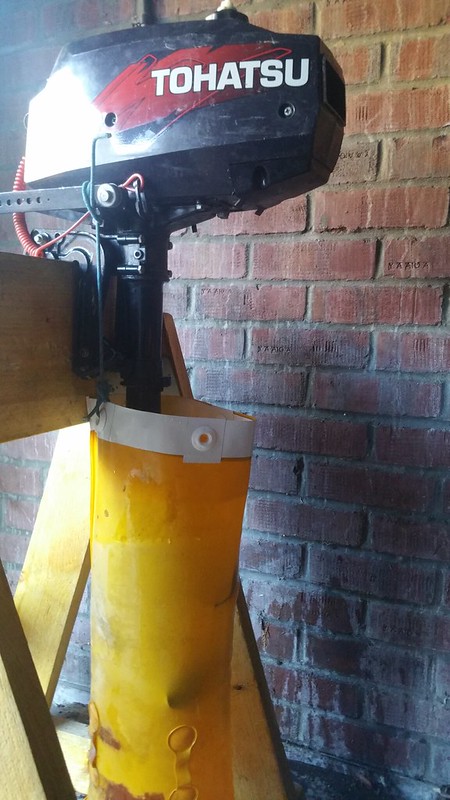
I've grown paranoid about this (I have the Tohatsu 3.5 2-stroke as well), so I made a portable flushing tank out of a buoyancy bag from a wrecked dinghy. Not the best photo but you get the idea...

50668208371_70542a20f7_c.jpg


With the engine well aboard the Achilles 24 it was no bother to lift the engine into the cockpit, put the yellow 'flushing sock' over the engine leg, put the engine back on its mounting in the well, then fill the sock with fresh water. That was quite a lot of water to carry on board a small yacht (probably over 20 litres, just for a single flush), but I really didn't want salt choking the cooling passages.
.
 
Two comments from me…after an amazing and boozy Scottish new year…
Firstly, I’d maybe suggest that some modern outboards have an ability or function, that via a flushing port, allows fresh water flushing, without the need for a running condition.
But most outboards of years gone by, won’t have this.
But on the latter point…I’d also add that I have had, still have, 2 stroke Yamaha and mercury engines from the 70’s and 80’s…that are yet to show suffering from the salt. Despite me now flushing after any salt exposed to, they all haven’t been before hand.
 
Two comments from me…after an amazing and boozy Scottish new year…
Firstly, I’d maybe suggest that some modern outboards have an ability or function, that via a flushing port, allows fresh water flushing, without the need for a running condition.
But most outboards of years gone by, won’t have this.
But on the latter point…I’d also add that I have had, still have, 2 stroke Yamaha and mercury engines from the 70’s and 80’s…that are yet to show suffering from the salt. Despite me now flushing after any salt exposed to, they all haven’t been before hand.
That's good to know.
Although there is a slight downside not being able to run the engine with just the hose method, I'm guessing that fresh water will still find it's way down the copper tube in the leg to the water pump.
 
How long were you typically leaving it, between shutting the engine off and flushing it through?

I've grown paranoid about this
No more than 5 minutes.

The tell tail gets less over time , an indication of the water ways around the head collecting salt. Once bits inside start to block the tell tail its time to clean. Its ever so easy to remove the 4 small head bolts (the head is just a small metal plate), scrape out the salt that you will clearly see, use a little liquid gasket on the head gasket and put back together. Will then be good for many years until it needs doing again.
 
That's good to know.
Although there is a slight downside not being able to run the engine with just the hose method, I'm guessing that fresh water will still find it's way down the copper tube in the leg to the water pump.
I’ve always presumed that most salt deposits happen where the engine heat is, in the cooling paths around the cylinder block, and not in the very cool impeller housing and pickup pipe.
This may be why the manufacturers fit the flushing point near the head not the impeller.
 
No more than 5 minutes.

The tell tail gets less over time , an indication of the water ways around the head collecting salt. Once bits inside start to block the tell tail its time to clean. Its ever so easy to remove the 4 small head bolts (the head is just a small metal plate), scrape out the salt that you will clearly see, use a little liquid gasket on the head gasket and put back together. Will then be good for many years until it needs doing again.

Great advice, and thanks very much.

Still, I'm surprised if residual seawater boils down to an immovable salt crust in minutes, in an engine that is no longer running.

I suppose it might be solved if something like my flushing-sock could be pulled over the engine leg while it is still idling, in order that the cooling passages cannot drain once it is shut down...although that assumes the cooling passages are part of a loop whose openings are only below the waterline (I'm in deep water myself here, guessing)...so one would need to clothes-peg the telltale too...

...I anticipate various objections to this. But if the cooling system's openings could be closed at the very moment the impeller stops turning, the liquid brine could be retained in the passages until the engine is cold, when almost all the salt would run away in the water, even without flushing. Am I crazily off-track?
 
Still, I'm surprised if residual seawater boils down to an immovable salt crust in minutes, in an engine that is no longer running.
Its just a theory with reasons why it could be ? Its difficult to go from sea to fresh without stopping the engine and would guess the moment you stop the engine the heat from the cylinder starts heating the water around the head as no flowing cold water.
 
Last edited:
That's good to know.
Although there is a slight downside not being able to run the engine with just the hose method, I'm guessing that fresh water will still find it's way down the copper tube in the leg to the water pump.
I haven't personally tried the fresh water flushing port on my 2016 mercury, that has the function. Just because it is used in fresh water anyway, but as far as I know, it flushes around the top end of the engine, around the head and jacket cooling cavities, then out the tell tale certainly, possibly and likely down the mid shaft and out pump intakes too. I don't think it will be anywhere flowing near the exhaust side of things, presumably not anywhere where gravity or a positive pressure might allow water to flow back in through the exhaust side and into the cylinders. Good function to have on newer engines, most likely. Or any engine perhaps. But my earlier point around the robustness of the old engines from Yamaha in particular, still stands. I have now and have had old 2 strokes from the late 70's, loads from the 80's certainly (currently 2x 8hp yam, 2hp yam, 3hp Malta yam, mercury 2.5hp, Suzuki 2.2hp and a seagull). one or two of them are old salty sea dogs in a past life before me, show signs of it externally in parts, but any I have had opened up (there is an anode in some old Yamaha to keep an eye on, near t stat) never look even close to showing anything detrimental inside, in terms of wear from corrosion.
Ideal to be able to flush them after salt for sure though. Most especially would be before any long term storage or period of dormancy.
 
Top