Wansworth
Well-Known Member
Potencial purchase has an outboard in a well that makes getting it in and out laborious .Do I need to flush it out after every trip or can it remain for months without attention?

Having a number of boats with outboard wells , have kept them in mostly for the whole sailing season without problems. Every couple of months, I lift the outboard for a cleanup and check how the anode is doing. In my neck of the woods, Trilux in the tin version does surprisingly well for both prop and leg.Potencial purchase has an outboard in a well that makes getting it in and out laborious .Do I need to flush it out after every trip or can it remain for months without attention?


Now there’s a thought!Before long you'll go electric and forget about flushing and weight


My Evinrude lived on the transom bracket, only being flushed at the end of the season, without problems but it was lifted clear of the water when not in use.Potencial purchase has an outboard in a well that makes getting it in and out laborious .Do I need to flush it out after every trip or can it remain for months without attention?
ThanksMy Evinrude lived on the transom bracket, only being flushed at the end of the season, without problems but it was lifted clear of the water when not in use.
If you leave it in the water it might suffer.
Perhaps you could add an additional anode to the AV plate to give extra protection. You'd certainly be well advised to inspect and replace existing anode(s) regularly and check for water ingress into the gear case.
Much will depend on the make. Some are better engineered for life in salt water than others.

You don’t need to flush every trip, but if you can do it after a dozen trips or so it will be plenty.Potencial purchase has an outboard in a well that makes getting it in and out laborious .Do I need to flush it out after every trip or can it remain for months without attention?
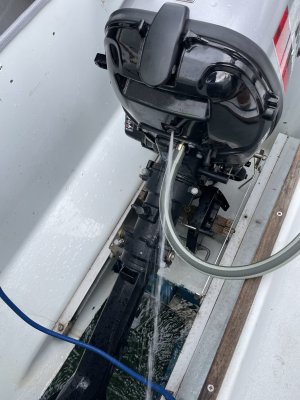
Mariner/Mercury/Tohatsu 4/5/6hp engines have a flushing port.You don’t need to flush every trip, but if you can do it after a dozen trips or so it will be plenty.
If it is too inconvenient to run the engine raised up vertically out of the water (not tilted) or ashore, you can use really well fitted Flush Muffs and a decent pressure hosepipe under the water too. You aren’t just trying to rinse out any saltwater though, you’re trying to dissolve any deposits, so the engine ought to be run for about 10mins a time. Big modern outboards (50hp+) often have freshwater hose inlets to flush without running the engine, but rare on yacht sized engines.
My Yamaha 70hp 4t has a port and gets flushed every trip, as it is so easy to do. I wasn’t aware of exactly which small outboard had adopted it, it is sensible but still not common on older engines.Mariner/Mercury/Tohatsu 4/5/6hp engines have a flushing port.
My boat has an outboard in a well. Parked in a marina. Water is close by and screwing a hose into the flushing port is pretty convenient. It gets done every time I rinse the boat down.
Engine leg lifted up out of the water when left for any period of time.
I have a 1m length of hose with the screw in barb for the flushing port at one end and a Hozelock fitting at the other.My Yamaha 70hp 4t has a port and gets flushed every trip, as it is so easy to do. I wasn’t aware of exactly which small outboard had adopted it, it is sensible but still not common on older engines.
Is that only on 2T models ?Mariner/Mercury/Tohatsu 4/5/6hp engines have a flushing port.
That’s 4t. I have a 2016 Mariner F6MH.Is that only on 2T models ?
Don't know any on 4T .
Ta
Where is it? I have a new tohatsu 6 and was disappointed to find you can't use flush muffs with it, have to use the old bucket of water.That’s 4t. I have a 2016 Mariner F6MH.
Shows it in the manual on the Mariner which is the same motor with different decals.Where is it? I have a new tohatsu 6 and was disappointed to find you can't use flush muffs with it, have to use the old bucket of water.
On bigger engines it is easy access designed to mate to hozelock type hose pipe fittings. You can be flushing minutes after securing to your pontoon berth.Shows it in the manual on the Mariner which is the same motor with different decals.
Underside of the power head, 12mm(?) bolt?