Flopper Stoppers

Nick_H

Well-Known Member
Joined
20 Apr 2004
Messages
7,660
www.ybw-boatsforsale.com
As anyone with a planing boat will know, they roll like a bitch at anchor with even small waves on the beam. In the med its worse 'cos there's lots of big boats whizzing around making lots of swell, and the anchorages are generally not protected from the south.

So I decided to make some flopper stoppers (actually I decided to buy some at quite a crazy cost, and was shamed into making them by people on here).

I decided that to be effective they had to obviously have a big surface area, but they also had to sink at least as fast as the boat rolled, or else they would only dampen the first roll, and would tend to snatch on the second roll. I also reckoned that to maximise the damping force, I needed minimum stretch in the suspension ropes. Of course, they would be hugely more effective if suspended from outriggers, but I didn't want the hassle or appearance of these, so settled for getting the best I could out of suspending them directly off the side cleats.

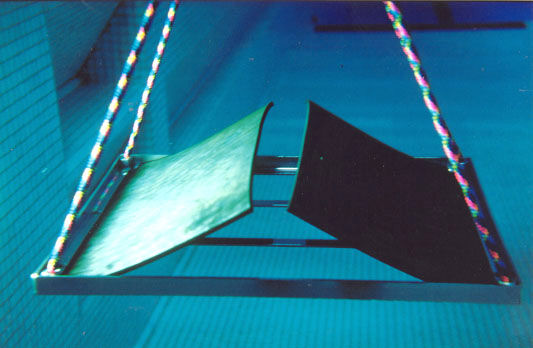
I started with two galvanised steel floor grates (like cattle grid), with round corners fabricated on them, and a surface area of about 3/4 sq metre each, for a 25 tonne, 58 foot boat. Then I zip tied re-inforced rubber matting onto the top, in a number of sections, otherwise I think the rubber would just lift and fall with the roll of the boat, and be less effective. Then I had suspension ropes made up in dyneema to minimise stretch, and added a tripping rope for retrieving them, and connected it all up. I wanted plenty of weight, so they would sink quickly enough, but I think I over did it, as they weight about 18 kgs each and are a bit heavy to move around the boat. Also having seen them in action, I think I could get away with lighter floor grates.

Amazingly BMI Baby accepted them as checked baggage, so they went to France with us last trip, and were tried out in a very flat sea with only occasional swell. They look like this, photo shows the flaps opening slightly as it sinks;


IMGP0657-flop.jpg


So the big question is, do they work?

Well, not very well is the answer. They do have an effect, but I would say they only reduce roll by a max of about 25%, but as you might expect, the bigger the roll, the more they work. We tried to anchor off Cannes during the film festival in May, and had to leave as the swell got untenable, so I'd like to try them in that sort of swell.

Undeterred, I have a second set to take down next time, and hopefully doubling the surface area will start to show more benefit. I'm also going to replace the grating with lighter stuff.

You can sort of see how they work from this short video, although there was very little swell around when it was taken.

web page
 
Great post, Nick

Is the second attempt going to use the same materials?

[ QUOTE ]
they would be hugely more effective if suspended from outriggers, but I didn't want the hassle or appearance of these,

[/ QUOTE ]

How about a pole outstretched accros the bathing platform?
At sea level it wouldnt show - maybe even telescopic so that it could be packed away.

I think you need some good lateral thinking here.

I love challenges like this
 
Been waiting for this post, having seen you arrive in France 2 weeks ago with the biggest load of excess baggage I've ever seen a bloke take on a plane!

They look great. I think they would be more effective in worse weather. I mean if they only reduce 25% of a small swell, they'd reduce say 50% of a bigger swell, surely, due to some kind of square law?

It would be worth trying them with outriggers maybe?

In rougher weather, when they move faster, might it be worth swapping the rubber sheet for some hinged aluminium plate flaps? Bit like those vents you put on outside of wall for tunble drier exhaust. The flaps would open vertical on the downstroke, so creating less water resistance than the rubber? I suppose you only need this if the suspension rope goes slack on the downstroke - if it doesn't yours are working fine

Otherwise you need more surface area, as you say. Presumably you can stack the second pair 18 inches below the first pair, so still use just the one suspension rope?

But great job though!
 
[ QUOTE ]
having seen you arrive in France 2 weeks ago with the biggest load of excess baggage I've ever seen

[/ QUOTE ]

I know, but she enjoys the break /forums/images/graemlins/grin.gif

I agree on all counts, I think best option is some specially fabricated in SS with hinged plates, which would sink quicker, so less weight needed. Fortunately best mate makes industrial washing machines for a living, so SS fabrication is never a problem. I've even thought about hinging the main structures so they open out double the size. Most of the cost was in having 20 eye splices put in the ropes, so i wont be too gutted about throwing the floor plates away and starting again.

Not feasible to stack the second pair of the existing ones due to weight, ropes are strong enough, but i'm not.
 
I wonder if some of the stopping power is reduced because you have suspended the unit from a central point ?

It seems to me that this will make the platform act as bit of a pendulum, and move laterally as the platform rises, this "dumping" sideways the water above it. As you drop the plates into the water , do they zig-zag downwards ?

There are some nice studies on "end-plate effect" which show the benefit of having a lip of - say 50 to 100 mm, which prevents the medium in which the plate is acting, from moving sideways. As used in modern jet aircraft, and birds of prey.


Mark Two will be fascinating !


So rethink: Why not make the unit in the form of an inverted metal parachute ? The object is to entrain as much water (mass) as possible on the upward roll. Flaps, as you already have them, on the perimeter open on the downward movement, and close on the upward one. The shape produces form stability on the upward pull (no lateral movement), and the units could stack inside each other.
 
[ QUOTE ]
So rethink: Why not make the unit in the form of an inverted metal parachute ? The object is to entrain as much water (mass) as possible on the upward roll. Flaps, as you already have them, on the perimeter open on the downward movement, and close on the upward one. The shape produces form stability on the upward pull (no lateral movement), and the units could stack inside each other.

[/ QUOTE ]

That's similar iirc to the US floppers stoppers, which are a bit of an inverted parachute/hemishere shape. But they are very expensive

Thinking some more: this idea of opening/closing flaps is to make sure they have max resistance on the up stroke and minimal on the downstroke. This is needed becuase the suspension ropes work in tension not compression. But only one flopperstopper is working at a time. So what about using rope that will take a compressive load, ie rods, then abandon all the flaps and have simple sheets of ali chequer plate or metal frames with plywood plates? (And maybe a lip around the edge to cure the end plate effect, as a refinement). This would double the damping effect, but at a cost of storing/rigging the rods, and making a deck attachment point (which could be a clamp to the midships cleat device, so as not to have to attach fittings to the boat. Or a clamp to bathing platform device, to minimise rod length and leverage)

(I'm not sure this is a great idea, but just keeping the discussion going in case we can think of useful refinements here)
 
[ QUOTE ]
Most of the cost was in having 20 eye splices put in the ropes

[/ QUOTE ]

You perfectionist! Bowlines, or ropes-thru-holes-and-figure-8-knot would have done! /forums/images/graemlins/grin.gif /forums/images/graemlins/grin.gif
 
A raggie dropping in on this as I have just bought and tested some flopper stoppers myself.

Seite%2015%20neu%20stabilisator%20open.jpg


The problem with a flopper stopper is there needs to be a certain amount of movement before they take effect. This really means that the outriggers are very important in acheiving an acceptable result. With my boom and spinnaker I get the flopper stoppers nearly 4 metres from the centreline (like an 8 metre wide boat). They stop the resonant rolling completely and stop one off waves by at least 50%. I will be definitely using them in future.

Mine weigh about 4 kgs each, but the weight needed depends on area. You can find them a quarter of the way down the page at:

BWS

One curious effect is that you get these funny circles on the water surface when they lift up due to the up current created. In my picture below the flopper stoppers are about 2-3 metres below the surface and with a strong tide they appeared at the stern of the boat:

DSC_1771.jpg
 
Interesting on a couple of points, firstly the weight, if only 4 kgs then mine are definitely heavier than they need to be. Also they have the lip, although its only an inch or so, which kinda supports Sarabande's point, and also feels intuitively right. I made the four corner ropes quite long, to try and avoid sideways slip, but seems a lip would help.

I think inverted dish shape is out just on practicality, too difficult to make, and I have a shallow storage locker on the bathing platform where I want to store them out of the way.

So I reckon version 2 will be half the weight, and with a lip around the edge. I'll report back.
 
Interesting stuff. I'm hoping that we'll achieve the desired effect by lowering our hydraulic bathing platform about a foot underwater. There are holes in it to allow water to flow freely, but it's still a large flat area so should have some effect.
 
I suppose you've also got a slightly lower centre of gravity with no flybridge, plus of course if you're not sitting on a flybridge then the apparent effect is much less anyway.

Interestingly though, just having a bigger boat doesn't necessarily help, unless of course its huge or has other types of stabilisers. Its sort of like a resonance thing, a certain wavelength and height will cause max roll in boats of a certain beam and draft. I've seen smaller superyachts rolling wildly at anchor, and often wondered how the guests feel about that having paid so many thousands.

I reckon gyro stabilisers could eventually become standard fit on boats over about 60 feet, maybe even over 40 feet, so it's a shame to see that the two available gyro systems for leisure boats have signed up to agreements with Ferretti and Azimut, leaving the Brit builders behind, although i'm not sure if the Azimut / Seakeeper one gives them exclusivity.
 
I agree that it is the resonant swell that is the biggest problem and fortunately flopper stoppers are the most effective with that - they are basically dampers after all.

They are less effective with things like wakes, which have a much shorter wave period and tend to have more energy in them.
 
Just a thought, but as mentioned before, there can be a slight delay in the effect becoming apparent because of the requirement for some movement in oreder to 'close' the flaps. Continuing on with your 'multi-flap' design, could there be scope for multi sized flaps? Maybe a section of v small and lightweight flaps that introduce some slowdown in movement, but not enough to prevent the bigger ones from closing. Sort of a progressive effect. Also, I notice the second design has only 2 flaps. Surely a set of smaller flaps would be more effective. Less mass to move on the the upstroke, but the same surface area braking effect when closed.
 
I think the problem with lots of little flaps is that it creates more drag on the down stroke. I think this might be why all flopper stoppers I have seen commercially have no more than 4 flaps, generally attached to the sides.

Having said that weight could be used to overcome the drag.
 
My thinking now is to have something like 1" square wire mesh in an angle iron frame with a couple of support bars. Actually, almost a direct copy of the BWS ones, but with wire mesh added. The mesh allows the use of very thin (1.5mm) reinforced rubber sheet, which in turn allows more smaller flaps without offering too much resistance on the downstroke.

I'm also not bothering to have round corners fabricated, and will use kiddies corner protectors instead to protect the gel coat from knocks when retrieving them.
 
Interesting experiment, but with a boat like yours I'd rather take the bull by the horns.
That is, invest some 50k$ and stick one of these things (pages 72-81) in the bilge.
And then stabilize the boat at the touch of a button, and laugh at the thought of floppers.
 
There's nowhere to fit one on my boat, otherwise i'd have done just that. They can't go just anywhere in the bilge, even if there was room, as they have to be located at the metacentric height of the boat, which is usually just under the cockpit floor level. I think they really need to be designed into the boat, but as I said above, I think every new larger boat will eventually have one.
 
Aha - sorry, must admit that I jumped in without being aware of what was already discussed.
As it happens, I had just read the Seakeeper review on the last edition of boatbuilder.
Which looks indeed interesting, better than Mitsubishi on paper - hence my 2 cents.
 
Top