fender fail, best way to sort damage?

steve yates

Well-Known Member
Joined
16 Oct 2014
Messages
4,102
Location
Benfleet, Essex/Keswick, Cumbria
Visit site
p2317225730-2.jpg
[/url][/IMG]

The fender popped out and the hull was rubbed against the concrete step, whats the best way to sort this please?
Thx, steve

 
I guess you are going to have to grind back the gelcoat, reapply and fair then repaint looking at the existing paint I doubt that you will match it as it looks a little faded.
 
I am not sure why you might need to 'grind back the gelcoat'. I would give it a good rub with wet and dry, about 500 grade to fair the edges of the paint, then use a stiff plastic spatula (you can buy them in a selection of sizes for a few pence) to fill any deep scratches with an epoxy filler, (if there are any?) prime, rub down again, prime again and rub down a second time with something like 1200 grade to hide the brush strokes, then two coats of one coat gloss paint as close as you can find to the original colour. You will not match the shade exactly but down low where it is the angle of light will help to hide until time heals. Apply the paint with a small roller, tip off lightly (once only, do not go back!) with a foam brush or a really good quality 3" bristle brush to eliminate bubbles and brush marks.
If you leave her until she is out of the water you can use power compounding tools to reduce the rubbing effort.
Of course you could repaint the whole hull but are you sure you want all that hassle?
 
Pretty much as Quandary says. I have had a lot of success with 2 pack polyurethane paint indeed I touch up the hull each winter. But looking closely at the hull you can see it is touched up. It can be used in place of epoxy indeed can even have filler added for deep scratches. Then over coated.
Some of the single pack hull paint can be very good. Really for a perfect job you are looking at repainting the whole hull. But a job less perfect might be a more practical approach. It depends a bit on whether you expect to get more scratches in the future. I certainly do. olewill
 
Not knowing how the fender was rigged....

The best method I have found for concrete bulkheads is to string two or three fenders vertically (the ones with the rope through the middle). This way they seem to slide up and down, rather than pop out when the tide changes. The weight seems to do the trick. They also don't hang-up the way fender boards can. I use Taylor Made Big Bs, but I think they are a US brand.

Sorry for your grief.
 
I agree with Quandary and Olewill.

Either use an epoxy filler or liquid epoxy + an appropriate filler. See the West system website for advice on choosing the filler and the mixing consistency.

Id aim to use the same paint sytem as the present, single pack or two pack. There will then be no problems when the time comes to fully repaint.

Regarding fendering. If that is a permanent berth would it be possible to fit dock fendering to the concrete.
 
I am not sure why you might need to 'grind back the gelcoat'. I would give it a good rub with wet and dry, about 500 grade to fair the edges of the paint, then use a stiff plastic spatula (you can buy them in a selection of sizes for a few pence) to fill any deep scratches with an epoxy filler, (if there are any?) prime, rub down again, prime again and rub down a second time with something like 1200 grade to hide the brush strokes, then two coats of one coat gloss paint as close as you can find to the original colour. You will not match the shade exactly but down low where it is the angle of light will help to hide until time heals. Apply the paint with a small roller, tip off lightly (once only, do not go back!) with a foam brush or a really good quality 3" bristle brush to eliminate bubbles and brush marks.
If you leave her until she is out of the water you can use power compounding tools to reduce the rubbing effort.
Of course you could repaint the whole hull but are you sure you want all that hassle?

I suggested grinding back the gelcoat because with abrasion on a concrete pier is likely to be deep and extensive, if it's shallow and just scuffs as you say local filling and fairing would suffice but it's really a mater of the extent of the damage and how fastidious you are about the repair.

When mooring alongside anything with concrete or steel a fender board is advisable.
 
To be fair to Steve, he had left the boat in charge of someone who certainly should have known better and they moved it in to the berth where it was damaged while he was away (it wisne me, honest!) A less reasonable man would have made much more fuss but he had other problems to sort at the time. Considering the roughness off the dummy lock wall I think he was lucky that the gel coat was not abraded more, but the damage is unsightly.
If it were mine, I would do a temporary paint job now to hide the scab with the aspiration that if time and motivation allows a more effective repair can be carried out when she is ashore.
 
TConsidering the roughness off the dummy lock wall I think he was lucky that the gel coat was not abraded more, but the damage is unsightly.

Yes, I've been in that dummy lock to shelter from a gale and it's a brutal edge which needed constant checking of fenders.

If it were mine, I would do a temporary paint job now to hide the scab with the aspiration that if time and motivation allows a more effective repair can be carried out when she is ashore.

Yup. Me too.
 
When mooring alongside anything with concrete or steel a fender board is advisable.
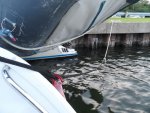
Look at the OP's picture. The concrete is quite low and there is really no way a fender board would stay in place with the changing tide. There are several like that around here.

13. line deflector 1.jpg
If you use a fender board, it will hang-up when the tide rises and falls.

6a. Fenders on a string 2.jpg
Fenders on a string works better in this case.

Fender boards are the thing for pilings, but not for docks with hang-up problems.
 
Last edited:
Thanks everyone, very useful advice. It's a shame but it doesn't affect her sailing ability :)

I agree, you won't see it from the saloon or cockpit.

Got to admit I couldn't ignore it for ever though. I have the impression there are other things you could be spending time making better before worrying about a scratched hull. So long as it's not deep enough to let water into the layup, then it's more important.

I'm just about getting to the point fixing stuff where cosmetics are starting to get a little priority, it's a good place to be as it means I'm curing the important stuff.
 
It's pretty handy actually, my partner wants her looking good, I want her working well; so she is in charge of all the cosmetic stuff and the interior, I have to get everything working properly and shipshape. She asked me to post and ask about the paintjob :)
 
Top