Fault finding a non working Simrad TP10 tiller pilot

ProDave

Well-Known Member
Joined
5 Sep 2010
Messages
16,165
Location
Alness / Black Isle Northern Scottish Highlands.
Visit site
This came with our new boat. And like many things that came with it, it does not appear to work.

First attempt was try it at home. I have a 4A bench power supply so I tried it on that, set to 12V. If you try and extend or retract the rod manually, the voltage dips as the current drawn exceeds 4A.

Second attempt, take it to the boat and try it. The rod can be manually driven in and out, but it does not drive continuously while holding the button as I would expect, but it drives in bursts then stops until you release and press the button again. This may be normal behaviour not knowing this model?

Now try and get it to steer the boat and it just sent us off steering to starboard and not even trying to maintain a course.

Time to read the manual a bit more. There is a set up and calibration routine described in the manual, but that needs the boat to be motoring in a calm sea, it was not calm that day so could not try it.

But while reading the manual, I see it's rated power consumption, is 500mA when in "auto"

If that is the maximum, then clearly mine drawing over 4A to move the rod in or out is not right. Or is that 500mA average, given that when operating in auto, maintaining a course, the rod will only be moving in and out a short amount and not continuously.

So I guess my first question to anyone that has one of these is what is the real power consumption when driving the rod in or out?

Or to put it another way does mine look like something is seized up and needs unsiezing before I go any further?
 
IIRC correctly there's a nominal current draw of >1A when being operated in 'free mode', and 2A when it stalls at a full command. I'm on my way to my boat and will check mine there and post later, but from what you write, I'd say that there's likely a mechanical issue like seizing.
On the good news front though, they're easy to open, investigate, fix & seal again:).
 
500mA will be the average current and 4A for the motor is about right.
You can download the service manual from online sources if you want to open it up and investigate further.
My TP30 had a fault where the pinion was free on the motor shaft. The service manual mentioned this fault and recommended a different grade of Loctite to secure it. This worked for me.
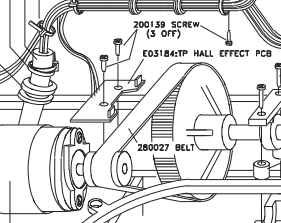
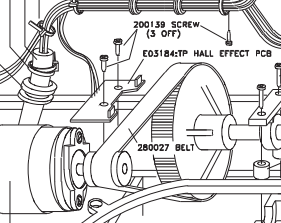
I think they can also fail when the hall effect pcb is displaced.
1691068376519.png

It is well worth fixing it because a new one is not cheap.
 

Attachments

  • 1691068354846.png
    1691068354846.png
    46.5 KB · Views: 1
Thanks both.

Whichever of you is at your boat next, could you confirm when you press either of the arrow buttons to drive it in and out (in standby mode) if it drives continuously as long as you hold the button, or does it drive for a short burst then stop and requires you to release and press again to move further.

I have the user manual and service manual but at the moment trying to establish if I actually have a fault or not. Once we get some calm weather at the boat i can try the calibration and set up routines in the user manual and then I will know for sure, but I remain a little surprised at >4A just to drive the unloaded shaft in and out.

It's on the boat at the moment so I can't take it apart just now.
 
500mA will be the average current and 4A for the motor is about right.
You can download the service manual from online sources if you want to open it up and investigate further.
My TP30 had a fault where the pinion was free on the motor shaft. The service manual mentioned this fault and recommended a different grade of Loctite to secure it. This worked for me.
I think they can also fail when the hall effect pcb is displaced.
View attachment 161190

It is well worth fixing it because a new one is not cheap.
I'd be grateful for a link to the online sources of the Simrad manuals/
 
Check the two little magnet set into the large pulley. The electronics count these for end of travel and course steering. Make sure they are there and the are close but not touching the two sensors on the little plate. I think it assumes that if it does not recieve any pulses then it must be at the end of its travel
 
Make sure you have a good solid 12v power supply with no high resistance connections.
It is possible your bench power supply has foldback current limiting so if the current briefly goes over 4A the voltage will drop and stall the motor which will try to draw more current and keep it in current limit mode.
Similarly on the boat a high resistance will drop the voltage as the current rises and cause the motor to stall and draw even more current and cause even more voltage drop.
Worth trying with a direct (fused) connection to a good battery before you open it up looking for other faults.
 
I have finally been to the boat and brought back the faulty TP10

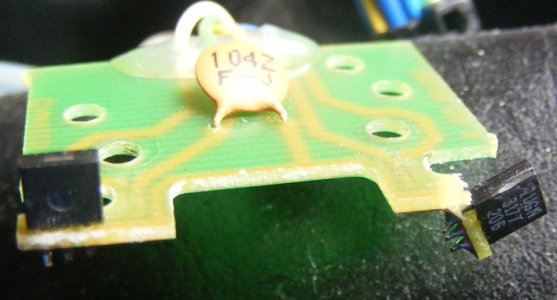
Opening it up and the fault is obvious, and as suspected to do with the hall effect sensor board.

board.jpg


Clearly the right hand sensor is broken off.

I wonder if the first time I tried it and had the very high current, it was then jamming and then broke the sensor?

The repair plan is to glue the broken bit of board with araldite, then reinfioce the no doubt broken tracks with copper wire, then try it, being careful to first determine nothing is physically jamming.
 
So while I wait for the glue on the PCB repair to cure (I only had slow set) I thought I would investigate the cause.

There are 2 magnets set into the plastic gear wheel that drives the lead screw. One of them was flush with the gear wheel, the other was sticking out. Further investigation showed both were free to move. I don't know what is supposed to hold them in place, but they are both now glued in, and flush with the face of the gear wheel.

It seems this is a product held together with glue and hope, and the glue or hope, has been found wanting.
 
An early one of mine had exactly the same problem. The whole pcb was available as a spare part for not a lot of money. I think the glue must have been improved because subsequent TPs have been fine.
 
Some progress. Now the board is repaired and put back, I can confirm both sensors give an output when the motor turns, and it will now manually drive in and out as long as you hold the buttons down. Current drawn driving the unloaded rod in and out is about 1.5 A

If I switch it to auto, it hunts in and out for a few seconds and then switches back to standby. I don't know if this is normal with no movement?

I guess the next step is take it back to the boat and run through the calibration procedure.
 
Top