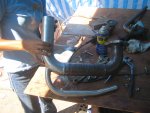
Exhaust elbow, specifically MD2020

Neeves

Well-Known Member
Joined
20 Nov 2011
Messages
14,073
Location
Sydney, Australia.
Visit site
Every thread on issues with an exhaust elbow and specifically the MD20 series (but I also believe the newer D1 series) mentions the difficulties of removal and the blocking of the elbow with a deposit, erroneously described as carbon but actually calcium hydroxide or carbonate pigmented with carbon.

The deposit can be removed with acid (proving that it is not carbon) but the acid also attacks the steel or the casting and I have found you can only acid treat once (and it is very messy)

If the elbow did not block there would be no need to remove it - and then the whole issues would go away. Not entirely true as the cast versions do corrode - but they block more frequently than corrode - so corrosion is not a big issue.

Along with the above the other oft repeated comment is to replace the elbow with a stainless version, or which there are a number of entrepeneurs out there making them. A google search also throws up pictures of what look like cast stainless version - identical to the cast iron or steel versions - looking very professional.

Despite the constant mention of replacing with a stainless version I have never seen a back up report suggesting they offer any solutions to the issues of the genuine cast version. The water intake (spigot) on the cast version seems to have a baffle inside, to spread the water? - and this baffle, or its method of attachment does corrode (and many stainless items corrode where there is any welding).

I've just removed my exhaust elbow (another interesting story) but I need to replace the elbow and am wondering whether to go down the stainless route or stick with the original cast version.

Do stainless elbows last longer? do they somehow stop the calcium build up,? are they corrosion free? - basically are they worth the money.

Any background

Jonathan


I have read, on this forum, that part of the problem is caused by running the engine under low load, say to recharge batteries.

If the deposition is, as I elude, a calcium deposit then the mechanism is a chemical process within the elbow - the calcium comes from seawater (and it maybe a calcium and magnesium deposit). It is difficult to envisage why stainless would reduce this deposition, unless something in the cast iron acts as a catalyst. But if it is a thermo-chemical process then running the engine, not under load, should not make any difference......? Calcium deposition also occurs on the water intake hoses - which you can clear by beating the hoses on a hard surface and then flushing them clean. Calcium and magnesium in seawater is common and in some parts of the world the water is saturated and there is a natural deposition (which would eventually form limestone or dolomite). There are facilities round the world extracting magnesium from seawater or brine - its common place (think Hartlepool between 1940 and 2000 - ish where 100,000s of tons were extracted). Think also of furring of your kettle (in the absence of a water softener).
 
Last edited:
On my question regarding stainless exhaust elbows I have noted the dire warning provided toward the end of this link

Volvo Penta MD2020 Series Exhaust Elbow, Part Number 861906. (Price of Stg282 including VAT - for the genuine cast steel version AND painted green!)

They omit to mention why the exhausts might explode.

And some discussion here, scroll down to 2nd Nov 2019, but no mention of explosions.

exhaust elbow Volvo Penta MD 2020 | Jeanneau Owners Forum

Aliexpress have them for sale in 304 stainless for about A$260 (I've added in delivery) which is about Stg140/150 but there is a 30 day shipping time (to Oz). We don't pay VAT here in Oz (yet) on mail order. The pictures provided look identical to a genuine Volvo elbow - as if they used the Volvo cast steel version as their mold.

109.15£ |Ap03 861906 21190094 Stainless Steel 304 Exhaust Elbow For Volvo Penta Md2010 Md2020 Md2030 - Exhaust Headers - AliExpress

I know I should support my local chandler (but they don't stock the parts, I have to order them and they charge me a delivery fee to the chandler). Looking at prices in the UK - the Aliexpress price is a no brainer

But I am concerned about explosions :)

Jonathan
 
Last edited:
There's no getting away from it blocking unfortunately,

I usually create new elbows out of 316 bsp threaded plumbing pipe, which has pretty thick walls. I weld up to seal, and then leave one or two joints sealed with exhaust putty, with a tack weld to prevent it coming apart in use. This means the assembly can be disassembled for cleaning. The mixing elbow itself can be acquired from Asap supplies in the UK, which then make it an easily replaceable part.

There are of course better ways engineering wise, but they require mandrel forming pipes and v clamp seals etc, mostly out of reach from a DIY perspective.
 
I had this happen on my Perkins Perama 2020(identical to Volvo Penta but different colour)many years ago. Unusually the Volvo Penta part was cheaper than the Perkins! Guess which one I bought! Only a 10mm hole in the centre when examined and my screwdriver went straight through the casting... Revs did increase to 3500 from 2500 when fitted though. Previous owner said 'I never go above 2500 rpm' on the trial sail.
 
I am no engineer, but I am unpersuaded that running an engine under very light loads will lead to faster fouling of the elbow (though there are other reasons for not doing so).

I imagine, but don't know, that the exhaust gases coming out of a higher loaded engine will be hotter, but even if they aren't there will be a much greater volume of them, and therefore much greater heat to cause the salts etc. to be precipitated out of the water being injected.

The metalwork of the engine too, I would think, be hotter in a heavily loaded engine than a lightly loaded engine, and some of this additional heat will be conducted to the elbow, though I imagine this would be a relatively very minor factor.

Regardless, think yourself lucky that the Volvo elbow is a mere £282. The Bukh replacement elbow for my DV36 is £512.33! :oops:
 
Last edited:
I’ve got a spare brand-new gasket for the exhaust elbow if you or anyone is interested? It was kicking around on my spares and as I no longer have a Volvo 20 series engine I don’t need it.

That's a good offer John, but not sensible for Australia - I hope someone puts it to good use.

I am surprised no-one, at all, has any experience of a stainless elbow (apart from Jon Frary) , from forum chat I had thought them more popular.

We will be ordering a stainless elbow via Aliexpress. Currently due mid July. We are waiting to see if we can get a better offer, we have already been offered a 5% discount (so if you use Aliexpress - be patient). Sadly it will take months, more likely years, before we know if stainless has any unknown issues - so hang in there for the future report :).

We had immense difficulty in removing the elbow. I destroyed one nut in trying to free it but freed one. The original intention was then to cut off the nuts in situ without damaging the studs. This was going to be very difficult and as our space is confined - potentially dangerous.. In the end we removed the complete exhaust manifold, I think 8 or 10 very slender and long bolts (2 of which were studs and had the control bow on them). We had to remove the alternator, control box and the coolant hose. We will need a new exhaust manifold gasket. Once I had the exhaust manifold and heat exchanger (all one unit) I simply cut the nuts parallel and as close to the studs as possible and the nuts 'failed' and were easy to remove this allowed me to remove the elbow. Now that I have the manifold/heat exchanger unit and access from any side or direction - it will be easy to clean up.

The elbow is not blocked but badly corroded and 'narrowed'. I had cleaned it once with acid - not worth trying again.

The basic problem is the engine is around 25 years old and is housed in a marine environment. I have previously cleaned the heat exchanger and the multi tube insert thing and when you take the heat exchanger apart - water goes everywhere. The exhaust elbow has been replaced already a couple of times and the nuts and studs have lost their protective paint (and I did not think to grease them each time). There is thus corrosion and the nuts lock. We did try with WD40, oxalic acid and heat to no benefit. Removing the exhaust manifold was straight forward, other than having to remove items that were in the way.

I will need to use new nuts and I will grease the studs this time and the pieces that hold the manifold.

The exhaust manifold has some blanks closing off some 'unnecessary' holes - do they need to be replaced? Someone told me they are called 'welsh's - or something similar.

If anyone thinks I should replace the thermostat or the coolant water hose (or anything else) - speak up - I'd welcome comment - I'm no engine expert. I may buy a Volvo gasket for the manifold - or simply buy some gasket paper and cut my own (its down the list of priorities currently).

Its winter here and though sunny day time the temperatures at 9am 'feel like' 2-4 degrees - so bracing sailing weather :). A good time for a bit of maintenance.

I you want to know if you suffer, or will suffer, from arthritis, anywhere, working on a marine diesel in a confined space is an excellent diagnostic tool :(

Jonathan
 
Every thread on issues with an exhaust elbow and specifically the MD20 series (but I also believe the newer D1 series) mentions the difficulties of removal and the blocking of the elbow with a deposit, erroneously described as carbon but actually calcium hydroxide or carbonate pigmented with carbon.

The deposit can be removed with acid (proving that it is not carbon) but the acid also attacks the steel or the casting and I have found you can only acid treat once (and it is very messy)

If the elbow did not block there would be no need to remove it - and then the whole issues would go away. Not entirely true as the cast versions do corrode - but they block more frequently than corrode - so corrosion is not a big issue.

Along with the above the other oft repeated comment is to replace the elbow with a stainless version, or which there are a number of entrepeneurs out there making them. A google search also throws up pictures of what look like cast stainless version - identical to the cast iron or steel versions - looking very professional.

Despite the constant mention of replacing with a stainless version I have never seen a back up report suggesting they offer any solutions to the issues of the genuine cast version. The water intake (spigot) on the cast version seems to have a baffle inside, to spread the water? - and this baffle, or its method of attachment does corrode (and many stainless items corrode where there is any welding).

I've just removed my exhaust elbow (another interesting story) but I need to replace the elbow and am wondering whether to go down the stainless route or stick with the original cast version.

Do stainless elbows last longer? do they somehow stop the calcium build up,? are they corrosion free? - basically are they worth the money.

Any background

Jonathan


I have read, on this forum, that part of the problem is caused by running the engine under low load, say to recharge batteries.

If the deposition is, as I elude, a calcium deposit then the mechanism is a chemical process within the elbow - the calcium comes from seawater (and it maybe a calcium and magnesium deposit). It is difficult to envisage why stainless would reduce this deposition, unless something in the cast iron acts as a catalyst. But if it is a thermo-chemical process then running the engine, not under load, should not make any difference......? Calcium deposition also occurs on the water intake hoses - which you can clear by beating the hoses on a hard surface and then flushing them clean. Calcium and magnesium in seawater is common and in some parts of the world the water is saturated and there is a natural deposition (which would eventually form limestone or dolomite). There are facilities round the world extracting magnesium from seawater or brine - its common place (think Hartlepool between 1940 and 2000 - ish where 100,000s of tons were extracted). Think also of furring of your kettle (in the absence of a water softener).
I have the Perkins 102-05 also know as a Volvo 2010 as a generator engine. The cast iron exhaust elbow was a constant source of irritation, needing decoking every 100 hrs. I swapped it for a cast s/s elbow off a Northern Lights generator, as they use the Perkins 100 series engines. That was 4 years ago. It never needed removal since, runs smoother and with more power. I would not hesitate to go the s/s route again.
 
I've converted both engines that have been in my boat, to s/s exhausts fabricated by a local welder in Dochgarroch.
It's an obvious thing to do isn't it? Mild steel versus a corrosive mixture of a salty liquid, further heated up by a gas in a marine environment, will only ever have one winner.
 
That's a good offer John, but not sensible for Australia - I hope someone puts it to good use.

I am surprised no-one, at all, has any experience of a stainless elbow (apart from Jon Frary) , from forum chat I had thought them more popular.

We will be ordering a stainless elbow via Aliexpress. Currently due mid July. We are waiting to see if we can get a better offer, we have already been offered a 5% discount (so if you use Aliexpress - be patient). Sadly it will take months, more likely years, before we know if stainless has any unknown issues - so hang in there for the future report :).

We had immense difficulty in removing the elbow. I destroyed one nut in trying to free it but freed one. The original intention was then to cut off the nuts in situ without damaging the studs. This was going to be very difficult and as our space is confined - potentially dangerous.. In the end we removed the complete exhaust manifold, I think 8 or 10 very slender and long bolts (2 of which were studs and had the control bow on them). We had to remove the alternator, control box and the coolant hose. We will need a new exhaust manifold gasket. Once I had the exhaust manifold and heat exchanger (all one unit) I simply cut the nuts parallel and as close to the studs as possible and the nuts 'failed' and were easy to remove this allowed me to remove the elbow. Now that I have the manifold/heat exchanger unit and access from any side or direction - it will be easy to clean up.

The elbow is not blocked but badly corroded and 'narrowed'. I had cleaned it once with acid - not worth trying again.

The basic problem is the engine is around 25 years old and is housed in a marine environment. I have previously cleaned the heat exchanger and the multi tube insert thing and when you take the heat exchanger apart - water goes everywhere. The exhaust elbow has been replaced already a couple of times and the nuts and studs have lost their protective paint (and I did not think to grease them each time). There is thus corrosion and the nuts lock. We did try with WD40, oxalic acid and heat to no benefit. Removing the exhaust manifold was straight forward, other than having to remove items that were in the way.

I will need to use new nuts and I will grease the studs this time and the pieces that hold the manifold.

The exhaust manifold has some blanks closing off some 'unnecessary' holes - do they need to be replaced? Someone told me they are called 'welsh's - or something similar.

If anyone thinks I should replace the thermostat or the coolant water hose (or anything else) - speak up - I'd welcome comment - I'm no engine expert. I may buy a Volvo gasket for the manifold - or simply buy some gasket paper and cut my own (its down the list of priorities currently).

Its winter here and though sunny day time the temperatures at 9am 'feel like' 2-4 degrees - so bracing sailing weather :). A good time for a bit of maintenance.

I you want to know if you suffer, or will suffer, from arthritis, anywhere, working on a marine diesel in a confined space is an excellent diagnostic tool :(

Jonathan
Jonathan I have a MD2020B on our 1995 Maxi that I took ownership of 5 years ago. I replaced the elbow with a cast s/s one 3 years ago as routine maintenance - the old cast one was partially blocked. The engine runs very well and I've had few issues with it since.
If I was you I would take the opportunity to change the thermostat and hoses at the same time. Before refitting the elbow I would clean the threads with a die nut and then coat them in copper slip (and use a new VP gasket!)
The engine should fire up from cold after about 10 seconds of preheat, if not, one or more glow plugs may have failed - we were needing over 30 seconds when I first got the boat and thought that was normal until I checked the plugs, one had failed, luckily the front one as the back one would need the fuel lines removed to gain access.
I'm a retired MN Marine Engineer so am comfortable working on these engines although access can be terrible!
 
I had a Volvo MD 2010 that had a cast Iron exhaust bend that had not been removed for inspection at any time.
It finally blew its immaculate coating of green paint on three corners of the casting after nearly 20 years of use. This engine by virtue of its low horse power would have been worked much harder than one with 3 times the power.

A temporary repair was made on remotest Scotland and a Stainless fabricated replacement ordered.

The temporary repair was a mixture of Butyl flash band tape, a wrapping of self Amalgamating electrical tape all clamped around the elbow with two jubilee clips in series.

This proved to be an effective repair and lasted for some considerable time and at full throttle.

I sympathise with your experience of removing the elbow and your choice to remove it with the exhaust manifold was good.

I found a mixture of plus gas penetrating oil, heat and a lot of unrepeatable Anglo saxon words persuaded the strange sized nuts to be removed without snapping a single stud. The nuts were rust bonded in place under a immaculate original coating of green paint.

On removal of the elbow it was more than 80% completely choked with calcretions.
The calcrete had also started to fill the aft end of the exhaust manifold .

That's when I decided to remove the manifold. Your gain my pain!

Take the opportunity to replace your thermostat now. Guess why!

Yep I had to remove my manifold again a year later as I did not make time to fit one then.

The new stainless elbow can be fitted with a standard larger AF nut size for the same thread.
This really helps as it doesn't have the corner webs that the cast elbow has that both failed and interfered with fitting a good full hex socket onto the retaining flange nuts.

I had no significant performance change before during temporary repair or after elbow replacement and absolutely no external indication that the elbow was ready to blow.


I have since found put that it is a volvo service requirement fir the elbow to be checked and cleaned every two years.

I have since sold the boat and would expect the new owner to get at least 10 years use out of the replacement even if the inspection schedule was ignored.

It may help that he is freshwater based!

Steve.
 
I have an MD2020. I had Volspec come & do a compression check etc with a view to possibly supply a new engine, due to some odd noises that I had experienced. In the end it was new injectors & tappet adjustment ( first in 18 years).
When finished, the engineer was not totally happy, although it sounded OK to me. He squeezed the bellows at the back of the heat exchanger & noted 2 things. First that they had moved slightly. Second that they were inflated very hard. He advised that this was due to a blocked exhaust elbow. He had one in his van.
I thought " Here we go. Cost is going to rocket". But no. Using the correct tools he changed the elbow & refitted the rear bellows in about 20 minutes. I actually thought that he had not done it, until he showed me the still warm old elbow with the pencil hole sized remaining aperture.
It is my third elbow in 17 years & nearly 5000 hours running & It takes me a couple of hours, by the time I have found my tools, uttered the obligatory magic words, fished the bits out of the bilges, stopped for a coffee, & cleared up
He confirmed that it would be silly to exchange an engine, running like a sewing machine. He felt that it survived due to the regular use. Over the years he had seen several in their yard with only 1500 hours, due to corrosion & poor maintenance.
 
Daydream believer I like to believe I have been focussed with maintenance (of the engine) but not of the corrosion. :(

I'm not impressed with the access to parts of the MD20xx engines - partially the engine and partially squeezing the engine Into a very confined space (the hull at the point of installation is not much more than the size of the engine).

TSB240 I don't have the repertoire of Anglo-Saxon expletives, which may have been part of my disadvantage - as I was brought up in Scotland. I am convinced, as it is not a major cost - new thermostat and I'll take the advice on the nuts.

SteveA I've taken on board your words of wisdom - I could have done with your expertise - but you learn the hard way and don't forget! I'd never taken any engine apart - until I owned a boat! (sheltered and impecunious teenage years). I've still most of it learn. I'm frustrated that I'm learning all of this at the back end of life :(

Many thanks to all contributors - I hope it has been useful to others.

I will report back on the use of the stainless elbow, aliexpress etc etc We will commit funding tomorrow.

Jonathan
 
I sit here thinking - there but the grace of god

We sail to SW Tasmania - I know, not that far off the beaten track - but the nearest road is maybe 100km away, no mobile network, no VHF coverage) other than cray fishermen) . What would I have done if all of this developed when we were there....? We have all the kit - but no spare elbows. I have noted that Volvo suggest, recommend, the elbow should be checked and cleaned every 2 years TSB240 news to me, I have the service manual at a cost) but sounds about right - I wonder how they suggest cleaning....

I know we could have sailed to 'safety' and a resource full Hobart. I like to think we would have lived with the reality and it would not be a particularly memorable story. But it does make me think we (I) was lucky in the past and lucky this time - I can dinghy home each night without a care in the world.

Jonathan
 
I fitted an s/s replacement to our MD2020 a few years ago as a precaution against the original cast one rusting through (upon removal it was found to be cracked). Too soon to be able to report anything about the replacement.
 
Top