MathiasW
Well-Known Member
It is a very conservative rule, but independent of wind strength...

I'm quite prepared to accept that I'm as thick as a brick, but I cant see how this formula would work using "feet". Further, I don't think that the RYA would issue guidance only suitable for deep water when their whole purpose is to promote leisure sailing. If you used feet then anchoring in 6 metres of water you would only put out about 16m of chain? Using metres I would put out about 30m which to my mind is about right. In any case this is what I was taught when I learned to sail, of course this is only a guide and it is up to the skipper to adjust it to suit the circumstances in each case. I think the important point is that if you are using rope then you need a lot more of it.Yes, I am (trying to, given Corona) sail around the worldSo that is for me real life...
This British Admiralty rule is, in fact, a conservative approximation to the standard catenary result that jdc was also referring to. It holds for deep water and really is VERY conservative for most cases. It will get at its limits in shallow water with a lot of swell and wind.
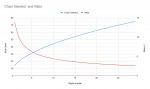
And beware! Your factor 12 is only correct when you use feet! It is a different, smaller factor when you use metres. The British Admiralty rule states L = 1.5 √Y, where Y is measured in metres and chain length L in shackles (90 ft).
I'm quite prepared to accept that I'm as thick as a brick, but I cant see how this formula would work using "feet". Further, I don't think that the RYA would issue guidance only suitable for deep water when their whole purpose is to promote leisure sailing. If you used feet then anchoring in 6 metres of water you would only put out about 16m of chain? Using metres I would put out about 30m which to my mind is about right. In any case this is what I was taught when I learned to sail, of course this is only a guide and it is up to the skipper to adjust it to suit the circumstances in each case. I think the important point is that if you are using rope then you need a lot more of it.
 The square root approximation to the catenary equation - and hence the guidance by RYA - is for shallow water and / or strong wind.
 I'm fairly sure that back when I did YM theory, which was a long time ago, the RYA guidance was 3x the depth for chain and 5x for rope. Maybe we didn't expect miracles from small anchors in gales in those days?
In sensible conditions you can imagine extending the curve of your chain upwards at the angle it meets the bow. Maybe closer to vertical than 45 degrees?
So some kind of 1pointsomething x depth plus n metres formula is justifiable.
I have kedged in very deep water using less than 2x rope plus a little bit of chain.
People who fish around wrecks often use quite short rodes in deep water.
 : Anchor Chain Calculator - SAN
Unless I misunderstood your previous post you were suggesting that the formula of 12 times the square root of the depth of water would only work using "feet" as the measurement. This seems to me to be wrong, the formula works perfectly well in metres.Sorry, as corrected in a later post, my memory had not served me well in this point.
And of course it works for feet as well as metres, or any other metrics you choose. You just need to adjust the factor in front of the square root.
If you have for units of metres
L_m = A_m * square_root(Y_m)
where L_m is the chain length in metres, Y_M the anchor depth in metres, and A_m the coefficient,
then you have for units of feet (with L_f, Y_f, A_f)
L_f = A_m/0.305 * square_root(Y_f*0.305) = A_m/square_root(0.305) * square_root(Y_f) = A_f * square_root(Y_f)
and thus A_f = A_m/square_root(0.305)
And yes, of course, rope requires much more length than chain does.
Unless I misunderstood your previous post you were suggesting that the formula of 12 times the square root of the depth of water would only work using "feet" as the measurement. This seems to me to be wrong, the formula works perfectly well in metres.
I did not redo the maths and had taken the factor 12 for face value... As long as the wind doesn't really get up, high forces on the chain with dynamic loads on top then , like catinary, it does very little to reduce the peak loads. The maths will be on a site somewhere.Anchor Buddy | Kiwi Anchor Rider
Genuinely useful in some circumstances and also cuts out a lot of the snatch whether or not you are using anything else to prevent snatch.

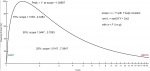
If looking just at the force to lift the last link off the sea bed then metres 14 x sqr(depth) seems pretty much bang on for 10mm chain with a 200Kgf horizontal load on the chain. At any depth.Unless I misunderstood your previous post you were suggesting that the formula of 12 times the square root of the depth of water would only work using "feet" as the measurement. This seems to me to be wrong, the formula works perfectly well in metres.
As long as the wind doesn't really get up, high forces on the chain with dynamic loads on top then , like catinary, it does very little to reduce the peak loads. The maths will be on a site somewhere.
Big long snubber is much more effective for that.
If looking just at the force to lift the last link off the sea bed then metres 14 x sqr(depth) seems pretty much bang on for 10mm chain with a 200Kgf horizontal load on the chain. At any depth.
Equal force scope
The catinary equation and your equation are on top of each other., there are 3 plots on the graph. Zoom in you'll see them all.Bang on with what? I do not see the usage of the catenary equation in your plot. That would be the reference. If you compare it with the British Admiralty rule, then of course it is bang on for all depths, as both are square root functions...
The catinary equation and your equation are on top of each other., there are 3 plots on the graph. Zoom in you'll see them all.
As long as the wind doesn't really get up, high forces on the chain with dynamic loads on top then , like catinary, it does very little to reduce the peak loads. The maths will be on a site somewhere.
Big long snubber is much more effective for that.
The snubber can be 80% the length of the rode. I.e. use a bit of chain and the rest nylon.Indeed. A kellet can at most be equivalent to an amount of chain that has the same weight as the kellet. For this the kellet needs to be located close to the anchor, but off the seabed. So, for any kellet that you can reasonably handle weight-wise, it does not add much. It only saves a few metres of chain but introduces a substantial amount of additional hassle if you need to get going quickly.
A snubber, in particular in shallow water, if large enough - and Jonathan has written a lot about this - will be MUCH more effective, and easier to handle as well...
Your maths and graphs are simplistic and mostly irrelevant.

????? Hä, really ?????So some kind of 1pointsomething x depth plus n metres formula is justifiable.

