Dyneema Guard Rail Lines- Chafe Protection

CJ13

Well-Known Member
Joined
10 Jan 2008
Messages
721
Visit site
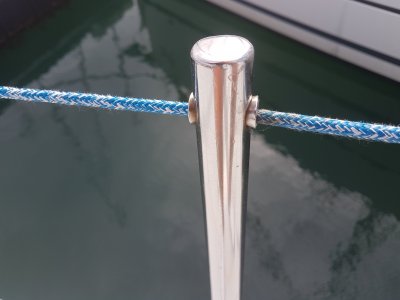
Following my earlier post I’m going to replace my plastic coated wire guard rail lines with 6mm dyneema.
The lines run thro holes in the stanchions and we tie fenders onto them.
For chafe protection where they run thro the stanchions I can either use split plastic tube, which has the advantage of being fairly rigid, so easy to tie fender to, or Dyneema Chafe Sleeves, which are soft so I suspect less easy to tie to?

Has anyone experience of either option or another solution?
 
would it not be easier and aesthetically more pleasing to remove the stanchions and have perfectly smooth radiused eyes machined in them?
 
I think you may be unnecessarily agonising. We retired our stainless life lines and replaced with Liros, I think it is 5mm dyneema braid. I worried about abrasion and threaded plastic sleeves, the appropriate number, onto the dyneema. I thought the sleeves would stay at the stanchions but they migrated - and I never used small cable ties to hold them in place. I stopped worrying about them, I decided I would let nature take its course and take the appropriate action later. 10 years later there is no sign of abrasion of the dyneema and no sign of degradation through UV.

Stainless and aluminium are both fairly soft and possibly the dyneema polishes the hole in the stanchion. Dyneema is not abrasion resistant but similarly without much effort you can polish stainless and aluminium (unless your stanchions are made from something exotic).

I don't know how many have changed their life lines to dyneema - so I have no idea of the statistics - but the issue (in terms of fears) of abrasion of dyneema in lifelines caused by stanchions is not unusual - but I don't recall anyone actually posting that their lifelines have abraded. Abrasion might be one of those fears that has no basis in reality - the same was said of UV and dyneema. Dyneema lifelines have failed when worn continuously by a working sheet - but that is entirely a different issue

Hang your fenders from the toe rail or appropriately located mooring lines.

Jonathan
 
Thanks Jonathan.

Our toe rail is solid so nothing to tie fenders to. I’d prefer to use the guard rail lines, but suspect that tying to 6mm dyneema won’t be very secure- I could of course be completely wrong!
 
Use self amalgamating tape at each end of a plastic tube or as noelex shows in post #6.
I used nylon tubing with amalgamating tape when I replaced my aluminium stanchions where the holes had been worn through with the stainless wire. One stanchion snapped one winter after I fitted a cover over the boat - on inspection all the holes were worn so replaced all the stanchions and new wire.
 
You can buy hollow braided tape, rock climbers use it, but it is also used as wear sleeves on yachts. It is effectively a fabric tube. It can be made from polyester or dyneema (and probably other materials). Most cordage makers supply. But if you have offcuts of rope, or could cut off 0.5m off one of your halyards or sheets you can simple strip the cover off the rope and hey presto you have a 0.5 m sleeve. The problem is sealing the ends when you cut it up as you need to fuse the filaments to stop it unravelling. It does not matter how you seal the ends - they never look neat (I have tried whipping - but its a laborious task (and still does not look neat).

I've used 10mm dyneema hollow braid from Nautilus Braids in NZ to join two sheets to cow hitch to a sail and as abrasion sleeves for one of our bridles, snubber.

If the cover is a similar size to the rope you want to apply it to then its a devil to instal - better a size of cover bigger than the rope as if its the same size it binds on the rope inside the tube (which is the theory behind a Brummel splice).

You could fix the sleeves by simply sewing the sleeves in the appropriate place - we use braided dyneema fishing line for sewing.

However as I said in an earlier post and as indicated by Lightwave 395 - it appears to be unnecessary to sleeve and is not the most beautiful of additions. Covering the lifelines also means you do not see what is going on inside the sleeve (which is why covered stainless is no long used).

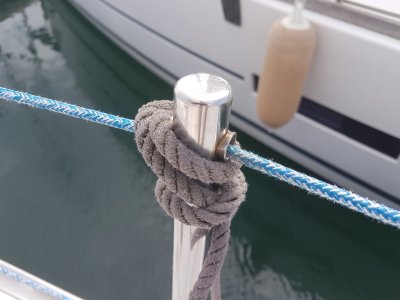
We have long ropes on our fenders. We attach at the lowest point possible and then take a turn round each stanchion/lifeline to the top. The tension on the rope is then taken by numerous tie off points - not just the top. As already suggested, pcatterall, take a clove hitch round a stanchion and the lifelines are not stressed at all.

Jonathan
 
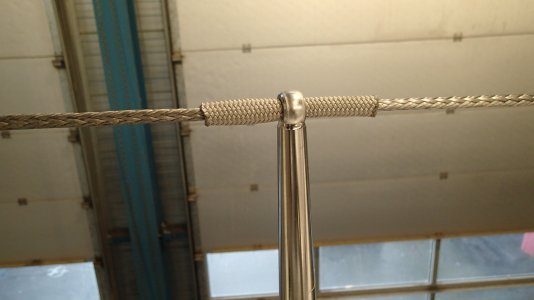
I used 6mm 12 core dyneema and a 8-12mm dyneema cover from liros for my lifelines.

On the stanchions i used a dremel fitted with a small sanding cylinder (80 grit) that fitted in the whole.

Sanded the hole and opening. Then with a rag and autosol, polished. Took a few mins for each one.

Been on for four years. No wear. Been on swinging mooring in F10 storms.
 
Thanks Jonathan.

Our toe rail is solid so nothing to tie fenders to. I’d prefer to use the guard rail lines, but suspect that tying to 6mm dyneema won’t be very secure- I could of course be completely wrong!
We generally tie fenders to the stanchion bases. If need to tie between stanchions always tie to lower guard wire only.
Tie with round turn and two half hitches and will be fine on the dyneema.
 
No one has mentioned it yet (I think) but would adhesive lined heat shrink work? The adhesive lining should stop sleeves migrating.
 
No one has mentioned it yet (I think) but would adhesive lined heat shrink work? The adhesive lining should stop sleeves migrating.
Dyneema melts at around 140°-150°C so you need to very careful with a heat gun. Glue lined heat shrink needs around 90°C to shrink.
 
Last edited:
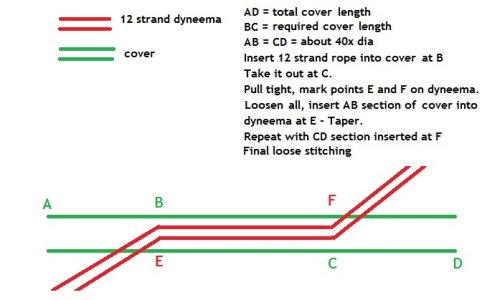
A neater way of applying a cover to 12 strand dyneema; it will not move and can run smoothly through blocks if need be. Pitiful Microsoft Paint drawing, hopefully it's understandable :)


Edit
I have found a video for that type of method with braided rope, of course it's a lot easier with 12strand dyneema
 

Attachments

  • Cover splice.jpg
    Cover splice.jpg
    66.1 KB · Views: 22
Last edited:
@Roberto i think i did similar to this. My cover is spliced into the core and tapered at around 50x length. The splice is whipped. It has not moved and is a smooth transition.
 
  • A split mandrel on a Dremel or similar holding a strip of sandpaper is the fast way to polish the holes. It's made for this.
  • The problem with spliced-on covers is that they move with changes in tension and you can't end-for-end the line. This is why riggers don't like to do it that way. The simple inserts that people have suggested above (also air line tubing) are well proven.
 
@Roberto i think i did similar to this. My cover is spliced into the core and tapered at around 50x length. The splice is whipped. It has not moved and is a smooth transition.
Yes if it's only for almost static friction against a stanchion the bury can be shorter, if on the other hand it has to contribute to the general rope structure then I reckon proper bury lengths are better, various theories available usually 40/50x for bury + 20x for taper, whatever.
The above sketch is not my idea of course, it's copied common practice whenever dyneema braid needs a cover (or also additional covers over 16strand cover ropes, same technique) as seen at Lorient la Base in Imocas, Ultim maxi trimarans, Class40s, Figaro, Mini650 etc. FWIW this "La Base" is just opposite my marina and home to possibly the biggest all size combined hi-tech ocean racing fleet in the world, I think they know a thing or two about all flavours of HMPE ropework, if something does not work no one will see it a second time on any boat :)
Others may think differently of course.
 
Dyneema melts at around 140°-150°C so you need to very careful with a heat gun. Glue lined heat shrink needs around 90°C to shrink.
As I have posted on previous threads. Do not use a heat gun or blow torch on Dyneema, you cannot control the temperature. Shrinking covers with boiling water is perfectly acceptable according to both the manufacturers of Dyneema and Marlow (I asked). I understand boiling water is a constant (and well known) temperature. If the covers do not shrink in boiling water - you have the wrong covers. There are covers manufactured and sold specifically for cordage (and they are different to osensibly 'similar' covers use for electric wiring/cabling). Cordage covers tend to be a bit more meaty than electric cable wiring and tend to comes transparent. 4:1 shrinkage is common but search and you will find 6:1 shrinkage - the greater the shrinkage the thicker the resultant cover (which may be good or bad - depends on your usage).

I have never used glue filled covers - I have never found the need.

Jonathan
 
Top