Dyneema for lashing guard rails?

ash2020

Well-Known Member
Joined
7 Jun 2010
Messages
849
Location
Fowey, Cornwall
Visit site
I need to lash the guard rails to the pulpit rails where there is a 3" gap. Would 2mm dyneema be suitable, maybe 4 turns? It says it has a breaking strain of 200kg. If it has 4 turns does that mean the total breaking strain is 800kg or is it still 200kg?
 
That's a good point. I hadn't considered that. Thanks.

Dyneema is very strong but be wary of chafe, I would use thicker line. I suspect the strength will also be less where it bends around the fittings to form the lashing. Why not use cheap and cheerful polyester or similar.
I think I will go for 4mm polyester. Thanks
 
I need to lash the guard rails to the pulpit rails where there is a 3" gap. Would 2mm dyneema be suitable, maybe 4 turns? It says it has a breaking strain of 200kg. If it has 4 turns does that mean the total breaking strain is 800kg or is it still 200kg?
The BS should be more like 400 kg (900 pounds). Either it is not Dyneema of very low quality. 2.5 mm Amsteel is 750 kg. Check the product specs.

The World Sailing standard is 1600 kilograms, so that would be 4 passes (2 loops), but the load is typically not spread evenly because of strands crossing each other, so allowing an extra 30-50% is established practice. 6 passes (3 loops) is the minimum and 8 passes is common.

World Sailing. See 13.14.3

Obviously, with 4 mm polyester (similar in strength), you will still need 8 passes. However, that is a big lashing that will really crowd the end fittings/thimbles, leading to uneven stress distribution. I may not even fit. Hence the common use of Dyneema.

---

Technically, that is breaking strength or stress. Stress is applied force. Strain is the stretch that happens when the stress is applied. Stress and strain are related but they are different things.
 
The BS should be more like 400 kg (900 pounds). Either it is not Dyneema of very low quality. 2.5 mm Amsteel is 750 kg. Check the product specs.

The World Sailing standard is 1600 kilograms, so that would be 4 passes (2 loops), but the load is typically not spread evenly because of strands crossing each other, so allowing an extra 30-50% is established practice. 6 passes (3 loops) is the minimum and 8 passes is common.

World Sailing. See 13.14.3

Obviously, with 4 mm polyester (similar in strength), you will still need 8 passes. However, that is a big lashing that will really crowd the end fittings/thimbles, leading to uneven stress distribution. I may not even fit. Hence the common use of Dyneema.

---

Technically, that is breaking strength or stress. Stress is applied force. Strain is the stretch that happens when the stress is applied. Stress and strain are related but they are different things.
Thank you for that comprehensive information. I imagined dyneema was dyneema, i.e. a standard breaking strain, didn't realise there was low quality dyneema. So what would the recommendation be? Type and no of turns for a small cruising vessel? Dyneema or polyester? Thanks again.
 
I have always seen the 'lashing' that connects the guard wire to the pushpit as the thing to cut making a MOB (PITW) easier to get onboard.

Dyneema is horrid stuff to cut and blunts knives for a past time.

My guard wires are dyneema, with a fancy outer braid, and I use 'normal' cordage as the cutting area.
 
I have used small diameter covered dyneema for this (3 or 4mm not sure) and it is fine. These small sizes are easy to cut through.
 
We have used full length dyneema guard "wires" for years now. No hassle, no problems and they are incredibly resilient.

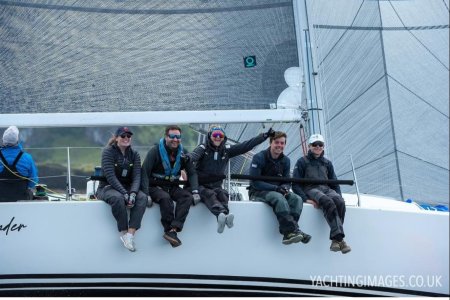
Spliced at both ends and used for hiking they have proven themself to be more than safe, and a bit comfier

WhatsApp Image 2024-08-07 at 07.58.14_cc6d7872.jpg

Its comfier but they should be hiking harder than that!

Use the dyneema. it will be perfectly fine
 
I have always seen the 'lashing' that connects the guard wire to the pushpit as the thing to cut making a MOB (PITW) easier to get onboard.

Dyneema is horrid stuff to cut and blunts knives for a past time.

My guard wires are dyneema, with a fancy outer braid, and I use 'normal' cordage as the cutting area.
 
We have used full length dyneema guard "wires" for years now. No hassle, no problems and they are incredibly resilient.

Spliced at both ends and used for hiking they have proven themself to be more than safe, and a bit comfier

View attachment 193043

Its comfier but they should be hiking harder than that!

Use the dyneema. it will be perfectly fine
I'm not going to be using dyneema for the whole thing, just the end lashings to get the right lemgth.
 
Top