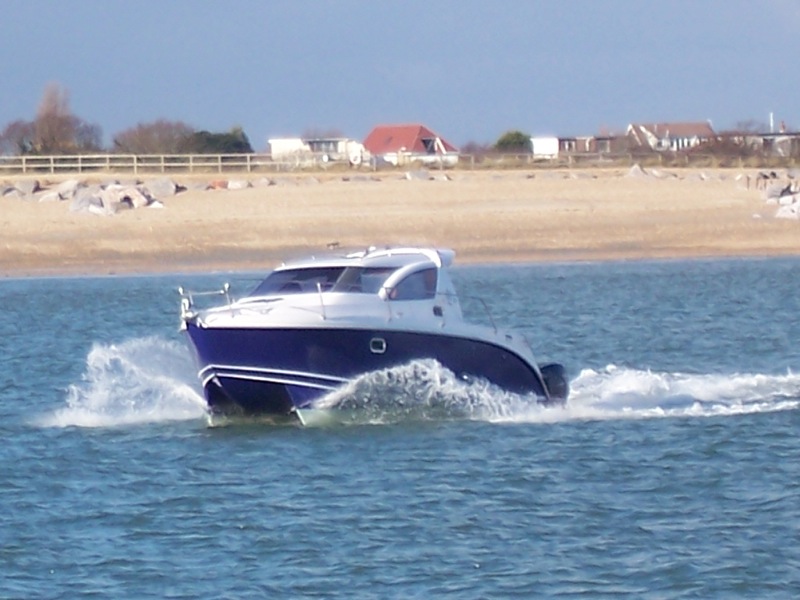
I may know a bit about catamarans but I am unsure on this. Having experienced both displacement and so called planing cats, I am still unsure. Do any experts on here have a view or experience?
I am only learning, but read a good article by Malcolm Tennant Here
What he says is that they do plane, but rather than on water on an 'Air Wave' through the hulls...at least that is what I got from it! A brief part of the article is as follows
"The planing cat will typically have a wing deck clearance that is less than that of the displacement cat. The major reason for this is that they are generally utilizing the ram effect of the water and air compressing in the tunnel to both provide some lift and to cushion the impact when leaping clear of waves. This works well, particularly on the smaller vessels, and the tunnel hull race boats, until such time as the boat has to slow down because of the conditions. The ram effect does not contribute anything at lower speeds and the craft is now susceptible to slamming from the low tunnel. At some stage the vessel becomes too big/heavy for the air/water cushion effect to work. What happens when you have to slow down in adverse conditions is a major parameter in the design of any power catamaran that is going to operate in other than sheltered water. Owners of small planing craft will be well aware that in some particular wave conditions it is often better to speed up rather than slow down. A similar effect occurs with our larger displacement boats. In some adverse sea states driving the boat at 18+ knots results in a very much smoother ride. The cats slice through the water in what an American owner of one of these boats calls “hydroglide”.
It should be obvious from the foregoing that there is a much larger size/speed overlap between the planing and displacement hull form catamarans than occurs in the equivalent monohulled vessels. With monohulls the displacement boat is on the low end of the performance scale and the planing boat on the high end and never the twain shall meet. Admittedly there is an amorphous hybrid called a semi displacement craft which attempts to bridge the gap. But generally speaking the planing and displacement vessels are quite distinct in their performance, purpose and area of operation. It is not possible to separate the planing and displacement catamarans on a straight performance basis in the same way as is possible with monohulls. It is often just not possible to say which type is superior for a particular purpose, or in a particular set of conditions, unless you define your requirements very carefully."
Generally, no. They sail in displacement mode. However, because the hulls are slender they can exceed conventional hull speed calculations. These comments really apply to high performance sailing cats but I suspect power cats with slender hulls obey the same rules. Good speeds can be obtained from quite low power engines. Low power engines are lighter and use less fuel. It may be the way forward in times of high fuel prices but buyers will need convincing !
If you take a planning Catamaran with Hulls (quite Large) at 1.2m each and the LOA is 9.2m then compare it to a SC29 with LOA of 9.13m and a beam of 3.19M thgen you have less hull to drag through the water because the combined beam of the Catamaran is 2.4m compared to 3.19m.
This is more efficient at speed and displacement (I think). The down side is you need more power to get it up on the plane but less needed to keep it there. For instance I estimate a cruise on the SC29 at 22 knots with D3 190s would be about 3400RPM, whereas with a displacement Cat of the same weight (4500kg) it should plane at 22knots at about 3100RPM. This means more fuel efficiency as the engines are working at a lower RPM.
I am also trying hard to understand more about them but without much variety of product in UK it is so difficult. I have sailed and motored much of what is available to try in the UK. I have not noticed a distinct "over the hump" experience on planing cats. The term "hydroglide" is new to me - I like it. It describes my experience so far. There is certainly a lot of lift from air compressed between the hulls, giving a soft ride. A foil fitted between the hulls creates more lift still - its like going up in an elevator rather than over a hump. So does a catamaran plane - I dont know.
Depends if it's a planing hull or not surely? Just like mono hulls some are displacement (albeit with very slender hulls they aren't restricted to the theoretical max speed for length), and some planing.
For example, ths a cat, but I think we can all agree it's planing... /forums/images/graemlins/cool.gif
"A planing boat's hull skims across the surface of the water rather than pushing through the water in the way a traditional displacement hull works. In the U.S. the term Hydroplaning is sometimes used instead of planing, but primarily to describe racing motorboats which plane. Hydroplaning is also an important concern in car safety (see Hydroplaning (car)).
Yes - but displacement catamarans can also go fast and develop a lot of lift due to dynamic forces generated between the hulls. Displacement cats can also skim across the surface. The usual description of plaining is overtalking your own bow wave and going over the "hump". How does this apply to cats?
I have definitely planed twice on my sailing catamaran. On each occassion the whole characteristics of the boat, and its handling were remarkable. It smoothed out significantlyand noise reduced. Speed was bout 18-20 kts on the fastest day. Needs a lot to get onto the plane, but dramatic when there.
From a rag and stick point of view a boat planes when it actually rides over its own bow wave and exceeds the displacement speed for the hull. Hence the hump. Still applies to any boat though if it goes fast enough?
I dont think there is a "hull speed" for a displacement catamaran. The bow wave is far less significant. For a displacement cat the so called "hull speed" is more related to frictional resistance than wave making resistance. The physics involved in "hull speed" is very different.
Victoraspey. From what I understand this is right. Boats operate in Displacement Mode, Forced Mode and Planing Mode. Form drag of a hull and the massive resistance as heavy boats try and climb their bow wave prevent them going faster than conventional hull speed calculations. Except ... slender hulled cats, which have very little form drag and can escape the forced mode. I suppose forced mode is "semi Displacement" . In displacement mode and forced mode, the power required to increase speed goes up by the square ( or more). Once a boat planes, the relationship (speed/power) is more linear, hence planing can be very efficient.
Many of the high power and planing cats do not have slender hulls but almost a planing mono hull, split length wise, which give great stability. And of course these plane.
High performance sailing cats can reach speeds of 30 knots but they are not planing. It may be possible to replicate this, non planing, performance with a power cat with relatively low power ( low fuel consumption) engines. It would look pretty daft.
If we continue to live in a world with increasing fuel prices, then I believe we will see more and more power cats as this is one way of maintaining "the need for speed" yet reducing fuel consumption.
We may have to adjust our perceptions on what our boats will look like !
[ QUOTE ]
If we continue to live in a world with increasing fuel prices, then I believe we will see more and more power cats as this is one way of maintaining "the need for speed" yet reducing fuel consumption.
We may have to adjust our perceptions on what our boats will look like !
[/ QUOTE ]
I think that is spot on.
because of time limitations with only a few days every now and then for boating people need speed to get any dustance in the limited time. Going displacment or SD is not really an option and this is where the fast cats can ome in with their greater economy.
The market I see opening up is the Cat of about 28 to 32 feet.
As you say this trend must continue as fuel prices continiue to rise. So for crusing boats its go slow but for most boats which are not cruising boats its change technology.
I don't think this cat is on the plane. Looks very much in displacement mode. Also, its got a centre hull.
Now this cat is planing. Hull level and only the stern touching the water
I'm not even sure about this one.. I'd like to see a picture on flat water. But at least we can see that it is a cat with slender hulls forward. Are the aft sections flat planing type or do they continue as rounded forms ?
[/ QUOTE ] The market I see opening up is the Cat of about 28 to 32 feet.
[/ QUOTE ]
I think this is right. But these cats will be difficult to design to achieve the significant fuel savings that will be needed to tempt buyers out of their conventional boats.
Also, in the UK, much of the marina business will need to open their minds to cats.