

Bertramdriver
Well-Known Member
The project was conceived as a solution for my wife who is not getting younger, and is becoming increasingly reluctant to run the risk of becoming another "passerelle sandwich". Also the sight of the Bertram lurching backwards towards the harbour wall waving our WMD 10' bezensoni manual has on occasions been effective in creating space for us to moor, but we never get asked around for a drink once tied up.
The original system was the usual yotties approach of supporting the free end of the passerelle by means of string and pulleys attached to the boat at the quay end whilst having a single pin support on the transom or swim platform. Our complication was that being a high platform aft cabin the passerelle could be as steep as 45* from vertical in some harbours, which on one occasion enabled me to dust ski off the boat and spread eagle on the harbour path. Not the most auspicious arrival.
The solution was obviously an automated passerelle system. However when I researched auto passerelles I had to face three key issues.
The weight penalty of an auto system hanging off the transom would probably condemn the Bertram to a life of displacement boating and major reinforcement.
The location of the mechanics would either seriously impede on our aft cabin headroom or require 60% of our diminutive swim platform.
No way could I find the £8000 required to supply and fit a commercial system.
As I had just fitted new gas struts to the tailgate of my car it occurred to me that most of the heavy work on the passerelle could be managed this way. Thus enabling my wife to stand on the fixed part of the passerelle when approaching the harbour wall, warps in hand, and at the last minute pull on a rope to gently lift the extension into place, then stepping serenely down to tie us on. That was the theory.
The first job was to beef up the transom to take the weight of the passerelle and a fat elderly man carrying an overpacked suitcase. The aft cabin was torn apart to give access to the inside of the grp transom wall and one square meter of 18mm marine ply was epoxied into place. A new transom mounting was bolted through, located about 15" below the original to reduce the aft deck to quayside angle. So hopefully no more dust skiing. The load weight is spread between the swim platform and the reinforced transom through a SS box 12" cube which holds the pump and reservoir.
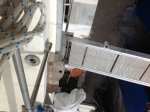
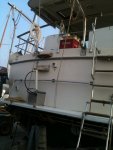
The hydraulics were easy. Once I realised that the system operated at 1500 psi or thereabouts and bought a decent valve to control the flow to the double action ram. The main tasks were finding the optimum placing of the fixed passerelle pivot on the transom, the best angle for the ram to give the up down movement over a 45* angle and the height of the steel support box for the ram which also houses the pump, solenoid valve and a small reservoir. I would like to say it was all planned out and calculated in detail, in fact it's all suck and see based on scratchy drawings. If it works good, if not try something else. And so we tried something else. The pump I brought out worked fine but was slow in operation. Adam the local engineer, who was helping me, had other thoughts and turned up with a salvaged trim pump pack for a 300 hp outboard. Once fitted with this "new" old pump the hydraulics worked much better. We agreed to swap pumps and we moved on.
The use of gas struts was not easy. The initial configueration was "up and under" ie as the fixed part of the passerelle was raised the extension fell from and extended from under the fixed section. What I learned is that the force applied to the lift is not linear. I know its obvious after the fact but I only believe what I do and see. When fully compressed the struts offer terrific force but as they extend the force falls away. The result is that when the hydraulics are engaged to lower the Passerelle, the struts easily swing the extension from 180* which is the natural resting position up to around around 50*. This means it does not have the power to lock onto the mounted part of the passerelle which may be at 60*. It's these last few degrees wherein the compromise lays. It would be nice to have the extension snap into the mounted section, but the additional force required is beyond the struts. We explored stronger, longer struts and alternate placing strategies but the original idea has proven to be the best compromise.
The eureka moment happened whilst sitting on the aft deck of a friends boat watching another boats passerelle smash against the harbour wall during a slop. Because it was configured as "up and under" the energy generated was being transferred onto the boats transom because the passerelle could not absorb any of the energy. I then realised that I was working on the wrong premis and my passerelle should be "up and over" ie the extension laying on top of the fixed section and swinging over and down. That way any pressure on the extension would cause it to swing up and out of harms way. This required the inversion of the centre hinge. Not rocket science but requiring some heavy work with a club hammer.
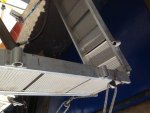

When leaving all we have to do is raise the fixed part hydraulically up to 15 degrees off vertical. The extension is raised and then falls naturally back onto its resting position in a controlled manner, the momentum taken up by the struts. To reduce rattles etc I will just tie a line around the end of the extension to squeeze it against the fixed section. When we arrive the hydraulics lower the folded passerelle to around 55 degrees from vertical. The gas struts then operate to balance the weight so it's an easy lift to flip it over and down. To improve the load weight and provide a safety margin I will be fitting a lip that sits across the two parts of the passerelle which will improve the rigidity.
To operate the system we have played with manual switches located on the helm, but I have just ordered from the US a four channel 12 volt 20 amp remote control which will enable us to control the the up down movements from anywhere on the boat. Cost £25.
So what I have is a 75% solution to the problem at a cost of less than 10% of a professional piece of kit. The hydraulic support to the fixed section provides a more stable and safer platform than the string driven precursor and it is no effort to step on and lock the extension into place, before charging the harbour walls to tie us on.
At the moment I am waiting for my engineer to machine the final fittings in stainless steel. During development we used mild steel to develop the fittings. Now we know what we're doing, every load bearing component will be in 316 Stainless Steel. All the will be fitted by the first week in September.
Ok for those who are seriously interested.
The initial system comprised
A double acting hydraulic ram from Flowfit on line for £140 (DA CYL 60/50/30/400). Hoses supplied as part of the deal.
A 12 vdc mid size hydraulic reversible steering pump bought on eBay for £50
A 12 vdc single acting reversible solenoid valve bought from Isis Fluid Control Systems for £100 (SV10-28-3B-N-12DG)
NB these units were swapped for the dedicated outboard trim pack, but it appears Flowfit have just launched a combined power pack comprising pump, reservoir, locking valves and remote control for around £150 so an easy fix for the next experimenter.
Two 200 Newton 400mm stainless steel gas struts bought from Force 4 Chandelry for £18
A remote 12vdc reversible switch and a small hydraulic reservoir salvaged from an 300 hp outboard. Free.
A pair of auto relays to control the flow of volts from battery to pump, heavy guage wire and the use of a spare 20 amp breaker on my 12 volt distribution board.
Control will be through the remote control from USA £25
Finally a 3 mm 316 stainless mounting box 300 mm cube, reinforced by 4 mm welded strapping at the point where the pivot for the ram is, made by my local fabricator for £200
Total parts outlay £700 +\- including bits and pieces.
The best part is that we will no longer terrify the yotties tied up stern to on the harbour wall. By the time they've realised what this unfolding drama means we'll be home and hosed, but we still don't expect to get invited round for drinks.
Ps I'm hoping Gary will invert my photos again. I still haven't figured out my iPads camera
The original system was the usual yotties approach of supporting the free end of the passerelle by means of string and pulleys attached to the boat at the quay end whilst having a single pin support on the transom or swim platform. Our complication was that being a high platform aft cabin the passerelle could be as steep as 45* from vertical in some harbours, which on one occasion enabled me to dust ski off the boat and spread eagle on the harbour path. Not the most auspicious arrival.
The solution was obviously an automated passerelle system. However when I researched auto passerelles I had to face three key issues.
The weight penalty of an auto system hanging off the transom would probably condemn the Bertram to a life of displacement boating and major reinforcement.
The location of the mechanics would either seriously impede on our aft cabin headroom or require 60% of our diminutive swim platform.
No way could I find the £8000 required to supply and fit a commercial system.
As I had just fitted new gas struts to the tailgate of my car it occurred to me that most of the heavy work on the passerelle could be managed this way. Thus enabling my wife to stand on the fixed part of the passerelle when approaching the harbour wall, warps in hand, and at the last minute pull on a rope to gently lift the extension into place, then stepping serenely down to tie us on. That was the theory.
The first job was to beef up the transom to take the weight of the passerelle and a fat elderly man carrying an overpacked suitcase. The aft cabin was torn apart to give access to the inside of the grp transom wall and one square meter of 18mm marine ply was epoxied into place. A new transom mounting was bolted through, located about 15" below the original to reduce the aft deck to quayside angle. So hopefully no more dust skiing. The load weight is spread between the swim platform and the reinforced transom through a SS box 12" cube which holds the pump and reservoir.
The hydraulics were easy. Once I realised that the system operated at 1500 psi or thereabouts and bought a decent valve to control the flow to the double action ram. The main tasks were finding the optimum placing of the fixed passerelle pivot on the transom, the best angle for the ram to give the up down movement over a 45* angle and the height of the steel support box for the ram which also houses the pump, solenoid valve and a small reservoir. I would like to say it was all planned out and calculated in detail, in fact it's all suck and see based on scratchy drawings. If it works good, if not try something else. And so we tried something else. The pump I brought out worked fine but was slow in operation. Adam the local engineer, who was helping me, had other thoughts and turned up with a salvaged trim pump pack for a 300 hp outboard. Once fitted with this "new" old pump the hydraulics worked much better. We agreed to swap pumps and we moved on.
The use of gas struts was not easy. The initial configueration was "up and under" ie as the fixed part of the passerelle was raised the extension fell from and extended from under the fixed section. What I learned is that the force applied to the lift is not linear. I know its obvious after the fact but I only believe what I do and see. When fully compressed the struts offer terrific force but as they extend the force falls away. The result is that when the hydraulics are engaged to lower the Passerelle, the struts easily swing the extension from 180* which is the natural resting position up to around around 50*. This means it does not have the power to lock onto the mounted part of the passerelle which may be at 60*. It's these last few degrees wherein the compromise lays. It would be nice to have the extension snap into the mounted section, but the additional force required is beyond the struts. We explored stronger, longer struts and alternate placing strategies but the original idea has proven to be the best compromise.
The eureka moment happened whilst sitting on the aft deck of a friends boat watching another boats passerelle smash against the harbour wall during a slop. Because it was configured as "up and under" the energy generated was being transferred onto the boats transom because the passerelle could not absorb any of the energy. I then realised that I was working on the wrong premis and my passerelle should be "up and over" ie the extension laying on top of the fixed section and swinging over and down. That way any pressure on the extension would cause it to swing up and out of harms way. This required the inversion of the centre hinge. Not rocket science but requiring some heavy work with a club hammer.
When leaving all we have to do is raise the fixed part hydraulically up to 15 degrees off vertical. The extension is raised and then falls naturally back onto its resting position in a controlled manner, the momentum taken up by the struts. To reduce rattles etc I will just tie a line around the end of the extension to squeeze it against the fixed section. When we arrive the hydraulics lower the folded passerelle to around 55 degrees from vertical. The gas struts then operate to balance the weight so it's an easy lift to flip it over and down. To improve the load weight and provide a safety margin I will be fitting a lip that sits across the two parts of the passerelle which will improve the rigidity.
To operate the system we have played with manual switches located on the helm, but I have just ordered from the US a four channel 12 volt 20 amp remote control which will enable us to control the the up down movements from anywhere on the boat. Cost £25.
So what I have is a 75% solution to the problem at a cost of less than 10% of a professional piece of kit. The hydraulic support to the fixed section provides a more stable and safer platform than the string driven precursor and it is no effort to step on and lock the extension into place, before charging the harbour walls to tie us on.
At the moment I am waiting for my engineer to machine the final fittings in stainless steel. During development we used mild steel to develop the fittings. Now we know what we're doing, every load bearing component will be in 316 Stainless Steel. All the will be fitted by the first week in September.
Ok for those who are seriously interested.
The initial system comprised
A double acting hydraulic ram from Flowfit on line for £140 (DA CYL 60/50/30/400). Hoses supplied as part of the deal.
A 12 vdc mid size hydraulic reversible steering pump bought on eBay for £50
A 12 vdc single acting reversible solenoid valve bought from Isis Fluid Control Systems for £100 (SV10-28-3B-N-12DG)
NB these units were swapped for the dedicated outboard trim pack, but it appears Flowfit have just launched a combined power pack comprising pump, reservoir, locking valves and remote control for around £150 so an easy fix for the next experimenter.
Two 200 Newton 400mm stainless steel gas struts bought from Force 4 Chandelry for £18
A remote 12vdc reversible switch and a small hydraulic reservoir salvaged from an 300 hp outboard. Free.
A pair of auto relays to control the flow of volts from battery to pump, heavy guage wire and the use of a spare 20 amp breaker on my 12 volt distribution board.
Control will be through the remote control from USA £25
Finally a 3 mm 316 stainless mounting box 300 mm cube, reinforced by 4 mm welded strapping at the point where the pivot for the ram is, made by my local fabricator for £200
Total parts outlay £700 +\- including bits and pieces.
The best part is that we will no longer terrify the yotties tied up stern to on the harbour wall. By the time they've realised what this unfolding drama means we'll be home and hosed, but we still don't expect to get invited round for drinks.
Ps I'm hoping Gary will invert my photos again. I still haven't figured out my iPads camera
Last edited:

