Dinghy Davits

A lot of people don't like to tow a dinghy and warn against it. I have never done so and intend to fit davits to my 34 foot boat rather than try it.

Boo2

As long as you take the outboard and oars off, towing a rubber dinghy is rarely a problem on coastal sailing. We have towed one many hundreds of miles, sometimes in pretty rough conditions with minimal issues. Think flipped twice in 10 years, when very badly provoked - and simply hove to and flipped back with boat hook. You should try it before assuming it would be a problem.
But clearly there is some extra drag hence why interested in davits.
 
Yes me to, leave the "bung" out with the tender on a slight angle and it will naturally drain.

Covers are a pain, hard to put on and equally hard to remove, fill up with water and blow off in the wind. Did the idea come from America - but I have found chaps are the answer - in other words cover the tubes in canvas, but leave the centre section uncovered. This provides the required UV protection (not that it really matters in the UK), while leaving the floor exposed which doesnt matter anyway and allows the water to drain without a covering getting in the way.

Other things to think about with davits is a very easy and large pair of quick release carbines. Snapping the tender onto and off the wire especially in a swell makes a great deal of difference.

Whatever you do, dont opt for aero style floors. To pull up tight to the davits, fixing points in the floor are the only sensible solution. Alos think about the weight of tender and engine and loading of the davit. It is surprising how heavy some tenders are, never mind if you want to raise and lower with the engine attached.

I opted for a Ribeye especially because they are about one of the lightest tenders on the market with a solid aluminium floor. All up with a 15 HP outboard I think I am around 100 Kg.
 
Another vote in favour of davits.

Our boat is 39' and it was one of the best things we ever fitted. They are strong enough for the dinghy to be lifted with the outboard on and this means that we can be going ashore within seconds of picking up a mooring. Never mind the ten minutes, we just lower the thing and put life jackets on and go.

The dingy is an 3.6 metre Avon Airdeck and I usually leave the dinghy slightly down by the stern with the drain valve open if the dinghy is likely to catch rainwater.

We've never been surcharged for having the dinghy on the back. I've even taking to pointing it out to people, but they all shrug their shoulders and just charge us for the LOA of the boat. (So far!!!)
 
Most of the davits I've seen permit an angled out installation, is there a reason that won't work on your Centurion ?

Boo2
IIRC most makers prefer you to mount them slightly angledout such that the lifting tackles pull against each other, preventing sideways movement.

in our case the lift points on the dinghy are a through bolted eye in the bow floor and two eye bolts in the transom. We have a plastc covered wire 3 point lift 'harness between these with a S/S ring a little back from the bow to which one lift tackle is napshackled and the other one goes to a similar ring in the wire nearer the transom.THewire harnesis removeable but in practice just gets left in place on the floor. returning to the bot withthe dinghy it is easy to grab the tackles and clip them on and they then provide a very useful hand hold and teher to keep the dinghy across the swim platform whilst we exit (fairly) gracefully grabbing hold of the support struts as additional helping handrails. We leave the 3 gallon fuel tank for the outboard permanently strapped in the dinghy even if we decide themotor should be lifted up onto the pushpit mount braacket, for which task we have a single arm pivoting lifting, manual 'crane mounted on the aft deck although we have to drop the starboard aft quarter guardrails that side for ease of swinging the motor inboard as ours sits on it's bracket inside the pushpit and not overhanging the stern. The engine lift 'crane also doubles as a MOB lift device for the Lifesling, it has a 4:1 tackle that could be tailed over to a sheet winch if needed for extra ooomph if SWmbO were to lift me instead of leave me to the sharks!

extra design considerations: We had to fit a new ensign bracket, a clamp on one onto the davit cross brace as the original Benny positionon the pushpit was masked completely by the dinghy when raised up The new position does allow the requisite ( Stars and stripes, yuk) ensign to fly nicely and it has a fitted sunbrella cover for UV protection when rolled up andnot in use.. We did not relocate the stern light but many do need to, ours is still visible, albeit it lights the underside of the hoisted dinghy and might mask it from a high ship's bridge directly astern viewpoint although it would still see a bright white light and floodli t white grp transom. If we ever get to doing frequent night sails again I will relocate the stern light o onto a bracket on the davits. I have bought, but not yet fitted clamp on fishing rod holders that will go on the davit arms each side to stow our rods ready for andduring trolling, hopefully they will stand the loadof a big sportfish;) .. .
 
Most of the davits I've seen permit an angled out installation, is there a reason that won't work on your Centurion ?

Boo2

You may well be able to do this, but the problem with low narrow transoms like the one in question is that the dinghy overhangs the width so much and is so low that it hits the water if the boat is heeling. Another reason why davits are more common on larger boats with wider and higher transoms, like the Westerly mentioned earlier.
 
Interesting a couple of people mention the inflatable floor type dinghies. I started out with one of these. Unfortunately I found it a serious mistake. The biggest problem I had was finding a way of "fixing" attachment points for the davit wires. I tried various arrangments but could never pull the dinghy so that the tubes were tight against the davits. I also found that it even at the correct pressure it didnt plane as well as a rigid bottom.

As to the harness I still havent got this quite right. I have one attchement point just forward of the dinghy transom and one about three quarters way forward bolted through the floor. It works fine but the dinghy tends to rotate one way or the other rather than remaining parallel with the water as it is lifted. Its easy to hold it in position as its raised but I cant help feeling the trick is to have a "Y" shaped harness either on the front or back lifting point, but then I suspect there are problems winding the wire tight enough to the davit to support the tender on its side tubes?

BTW I changed the old outboard for a 20 HP two stroke and with a 3.2m Ribeye it seems just about the perfect combination in that it will now plane easily three up. Fine if you are happy to "poodle" in the dinghy but dont underestimate the amount of power needed to get on the plane, which does have its advantage if you are using the tender in earnest. I was only thinking of the lovelly anchorage around the back of Sark last year, but it is a fair old motor to the harbour, which is better than trying to haul the tender up the steps. You will know what I mean if you have visited.
 
As long as you take the outboard and oars off, towing a rubber dinghy is rarely a problem on coastal sailing. We have towed one many hundreds of miles, sometimes in pretty rough conditions with minimal issues. Think flipped twice in 10 years, when very badly provoked - and simply hove to and flipped back with boat hook. You should try it before assuming it would be a problem.
But clearly there is some extra drag hence why interested in davits.

I have had a dinghy airborne a few times in rough weather and an inflatable will take perhaps 0.5knots off your speed-quite a lot if you are not a fast sailing boat anyway. Also a tender with water in it gets pretty heavy. It is nice not to have to keep checking the tender is still there!
 
Most of the davits I've seen permit an angled out installation, is there a reason that won't work on your Centurion ?

Boo2

Being home-made I can make them in any configuration, so that would be no problem.

However, the problem lies with the lines of the boat. While most modern boats have wide transoms so as to accommodate stern cabins, older boats like the Centurion 32 were designed for IOR and have an overhanging transom that is quite narrower than maximum beam; they also often have tumblehome. The combined effect of all this means that there is a longer effective waterline when heeled and waves passing along the shipside remain very close as they move aft giving a better shape (as in more symmetrical) to the 'hole' in the water, which means 'better' performance. Unfortunately they also render any object that protrudes athwart-ships at the stern too close to the water.

(See also Tranona's post #28)
 
Some observations: we have davits on a 30-footer. We carry a 2.75 RIB with a 5HP mariner 2-stroke and external tank, so considerable weight.
The waterline changes radically when the rib is launched. The davits should be long enough to reach the centreline of the dinghy, offset strops are a bit of a nuisance. We have quick-release snap-shackles on the falls as the RIB will be our liferaft if required.
We are getting on in years and find the stability of the RIB overrides any inconvenience incurred.
You must get used to not turning your boat too soon in order to avoid hooking something with the dinghy!
Our boat is nice and fat-@rsed, so the Rib doesn't stick out too far either side, however, the large stateroom/aft cabin is susceptible to dinghy noise, both afloat (the chuckle of water on the hard chine) and suspended (creaking and squeaking - we have added old fenders between the davits and tube to alleviate). It needs to be cross lashed to stop sawing from side to side, which of course adds another level of thought to the quick-release system.
We had to move the aft nav light to where it could be seen with the dinghy stowed. We also added a SS wire HF aerial from the masthead to the pulley shaft of the "motor-end" davit, it's rarely connected to a radio, but acts to ease the strain on that davit.
IMG00045%201_zps41dhvutm.jpg

aerial takes the strain
IMG00043%201_zpsy2o9vhne.jpg

Aft light moved to top of davit
 
This photo shows why it would be difficult on my boat's narrow transom. Notice how different the shape of the deck is from modern boats of a similar size. That's me in the cockpit.

HPIM1385_zpsrlsck4r0.jpg
 
As long as you take the outboard and oars off, towing a rubber dinghy is rarely a problem on coastal sailing. We have towed one many hundreds of miles, sometimes in pretty rough conditions with minimal issues. Think flipped twice in 10 years, when very badly provoked - and simply hove to and flipped back with boat hook. You should try it before assuming it would be a problem.
But clearly there is some extra drag hence why interested in davits.
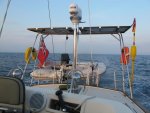
I had Avons over the years do a propellor imitation rotating (spinning) furiously until the painter was snarled and wrecked with kinks, then ione tried a tactic change and wiped out a pushpit mounted stern light flipping it to the deeps. Other times it just filled with water and was too heavy to right. AFTEr that I half deflated them and carried on the coach roof or fully deflated and lashed on deck in the bag or as he boats got bigger in a locker. Much better when we carried them fully inflated on the foredeck but some boats have a babystay in the way. Towing is a huge drag speed sapping/fuel wasting excercise. I had a nice little rigid pram dink very early in my career that frit me to death trying to join me in the cockpit crossing Poole bay one time in a blow, that was soon swapped out for an inflatable Avon Redcrest that at least was soft hearted if it chose to leap on board to hit me. I was very happy with the inflatable on the foredeck method and we could lift an launch even a Tinker traveller that way when we had one and the later Zodiac fastroller 2.85 was a doddle, even on my own with no halyard or SWMBO assist. Davits however are the bees knees and bog's dollocks combined IF of course you have a fat enough arse and wallet.
 
2014-07-26 19.53.39.jpg

I sometimes wish the davits were raised more above the deck, but I am guessing it would still have to be an enormous following sea to cause a problem.
 
Last edited:
Many years ago when we had a wW3 ketch we had an unplanned 100 mile downhill sleigh ride between L'Aberwrac'h and St Peter Port in huge seas, after many days of severe gales, with 50kts plus wind over our deck and we were doing up to 10kts SOG away from it. We were in company with another similar W33 ketch except that we were a fin keeler and they were twin keeler and they had a tinker tramp dinghy hanging in davits on the stern. They had no water get in the dinghy at all and no seas got close, they said even though there were breaking crests everywhere especially so in the periods when the tide was running hard into the wind. Until the I had been anti-davits but had my doubts overruled. Until that trip we had watched and envied them in several anchorages around Biscay in having their dink up and running ( usually launched by their kids) whilst I was still pumping away at ours and puffing and panting to boot..


FWIW I think the biggest risk to a breaking crest in the dinghy would be on a beam reach rather than a following sea and in the tale recounted above a beam sea was not a safe option at all, we would have rolled.
 
Last edited:
Not enough transom width on most boats until you get towards 40'.

Unfortunately I cannot because the transom is too narrow (Centurion 32) and Murphy now lives upside down on the foredeck, ready to be launched with the spi-pole serving as a jib (or 'sheer leg') the lifting / lowering being via the storm-jib halyard.

You may well be able to do this, but the problem with low narrow transoms like the one in question is that the dinghy overhangs the width so much and is so low that it hits the water if the boat is heeling. Another reason why davits are more common on larger boats with wider and higher transoms, like the Westerly mentioned earlier.
I can see that the height of the top of the transom matters (actually the height of the base of the davits but normally I guess that's the same thing) but not the width of it ?

Take my boat for example : transom top is ~36" above the waterline and transom width is also something like 36". Assume dinghy is 9' long (108") this gives it a semi width of 54" and is 18" deep.

At a yacht heel angle of 30 degrees the dinghy bows or stern will drop by 27" towards the water and at 45 degrees the drop will be 38".

The clearance from the waterline of the dinghy bows (or stern) is : transom height + davits height - dink thickness - dink bows drop.

For davits having 40" height the above gives 31" of clearance at 30 degrees heel and 20" at 45 degrees heel. The yacht transom width makes no difference as far as I can see, or am I missing something ?

Boo2
 
Interesting a couple of people mention the inflatable floor type dinghies. I started out with one of these. Unfortunately I found it a serious mistake. The biggest problem I had was finding a way of "fixing" attachment points for the davit wires. I tried various arrangements but could never pull the dinghy so that the tubes were tight against the davits.....

Not that I like inflatable floors, but...

The solution to securing ALL dingies is tricing lines. Even if there are good strong points, redudnancy is good. Just cris-cross a pair of lines tight under and up.
 
Top
