Dinghy camping around thr Thames estury ?

Rufuschucklebutty

New Member
Joined
14 Aug 2013
Messages
9
Visit site
I would like to do some Roger Barnes style dinghy camping but with a 10ft boat and Seagull outboard instead of sails, what are the waters around the Thames estuary like in the calmest of weather ?

I'm talking of short well planned hops hugging the coast that are well within safe limits
 
I have absolutely no experience of such behaviour, though a couple of lads from our club dinghied from the Colne to the Solent many years ago. There are numerous sheltered creeks and even some beaches with plenty of landing-places, so I would have thought it would be a doddle, if rather too hearty for me.
 
Calm or knot... tides can run at 3 knots, it could be worth keeping this in mind.
Not a problem in sheltered creeks and backwaters but personally would not want the be attepting to go up Sea Reach against any Ebb Spring with a 10 ft dinghy and that mighty 1.5hp smoke machine.
 
All sorts of opportunities..... fabulous opportunities as you go up the rivers of the Estuary. The Kent, Essex and Suffolk rivers have so many things to go. Buying a copy of East Coast Pilot will help even though it is designed for yacht use rather than camping. But you read all about each of those rivers. Crossing the Estuary does have some issues for a 10 ft dinghy. Getting and learning how to sail would be better - you would get through quite a bit of fuel otherwise or a bit of rowing! Settled weather of course.
 
I would like to do some Roger Barnes style dinghy camping but with a 10ft boat and Seagull outboard instead of sails,
I suspect Mr Barnes would raise an eyebrow at the juxtaposition of an outboard and his style of adventuring! I don’t know the area you are intending but worth taking a look at Donny Wilcox YouTube channel for small boat wild camping inspiration - both on board and ashore. He doesn’t do the Thames but the sort of kit he carries will give you ideas. He tends to use modern engines though - which might be wise if you are going to be in the middle of a shipping lane.
 
Consider something a bit bigger that won't tip you in (hopefully) with sails as well as outboard and will take a bit of rough water - which you can sleep aboard so not limited to finding somewhere to pitch a tent - read Charlie Stock's book 'Sailing just for fun' on his ventures with his wife in 'Shoal Waters' a 16ft boat with a small cabin and no engine - look maybe for something like a Leisure 17 or a Prelude but there are others.

Having said that, we do the creeks and would do the Backwaters happily with the 10ft dinghy but wouldn't go out to sea and probably wouldn't do the Blackwater as it gets quite lumpy.
 
Last edited:
Absolutely, go for it. My suggestion would be to forget "coast" it would be very boring and nothing to see. Think creeks and rivers. Even the Thames can feel like a motorway, with nothing to see as you are sunk down between the banks whereas a canal can have much better visibility.
Sitting at the back of the boat, by the engine ,twisted at through 90 or more so you can see forwards gets v uncomfortable quickly. Consider some arrangement so you sit in the middle, facing forwards but still able to steer.
My sailing started when my parents bought an Otter sailing dinghy (11'3" I think) with a Seagull and a pair of oars. The motor was used a couple of times as we soon realised sailing was quieter, faster, and much more fun. I did some camping trips in that, plenty of space
 
I'll add my voice to the guy saying that mud is the enemy. If it's muddy you need to arrive and leave on a high tide which means you're stuck anywhere you camp around 12 hours.

If you can find places you can get off the boat and camp then the creeks should be a joy to explore.

The problem I find around Chichester is that anywhere with hard standing is accompanied by development because, as far back as the Romans, they wanted to build where they had access to the water. Which makes wild camping a bit awkward, apart from sand/shingle beaches.
 
A friend of Roger Barns, Mary Dooley, used to camp cruise a Mirror dinghy. But sails rather than engine. She has moved onto a Scamp, specificly designed for such adventures. A Mirror was sailed from the Thames to the Black Sea.
If you could find one, a Wanderer is also designed for the job, at 14ft.
Having had several Seagulls, I would not want to go that route now. Great in their day, pretty reliable, but thirsty, smelly and noisey. A 2.2 Honda would be far better.
 
. A 2.2 Honda would be far better.
I used to have one 25 yrs ago when I dinghy cruised… the centrifugal clutch and no impeller And water passages to worry about blocking up were selling points. BUT it’s noise put me off using it. Not just the decibels but the tone. One thing using it for a 5 minute dinghy hop as a tender quite another for a whole afternoon.
 
Fred drift ?
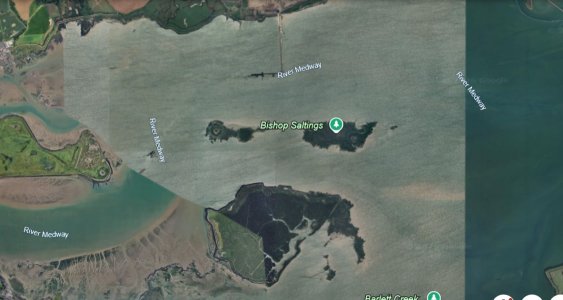
Folks have been known to camp on Darnett Fort on the Bishop Saltings in the Medway.
1777444951115.jpeg
Or
Hire one of the very comfortable chalets at Allington lock. Safe parking and handy slipway on site for that dinghy and explore up stream possible to go beyond Tonbridge.
A frequent trip for kayakers.
Home – Medway Navigation
 
I would like to do some Roger Barnes style dinghy camping but with a 10ft boat and Seagull outboard instead of sails, what are the waters around the Thames estuary like in the calmest of weather ?

I'm talking of short well planned hops hugging the coast that are well within safe limits
Recommend you try the River Blackwater. There are a number of places where you can land where there is not too much mud and a place to pitch a small tent (may not be legal as on private land but if discreet and considerate might get away with it, others have). Wherever you go, a big challenge will be finding a place to park a car and launch your boat without spending money. I beleive bradwell marina charge a fee for using their slipway with free parking..Have fun!
 
In my one attempt at dinghy camping many moons ago, we were made very unwelcome trying to camp at Brightlingsea, East Mersea and Bradwell.
Never wanted to repeat the experience. We bought a boat with a lid the next season.
 
There are a few places with sand or shingle, rather than mud. It tends to be particular odd corners, rather than whole areas. You will get to know - and look out for, these. (Once you have selected a river or limited area for a trip, ask on here and you will likely get advice where these are, and other useful suggestions.)

You will get muddy, and often! Be very wary of walking on mud. In some areas it is fine - if messy - but in others it is somewhat like quicksand, and you can be trapped as the tide comes in, or night falls. In days of yore, people had mud shoes (I can't remember the name) - boards or short planks tied to the feet (a bit like snowshoes without the holes) for walking on mud.

One of the characteristics of the East Coast is that there are relatively few towns or significant settlements actually at the waterside - they crop up almost anywhere where land is both a little higher than the marshes and close to a river. This is both to your advantage and disadvantage.

The land above the high water mark is almost all privately owned. Most of time you will be well out of the way and unbothered by anyone, but don't be surprised if occasionally someone asks you (more or less politely!) to move on if you are camping, out even just resting, ashore.

It is vitally important that you understand navigation and especially tides (including the effect of wind against tide), and that at the same time one side of, say, a sandbank or a river, may be benign and the other very dangerous. As the saying goes 'make the tide your friend' - use the tide to your advantage, and avoid as far as possible fighting against it. This is especially important given the small size (=slower) of your boat and even more so when rowing - you will be moving so slowly the tide will often be either a huge increase or huge reduction in your speed over the ground, or even prevent you making progress at all.

You say about doing this in the calmest of weather, but UK weather is usually very changeable. Rarely is it as settled as it has been the last week or so, and in the summer on calm days you will often get a strong sea breeze developing as the day goes on. Do study the weather forecasts and understand the general situation as well as the specific day's forecast in the days before you set of

The open Thames Estuary is hazardous, the distances involved/time taken, long fetches for the wind to build up waves, lots of sandbanks/shallows, shipping, fishing and workboats, strong currents. Just knowing where you are in relation to everything, in principle easy with GPS, or working out the optimal routes to save time and for safety (both often different from the shortest route in a straight line) is more challenging than it may any first appear. It is an interesting, challenging place and somewhat mysterious in character. Definitely best saved until you have built up experience in more sheltered rivers and e.g places like Walton Backwaters.

I recommend reading 'Sailing Just for Fun' by Charlie Stock. He travelled amazing distances all round the East Coast in a 17ft dinghy he'd put a cabin roof on (and inserted extra ballast for additional stability). No engine, just sails and oars. It is entertaining, but you will learn a lot about making the most of tides, winds, daylight, moonlight, etc.; the particular delights and challenges of the East Coast area; enjoying comforts in a small boat; and creeping up and down shallow creeks and inlets.

Less practically orientated, but hugely entertaining and also inspiring is 'The Unlikely Voyage of Jack de Crow' by A J Mackinnon. He sailed and rowed an 11 foot Mirror dinghy from a stream in rural Shropshire (or was it Herefordshire?), by rivers and canals across England, across the Channel to France, then through Europe to the Black Sea, having lots of adventures on the way.

Good luck. Have fun. Stay safe.
 
Last edited:
I can’t think of a quicker way of deciding that you want to be able to sail.

Having got that far, make a boat tent and sleep on the boat, either at anchor or ashore on the (probably muddy!) foreshore.

Saves a huge, huge, amount of wasted time and no worries about stroppy landowners.
 
I’ve spent many, many nights wild camping on the Stour, Orwell and Deben foreshores over the years and never been bothered or moved on. To the OP, I’d adhere to the “it’s better to beg forgiveness than seek permission” approach and just get on with it.
 
Top