Diesel engine bay insulation

raptorheli2

Active Member
Joined
13 Aug 2022
Messages
53
Visit site
Hi all,

I've had to pull the engine out my boat recently (volvo penta d3 190) for maintenance and whilst out I want to upgrade the sound deadening.

I've had a good search around but I can't find anything really similar to my needs easily.

Can anyone suggest what is a decent option for replacing 25mm egg box foam whilst the engine is out? I assume anything will help dampen it compared to this stuff but looking for anyone with some experience before spending.
 
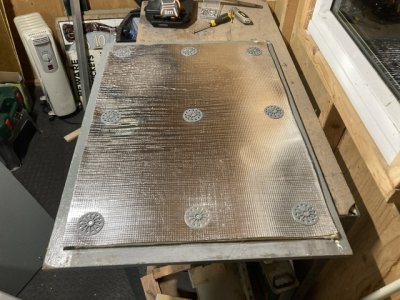
I replaced the egg box foam on the underside of the saloon floor panels above the engine bay during the winter. Having explored various options I went or Aquafon , which was recommended by ASAP supplies. I used the 27mm on the basis that the 30mm added weight for only a small increase in sound reduction.

The fixings that are supplied with it are pretty poor but I used insulation fixing discs and screws, which worked well. Overall it seems to do a good job.
 
did it make much difference to noise? I could try and put this over the current egg box foam stuff I guess without much penalty.
 
I got sound insulating panels in a heavy weight foam with a self adhesive backing to stick to the panels between the engine and the lazarette, for me weight was not an issue as I had to replace all the ballast in the boat and when balancing up the boat the extra weight of the panels would be off set with a very small reduction in ballast.
I got the panels through our local DIY store. they came in 1m x 0.5m size and 30mm thick

raptorheli2 said:
did it make much difference to noise? I could try and put this over the current egg box foam stuff I guess without much penalty.
A bit, the noise is noticeably less in the cockpit directly over the engine, I had the eggshell foam before
 
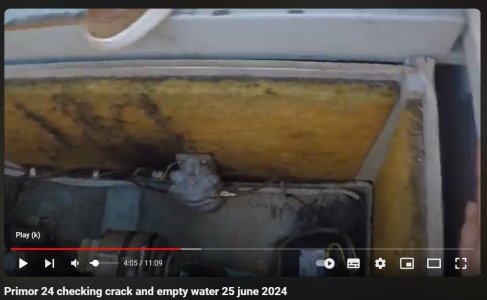
My mobo with a 6cyl 170HP lump in has soft sponge like foam bonded to the panels / bulkheads ...

Sound needs that soft style to absorb the sound waves .. stiff egg-box style will not deaden it .. on;y partially ...

insualtion.jpg

Still from the repair video showing the soft insulation ..
 
did it make much difference to noise? I could try and put this over the current egg box foam stuff I guess without much penalty.

Difficult to assess accurately as there was six months or more between using the boat with the old and then with the new sound insulation but I would say that the new stuff is better.

Not sure if installing over the egg box stuff would add value but if there is room I guess there is nothing lost in trying and in that case the provided fixings might work on vertical surfaces but you would need to get them behind the foam, probably by cutting a + and sliding one in (they are a square plate with a metal rod attached - the plate sticks to the bulkhead and the rod pierces the insulation and a fixing goes on the rod to hold it in place. NB the rods are too long and would need trimming).

I initially got a different type from ASAP and being local to them I opted to pick it up. It turned out to be very heavy and no good for what we wanted (underside of horizontal surfaces) but chatting with their technical advisor he was very keen on the Aquafon and said it was what they are recommending as the best option.
.
 
I went for rockflam.
Reduced the engine noise, also helps to contain fire on engine bay.
Can't give you an honest opinion because i haven't been using it long enough
 
Difficult to assess accurately as there was six months or more between using the boat with the old and then with the new sound insulation but I would say that the new stuff is better.

Not sure if installing over the egg box stuff would add value but if there is room I guess there is nothing lost in trying and in that case the provided fixings might work on vertical surfaces but you would need to get them behind the foam, probably by cutting a + and sliding one in (they are a square plate with a metal rod attached - the plate sticks to the bulkhead and the rod pierces the insulation and a fixing goes on the rod to hold it in place. NB the rods are too long and would need trimming).

I initially got a different type from ASAP and being local to them I opted to pick it up. It turned out to be very heavy and no good for what we wanted (underside of horizontal surfaces) but chatting with their technical advisor he was very keen on the Aquafon and said it was what they are recommending as the best option.
.
What thickness did you go for?
 
What thickness did you go for?

We went for the 27mm because the 30mm didn’t appear to provide much more in terms of sound reduction. Weight was a consideration because it was going to be hanging from the underside of the saloon floorboards.
 
I used jet engine test bay insulation...
Darned expensive stuff, sadly my source has retired, so I can't get any more for free.
( I received All sorts of left over off cuts.)
 
We went for the 27mm because the 30mm didn’t appear to provide much more in terms of sound reduction. Weight was a consideration because it was going to be hanging from the underside of the saloon floorboards.
Thanks you,
I ask the question, I'm doing exactly the same.

The current set up as a game a Jenga trying to lay 12 panels ply panels back in the same place they were lifted from......I've now made four, larger panels on rams and will cover them with holly and teak HPL once the strengthening timbers and noise insulation has been secured.
 
Thanks for sharing, may I ask what heads for the securing bolts are on the other (top side) of the sole and what thickness timber did you use?
 
Thanks for sharing, may I ask what heads for the securing bolts are on the other (top side) of the sole and what thickness timber did you use?

They are the original boards that previously had the egg box from type insulation, which I removed. The washers are each held in place with a single screw into the wood so no bolts. I can’t recall the thickness of the boards but I can measure when I get to the boat tomorrow.
.
 
Sound needs that soft style to absorb the sound waves .. stiff egg-box style will not deaden it .. on;y partially ...

It is a gross oversimplification to say that a soft style material that is needed. Also, every sound insulating material only partially 'deadens' the sound - the egg box style is not unique in that - the question is how partial.

Different frequencies require different material characteristics, but more fundamentally you are not only trying to 'absorb' the sound. Absorption is only one of the tools that needs to be deployed to maximise insulating effect, and is not even necessarily the most important one.

I'm no expert on sound insulation in boats, but I know fair amount about sound in other contexts. Sound is interesting, complicated stuff. High frequencies are very directional, but lower frequencies travel round corners, for example. Our ears, too, respond differently to different frequencies at different volumes.

Imagine you have a rock band rehearsing in the next room while you are trying to sleep or whatever. The first thing to do is to shut the intervening door. Then put draught insulation round the door to seal the gaps. Then put a screen between the band and the door to deflect the sound. Only after that would you put carpet down and close all the curtains in the band room to deaden the sound. Ideally you'd then move them out into an outbuilding so the sound wasn't coming through the walls.

For a boat you first want to reduce as far as possible any direct air paths between the engine compartment and the outside world/occupied spaces (while still allowing sufficient combustion air and cooling to the motor) - e.g gaps between panels, holes where equipment or fasteners have been removed.. The remaining air paths would benefit from e.g. convoluted paths, changes in area along its length, and deadening material on the surfaces (in turn likely to require an increase in area in order to avoid restricting the required air flow) to limit the sound escaping via that route.

Then having minimised as far as possible direct air transmission, the challenge is to reduce the transmission of sound through the structures of the boat - bulkheads, panels, frames etc. This is why serious sound insulation is heavy - it is to reduces the vibration of the panels etc. themselves, induced by the air vibrations in the engine compartment, because the vibration of those panels and structures will then project sound (vibrating air movement) on their other side, outside the engine compartment. (On a practical note, it is important that insulating panels are firmly fixed to the panels they are mounted on, and as far as possible over its whole area. (I'd want adhesive in addition to any fixing pins & washers.) The fixing is not just to prevent the insulation falling into the bilges, but importantly to deaden the vibration of the panel - the better it becomes part of the panel, the more effective it will be.)

In principle, you could do without any sound 'absorption' material inside the engine compartment if you could just make the structure around the engine completely rigid, but in practice you can't, so you also apply material that will do one or both of two things. One is to reflect the sound, which will (especially effectively if the shape of the engine compartment is irregular), over time break down the soundwaves. The other is to 'absorb' it, and this would ideally be done by multiple layers of different materials, each aimed at a different part of the sound (and sub-sonic) spectrum.

The ideal sound insulating materials would be very heavy and very thick, and very expensive. Unfortunately we don't have infinite space, weight carrying capacity, and money to spend, so manufacturers come up with practical compromises to suit different pockets. These are informed to a greater or lesser extent by serious research.

If all else fails try earplugs. (I wear them in the car on long journeys!)
 
Last edited:
Top