Deck reinforcement for an inner forestay?

  • Thread starter Thread starter prv
  • Start date Start date

prv

Well-Known Member
Joined
29 Nov 2009
Messages
37,358
Location
Southampton
Visit site
Not on this year's list, but at some point I'll want to fit the storm jib stay for which I added a mast tang while the rig was down. To help me decide when to do it (ie, how much time will need to be set aside) I want to get a handle now on what's likely to be involved. Rigging the stay itself is straightforward, I know what I'm going to use for that, it's fitting the padeye on deck for the bottom of it that I need some help with.

The boat has a modern-style anchor locker, sealed off from the accommodation. The aft bulkhead of the locker looks to be in about the right place for the padeye, so will form the basis of the necessary reinforcement. The trouble is, I don't really have a feel for how much reinforcement is likely to be needed. The boat (a 34' 1998 Maxi) is relatively lightly built, certainly compared to my little tank of a Crabber, and I don't want to be doubting the forestay attachment in the sort of conditions where I'm likely to need it.

The basic plan would be a pad-eye on deck, with an inverted L-shaped piece of stainless below with the pad-eye bolts through the short leg of the L, and the long leg against the anchor locker bulkhead and bolted through it. I'm guessing I should first add extra fibreglass to the bulkhead, and possibly the deck. I've done a certain amount of glassing by now, but none of it really loadbearing in this way. I don't have much of a feel for how much I need to add. The bulkhead only extends about 14" down from the deckhead, then it curves under to form a shelf in the locker and foot-room in the cabin. So it could stiffen the deck, but not directly transfer load down to the hull.

Any advice, rules of thumb, design principles, and photos of similar jobs are welcome.

Cheers,

Pete
 
The structural strength of the back end of an anchor locker sounds a bit suspect for this application.

The more common methods are to add a bulkhead or though bolt the lower end of the stay through through bow section with a stainless steel pad on the exterior.

An epoxy resin should be used for any bulkhead as the tension will be great, and using a standard resin may not be strong enough.

Good luck and fair winds. :)
 
The below information was from another post I made. The design information is from the quoted reference.

....... For backing pads under the deck use a pad thickness that is 4 times the mounting bolt OD; width / breadth of the pad should be approximately 10 times the deck thickness. This latter dimension is really for thinner decks, plywood pads, so you could reduce it for thicker decks.

The information is from The Boat Data Book, 6th Addition, Ian Nicolson, 2009, Adlard Coles Nautical.

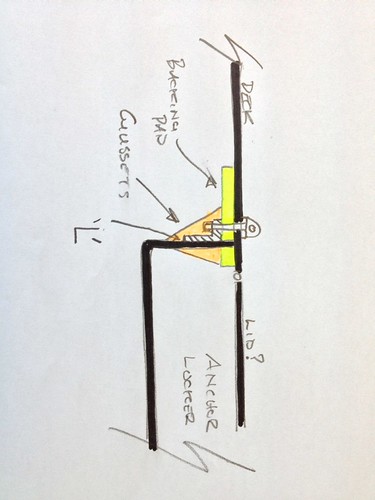
Perhaps a combination of the L and a load bearing backing pad on either side of the anchor locker bulkhead butted against the underside of the deck to stiffen the area overall. If possible the outside of the anchor bulkhead (in the anchor locker) could have triangular stiffeners of ply epoxy glued into place i.e. the short side of the triangle butting against the underside of the deck, the long side running down the bulkhead apex down. This could also be done on the inside as well. The idea is that you bring stiffness into the bulkhead through geometry (form stiffness) and resist any strain in the bulkhead which may be try to bend the bulkhead around its interface (hinge) with the deck.

My Rival 41C is cutter rigged and the inner forestay is connected to a U Bolt attached through deck to the backing plate only not quite as large as the dimensions shown. However, the deck is very thick at this point as well.

A quick sketch of the idea above is probably better: -

8530759222_a3fc6e6e38.jpg
 
Last edited by a moderator:
The idea of an L shaped bracket from under the deck to the bulkhead is a problem. You are just relying on the strength of the L bend ie it will tend to straighten out. You are fortunate in having the bulkhead. Rather than reinforce with fibreglass I would suggest two long stainless steel strips to carry the load down at an angle to the hull . ie one down to Port one to starboard. Bolt this to the bulkhead in several places. Now to transfer the load path from 2 strips coming together under the deck to a fitting of some sort is the question.
You could fit a large saddle under deck matching a similar saddle on top. Fit a shackle or better a bottle screw so there is no movement of the deck before the straps take the load. If you use a shackle and saddle, assemble the 2 then tighten the through bolts to get some pull down tension. Any support from underneath must have no give in it before it takes the load.
Or if you want to use an L shaped bracket then you need to get gussets welded in to triangulate to take load. I would still suggest straps downward rather than fibreglass. good luck olewill
 
Mine went through the deck with a more-or-less cosmetic plate and then continued through the fore cabin in straight line to a plate on the outside of the hull. The whole arrangement is in a dead straight line (and was a pain to make it so!).

Thus, there is no real load on the deck but probably (like the rest of the boat) it was an overkill.

On the other hand, we are talking about storm sails.
 
I agree with the comment that an L-shaped bracket is problematic. For attaching the stay (and tack) and transferring the load through the deck I would recommend the double pad-eye from Wichard, they have a matching saddle fitting for the under side of the deck.

http://www.ybw.com/forums/images/attach/jpg.gif

I also think that if you only anchor the load to the 14" bulkhead (and not down to the hull) you will have to accept some flexing of the deck, depending om the stiffness of the bulkhead and how it is bonded to the hull sides.

On my boat the inner forestay fitting is forward of the anchor box lid, just 40 cm or so behind the main forestay – so not quite comparable to what you intend. To anchor the load I used a turnbuckle, some dyneema string and two s/s eyenuts throughbolted either side of the stem:


I would also guess that in most cases it is not essential to continue the load path in a straight line from the stay, as the deck will be stiff enough in the horisontal plane. The important thing is to stop the deck from flexing upwards.
 
As was said an L shaped fitting is problematic.It'll tend to straighten up so needs gusseting and if the attachment point is too far off the line of the bulkhead it'll tend to pivot up stressing the bulkhead horizontally and putting unfair loads on the deck.
My own arrangement takes the load straight to the stem via a rigging screw inside the anchor locker.That's the ideal set up.In your case I think it is imperative to take the load down to the sides of the hull.To achieve that you should epoxy to the bulkhead a piece of ,say, 12mm marine (or exterior grade) plywood shaped like the bulkhead and then fiberglass it to the sides of the hull.As Oldsaltoz said use epoxy resin.Thoroughly abrade the area to be laminated.Use glass rovings only.
Two L shaped fittings can then be fitted,one inside the fore cabin and another in the anchor locker.This will distribute the loads evenly.To that a plate can be through bolted on deck to take the forestay rigging screw.The deck doesn't need to be beefed up.
In order to make it look pretty again in the forecabin just stick a piece of varnished 3mm or so plywood on top.
 
As OldBoots shows a gusset or some form of longitudinal support (T section) is necessary, as well as the lateral L. I would put a U bolt through the deck.
When I did mine, I was lucky as my stemhead fitting had 3 holes in it, so I could move the forestay to the forward hole and attach the inner stay to the aft hole, giving me a 6 to 8 inch gap between them.
 
Inner forestay re-inforcement

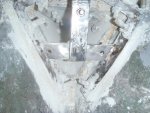
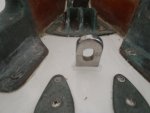
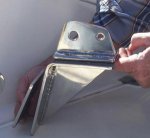
Not sure I have mastered the 'technology' for posting attachments......but if I have you will see a couple of photo's showing an anchor point I fitted for an inner forestay.
 

Attachments

  • P1180059.jpg
    P1180059.jpg
    96 KB · Views: 19
  • PC280035.jpg
    PC280035.jpg
    75.9 KB · Views: 16
If you're unlucky enough to to be in conditions that need the storm jib, there will be enormous tension in the inner forestay. You will want the stay tight in order to keep the luff straight to be able to get to windward. On top of that there will be the effect of 40? 50?? knots of wind on the sail. Like others on here, I opted to have a stainless bar made to carry the load, in a straight line, down to the bows, straight through and onto a plate on the outside of the hull which follows the curve of the bow.

Is the tang at the top of the stay on the mast very strong too? And presumably it is close to the masthead, or you have considered the bend it will apply to the mast?
 
Is the tang at the top of the stay on the mast very strong too? And presumably it is close to the masthead, or you have considered the bend it will apply to the mast?

Well, it's a Wichard fitting sold for the purpose, so I assume it's up to the job. It's within a foot of the aft-swept cap shrouds, which are what provide the main aft support for the mast (the backstay is very thin and more of a tuning control).

Thanks for all the other posts too. Good point about the web / gusset needed on the L plate. 30boat's suggestion seems the most practical given the layout of the boat.

Definitely a non-trivial job!

Pete
 
Well, it's a Wichard fitting sold for the purpose, so I assume it's up to the job. It's within a foot of the aft-swept cap shrouds, which are what provide the main aft support for the mast (the backstay is very thin and more of a tuning control).

Thanks for all the other posts too. Good point about the web / gusset needed on the L plate. 30boat's suggestion seems the most practical given the layout of the boat.


Definitely a non-trivial job!


Pete

The Wichard fitting is a good one and the placement on the mast seems ok,it's basically what I have.Similar rig too.
 
Dufour routinely fit a Wichard double padeye to the deck just in front of where the rear wall of the anchor well is bonded to the deck. In these boats the anchor well wall is bonded to the hull right down to the waterline. They do this as a factory fit for an inner forestay as well as the downhaul for the spinnaker pole. The padeye simply has four penny washers to stop it pulling though the deck. The loads on an inner forestay are much lower than on the actual forestay. It is not there to keep the mast up. However, this system seems a little light weight and some have added a right angle bracket to ensure the padeye is bolted to the back of the anchor well as well as to the deck. I've no idea whether this reinforcement is necessary. I've never heard of a failure in boats with the standard factory fit but then not many people ever get to use their storm jib in earnest.
 
Dufour routinely fit a Wichard double padeye to the deck just in front of where the rear wall of the anchor well is bonded to the deck. In these boats the anchor well wall is bonded to the hull right down to the waterline. They do this as a factory fit for an inner forestay as well as the downhaul for the spinnaker pole. The padeye simply has four penny washers to stop it pulling though the deck. The loads on an inner forestay are much lower than on the actual forestay. It is not there to keep the mast up. However, this system seems a little light weight and some have added a right angle bracket to ensure the padeye is bolted to the back of the anchor well as well as to the deck. I've no idea whether this reinforcement is necessary. I've never heard of a failure in boats with the standard factory fit but then not many people ever get to use their storm jib in earnest.

I've used my removable forestay on several occasions admittedly with a jib, not a stormjib but the loads can be huge in higher winds .I certainly wouldn't trust such an arrangement.
 
This is all great discussion, and I would opt for one of two configurations:
1) for the inner stay aft of the anchor locker, I'd send the support down and out the bow.
2) or to avoid the need for running backstays, I'd opt for a slutter rig with a working job on a furler.
 
Top