Dead Saildrive; electrolysis? but why isn't the anode more damaged?

LostinFrance

Well-Known Member

Joined
21 Nov 2006
Messages
159
Location
France
Visit site
IMG_1665.jpgIMG_1664.jpgIMG_1660.jpgIMG_1662.jpgIMG_1659.jpg
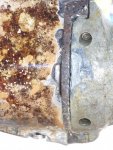
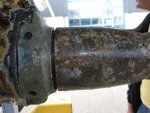
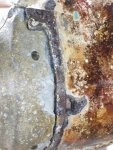
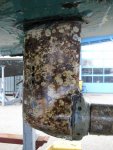
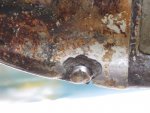
Not the best of sights to see on a Saturday morning, especially when it's your own boat. I've always been so scrupulous in replacing the anode every year and I can't understand why the saildrive is so buggered when the anode looks like it could be used for next year too!

Apart from the cost of replacement I'm trying to understand the reasons here; if anyone has some input of the useful kind I'd really appreciate it.

The boat was put back into the water late last year in June, the only thing I did differently to every other year is change the drain screw on the bottom. There was no apparent damage at this time anywhere.

It spent all year until now in the water, only occasionally on mains electricity.

I fitted a solar panel last year - possible problem?

I fitted a Galvanic Isolator to the mains inlet five years ago.

I did wonder if there was damaged caused when the sling from the crane wasn't removed from the water and, not noticing this, I wrapped the prop with it. I was wondering if it put strain around the bearing housing (where the metal is eaten) and cracked the alloy, making it easier to be attacked, but the area around the drain screw is also badly eaten.

The boat spent it's last two years in Holland, I don't know if this problem is more prevalent there. Unfortunately the boat is still in Holland, so it's not exactly next door to me to investigate further and I thought I'd better leave it all untouched in the (99.9% forlorn, I know) hope that the insurers might cough up.

Anyone know where I can get second hand S130's?
 
Forgive me, but is it that bad? I must admit that I find the photo's difficult to get a true picture from, but are you perhaps over reacting a bit? Others may have a different impression though.
 
What make is it? I went to purchase a replacement anode for our Yanmar SD last week and was told that Yanmar have withdrawn the old zinc anodes and replaced them with an aluminium alloy because the zincs were not performing well.
 
Forgive me, but is it that bad? I must admit that I find the photo's difficult to get a true picture from, but are you perhaps over reacting a bit? Others may have a different impression though.

Well it's not so bad that oil is leaking, but it looks bad enough for me not to want to trust it, but I'm interested in your opinion.
I had hoped that it might be repairable with the sort of liquid metal stuff you can get nowadays, but the problem for me is that I am due to take the boat back to it's home in La Rochelle very soon, and I don't want to find I've got a problem when I really do need the engine. I'm more of a wood man than metal engineering man.
 
What make is it? I went to purchase a replacement anode for our Yanmar SD last week and was told that Yanmar have withdrawn the old zinc anodes and replaced them with an aluminium alloy because the zincs were not performing well.

Thats interesting, but the make is volvo, the anode was some sort of generic, the name escapes me, as has the receipt.
 
Well it's not so bad that oil is leaking, but it looks bad enough for me not to want to trust it, but I'm interested in your opinion.
I had hoped that it might be repairable with the sort of liquid metal stuff you can get nowadays, but the problem for me is that I am due to take the boat back to it's home in La Rochelle very soon, and I don't want to find I've got a problem when I really do need the engine. I'm more of a wood man than metal engineering man.

FWIW Anything like liquid metal would only be cosmetic.
Personally, I would give it a good clean up, get rid of all the old paint and fouling (which is what makes the pictures difficult to "read"). Then either post more pictures here or (better) get somebody to have a look at it. It may just be surface pitting which isn't pretty, but it need not be fatal.
 
I see what you mean about the pictures, but the area where the drive shaft is fitted (behind the anode) has lots more than surface pitting, whole chunks of metal has disappeared leaving the internal fitting and rubber sealing ring visible, it's that area that is damaged, as well as this better picture of the drain plugIMG_1666.jpg, rather than the rest of the leg.
 
That does look worse!

Suggest you wait until Vyv-cox comes along. He seems to be our resident expert on these things and can be relied upon to give good advice.
 
You appear to have a nice example of galvanic corrosion, if that's any consolation! The saildrive leg is corroding in preference to the drain plug, and apparently to the anode as well, which is difficult to understand. There can be issues in fresh water due to changes in the galvanic series but I would be surprised if this would have such a major effect. The classic condition that causes saildrive corrosion is bridging the insulation between it and the engine/gearbox but this doesn't seem to be the problem here. I question the composition of the anode, either it may be zinc that has become inactive in fresh water, or there is something very odd about it.
 
It's as if the anode has become isolated from the leg. Could it have been coated with something that's remained on the internal surfaces?

I was also thinking along those lines, unless there is something very wrong with the anode composition.

With Nigel Mercier's sail drive problem in the back of my mind I am wondering if there is also an electrical issue on the boat which needs to be investigated.

What engine is it...... we need to know that before talking about insulation ..
 
It's a Volvo MD2030 with 130S drive. It's been in Holland for the last two years, I sailed (motored a bit as well) from the south through to the Isselmeer via the canal network last year . I'm wondering now if freshwater is the problem, although I thought that there was very little freshwater in those lakes now.
What I have had for the last couple of years is a discharge of about 0.2A showing on my battery meter even when everything is switched off with the main switch. I think I tracked this down (but never been able to fix it) to the engine circuit - I have house & engine circuits. I had a new fuel tank fitted and the guys fitted a fuel gauge which they linked to the engine fusebox (on the engine itself) and I noticed the light stayed on (hence the 0.2A discharge I guessed). This seemed to be overcome by turning the engine key which made the starter motor solenoid clonk, and hey presto the discharge and fuel gauge light went off. Potential problem? But this has been for three years now and I haven't seen any corrosion before this time.
 
There are quite a lot of cheap anodes for sale that simply don't work.
We see it quite often when owners want to save a few bob supply their own anodes rather than the McDuff ones we use and time and again they come out looking as good as new at the end of the season.

I have a Yanmar leg and even though Yanmar charge extortionate rates for spares I'll still fit theirs rather than cheap copies as its just not worth the risk.

As far as your damage I would grind clean with a flap disc or similar and coat with West epoxy with alloy powder as soon as you've degreased.
 
I With Nigel Mercier's sail drive problem in the back of my mind I am wondering if there is also an electrical issue on the boat which needs to be investigated...

+1
http://www.ybw.com/forums/showthread.php?339184-Saildrive-anode-and-corrosion
http://www.ybw.com/forums/showthread.php?343853-Volvo-Penta-Saildrive-isolation-how
http://www.ybw.com/forums/showthread.php?366165-Schr%F6dinger-s-cathode
http://www.ybw.com/forums/showthread.php?347803-Saildrive-corrosion-galvanic-isolation-and-grounding

Bottom line is I had a fault which was causing the saildrive to be connected to the boat ground. My corrosion looks almost identical to the pictures the OP posted, although my anode had gone.
 
Last edited:
This is my understanding. I had a saildrive for 20 years with no problems and always followed this maintenance.
The anode is to protect your propeller not your sail drive! You should have painted your saildrive leg with the right purpose made paint to protect the alluminium that your leg is made from. The anode should be protecting your copper-bronze prop from electrolysis. If your propeller is OK then it's doing it's job.
Have you been painting the sail leg with the same paint as your hull? If so you have been painting a copper based paint onto aluminium which would cause the damage.
 
Your prop is protected by the anode not the saildrive. You should have protected the saildrive by painting it with a special paint for aluminium. If you have painted it with you normal antifoul you will have accelerated the corrosion process.
 
Your prop is protected by the anode not the saildrive. You should have protected the saildrive by painting it with a special paint for aluminium. If you have painted it with you normal antifoul you will have accelerated the corrosion process.

Thanks for the reply , my biggest concern is the saildrive - but the owner of the boat yard is saying that the prop is knackered too as it doesn't ring when tapped - I've always been conscious of the problems of electrolysis and (as I built the boat myself from Van de Stadt plans) so I've always strived to do everything properly. The saildrive has never been antifouled except with the specialist spray on stuff, and the original volvo paint has never been removed. It's only been in the water for five years!
 

WOW thanks for your post, there is a lot there for me to think about and investigate.
 
There are quite a lot of cheap anodes for sale that simply don't work.
We see it quite often when owners want to save a few bob supply their own anodes rather than the McDuff ones we use and time and again they come out looking as good as new at the end of the season.

I have a Yanmar leg and even though Yanmar charge extortionate rates for spares I'll still fit theirs rather than cheap copies as its just not worth the risk.

As far as your damage I would grind clean with a flap disc or similar and coat with West epoxy with alloy powder as soon as you've degreased.

Thanks for your advice, I'm beginning to wonder about the quality of the anode, but more pressing is getting the boat back home; as the drive is not so damaged to leak, I'm tempted to do a repair and try it. It's just that I've got to go through some difficult waters where a motor is jolly useful if you get into trouble and my days as a "young lion" are a distant memory, if not a fantasy!
 
Top