Dangerously unintelligible VHF exchanges

I wrote legal documentation for many years. I don't like the way the COLREGS are worded. Here's my attempt. Comments welcome.

(3) X is within an arc of 67.5º

I was hoping someone would try this! Yes, one can simplify "abaft the beam" by measuring from the bow or stern instead (which was my thinking too). This attempt doesn't explicitly mention the measurement is from the stern, but only implies it by reference to the lights. It also reveals or introduces another wrinkle: particularly for very large ships, an angle measured at the bow or stern will differ from one measured from amidships (which is not necessarily the widest part either).

In any case, as mentioned above, there are a great many training aids available on the topic. Ignorance would seem to largely stem from ego ("I know what I'm doing, and how to not hit anyone!"); if one gets to the point of splitting hairs then mistakes have already been made.
 
Last edited:
Answered your own question really.

Either slow down and/or alter to stbd (including a full round turn if reqd).

Yep. I am no expert either. It was drummed into me that ColRegs are the rules, but even if you are Stand On it is still your responsibility to avoid a collision.
 
Many years ago I was working in the North Sea on a Norwegian survey vessel. One evening on the bridge the Skipper asked me to listen to a VHF exchange we were eavesdropping on. “What language is that? It’s not English, I don’t recognise it”, he said. I listened carefully and after a while said “I’m not sure, but I think it’s two fishermen working out of Peterhead” And so it proved to be :-)
 
I was making a passage past (not through) a danger area and two Range Safety Boats (Smit/Boskalis) were chatting away, on channel 16, about all sorts of things, not related to navigation. They were obvioulsy very bored. The chat turned to what takeaway they were going to get that evening. I butted in with a request for Beef with Water Chestnuts and the chat ended abruptly.
 
Many years ago I was working in the North Sea on a Norwegian survey vessel. One evening on the bridge the Skipper asked me to listen to a VHF exchange we were eavesdropping on. “What language is that? It’s not English, I don’t recognise it”, he said. I listened carefully and after a while said “I’m not sure, but I think it’s two fishermen working out of Peterhead” And so it proved to be :)

I had similar, anchored somewhere on the West Coast of Scotland. Middle of the night. Only boat in the anchorage. A fishing boat came in and anchored right next to me to sort itself out, the clanking noises were great and the floodlights lit up my cabin like daylight.

I really liked it, made me feel like a serious adventure sailor. It got even better when they started speaking Gaelic to each other over the noise. In my head I was Bill Tillman encountering strange cultures in a remote rocky wilderness.

it was a long while before I worked out they were speaking broad Glaswegian combined with so much profanity I hadn't been able to make out English sentences.
 
I was making a passage past (not through) a danger area and two Range Safety Boats (Smit/Boskalis) were chatting away, on channel 16, about all sorts of things, not related to navigation. They were obvioulsy very bored. The chat turned to what takeaway they were going to get that evening. I butted in with a request for Beef with Water Chestnuts and the chat ended abruptly.
Couple of friends on the way home were discussing the merits of a mutual female acquaintance. They were in the same boat, but the transmit button was jammed in. Since then I took to checking mine, often.
 
Couple of friends on the way home were discussing the merits of a mutual female acquaintance. They were in the same boat, but the transmit button was jammed in. Since then I took to checking mine, often.
A club I won't name, Solent area, some years ago, a few people were chatting on Ch37, similar subject, not realising they could be heard by about 15 clubs in the area.
 
I wrote legal documentation for many years. I don't like the way the COLREGS are worded. Here's my attempt. Comments welcome.

ORIGINAL
A vessel shall be deemed to be overtaking when coming up with another vessel from a direction more than 22.5° abaft her beam, that is, in such a position with reference to the vessel she is overtaking, that at night she would be able to see only the sternlight of that vessel but neither of her sidelights.
57 words, 306 characters

MY RE-WRITE
A vessel (X) is overtaking when:
(1) X is approaching another vessel (Y), and
(2) X is going faster than Y, and

(3) X is within an arc of 67.5º either side of the centreline of Y, so that at night X would see only the sternlight of Y but neither of its sidelights
54 words, 262 characters

I might chip in some thoughts on the use of ship-to-ship VHF later.
Isn’t your (2) quite unnecessary. How can you approach a vessel in front of yours unless you are going faster?
 
Isn’t your (2) quite unnecessary. How can you approach a vessel in front of yours unless you are going faster?
It depends what the reader thinks is meant by the word "approach". Like you I wondered if paragraph 2 is necessary but I left it in for clarity. But of course this is all a lot of nonsense really, nobody is ever going to ask any of us to re-write the COLREGS!
 
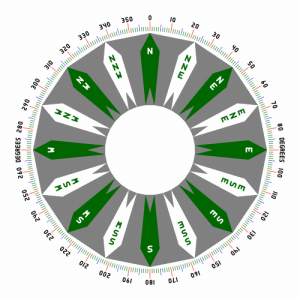
Took me a while to understand those odd looking angles until I realised they were the old 16 points of a compass. Abeam (90 degrees) plus another point (22.5 degrees) is, for example, ESE, ie 112.5 degrees. Sorry if that sounds daft but the relationship between the lights and the 16 points didn't occur until quite recently!

compass16.gif
 
Took me a while to understand those odd looking angles until I realised they were the old 16 points of a compass. Abeam (90 degrees) plus another point (22.5 degrees) is, for example, ESE, ie 112.5 degrees. Sorry if that sounds daft but the relationship between the lights and the 16 points didn't occur until quite recently!

View attachment 166989
It's one of those things that is really obvious when it hits you, but really hard to notice! I'm used to angular measures and so to me an angle of 22.5° is clearly a quarter of a right angle, but if you aren't used to thinking that way, the numbers don't make obvious sense.
 
Took me a while to understand those odd looking angles until I realised they were the old 16 points of a compass. Abeam (90 degrees) plus another point (22.5 degrees) is, for example, ESE, ie 112.5 degrees. Sorry if that sounds daft but the relationship between the lights and the 16 points didn't occur until quite recently!

View attachment 166989
Technically abeam plus 2 points.

One point is 11.25deg (or one 32nd of the compass).
 
Took me a while to understand those odd looking angles until I realised they were the old 16 points of a compass. Abeam (90 degrees) plus another point (22.5 degrees) is, for example, ESE, ie 112.5 degrees. Sorry if that sounds daft but the relationship between the lights and the 16 points didn't occur until quite recently!

View attachment 166989
Well, I learned something today. Great post.
 
With all due respect, I don't think all this blurb is necessary. "Overtaking" is not a difficult concept for anyone to understand unless, of course, you overcomplicate it, and then people begin to doubt themselves.
So IMHO if we just told people something simple like
"when you're overtaking another boat/ship you have to stay well away from it"
everyone would understand.
But it is not that simple. Lets say there is a vessel on your port side and you are converging and the faster vessel. If you are more than 22.5 degrees then then you are stand on. If you are approaching at less than 22.5 degrees the other vessel is stand on. So in laymans terms the faster vessel is over taking but under the colregs that is not the case because at more than 22.5 degrees you are simply a vessel approaching from Starboard.
 
Top