D12 high temp.. or false sensor reading

Similar base level problem on D12 800 with port engine on 2008 model sat in my SQ58, only really spotted end of last season when going to and from Sant Carles to Mallorca. Sits for hours at 1850rpm at about 85’c push it up and within maybe 10 mins 1900/2000 rpm point engine temp pushes past 90’c and alarm kicks in?

Slow down for 5mins, resume 1850rpm all fine for hours? I have noticed exhaust from port looks a little more obvious, let’s say a little more white/grey, enough to catch my eye? I’m thinking of descaling exchangers along with normal service stuff when I get there later this week, but now I’ve seen this thread it’s got me wondering too??
 
For what it's worth the volvo penta d12 user manual states that normal running temperature is between 75c and 95c.

It won't be a problem in the wiring between the ecu and the gauge, that section is digital, so will either work or it won't,it won't result in a wrong value, if its an increase in resistance in the wiring causing this it will be in the section of wiring between the sender and the ecu, or possibly in the sender to earth wiring.
 
Similar base level problem on D12 800 with port engine on 2008 model sat in my SQ58, only really spotted end of last season when going to and from Sant Carles to Mallorca. Sits for hours at 1850rpm at about 85’c push it up and within maybe 10 mins 1900/2000 rpm point engine temp pushes past 90’c and alarm kicks in?

Slow down for 5mins, resume 1850rpm all fine for hours? I have noticed exhaust from port looks a little more obvious, let’s say a little more white/grey, enough to catch my eye? I’m thinking of descaling exchangers along with normal service stuff when I get there later this week, but now I’ve seen this thread it’s got me wondering too??

Your problem is blocked heat exchangers, I get the same on a d4 every 3 or 4 years, mine runs rock solid at 85c until you go above 3000rpm, then the temp climbs to 90+. Cleaning the heat exchangers fixes it for another 3 or 4 years.
 
Your problem is blocked heat exchangers, I get the same on a d4 every 3 or 4 years, mine runs rock solid at 85c until you go above 3000rpm, then the temp climbs to 90+. Cleaning the heat exchangers fixes it for another 3 or 4 years.

Better watch some more You Tube and find out how to actually get to them?
 
What do you D12 , 11 guys get at marina movements after a run out ?
I get them dropping from 84/85 to 79 / 80 @ 600 rpm berthing up after a run ,
MAN inline 6 12,8 L so more / less same size
 
Never really paid much attention to marina movements after a run but what I do know is that when I’ve pushed to see how this portside overheat alarm plays is that just by dropping say 100rpm from 1850 is that it drops nice and steadily in like 2mins to 80’c, still doing 19/20nmh, i suspect probably keep dropping a little if I continued, as Julians said above 75-85’c is normal operating range But this alarm thing over such a small rpm range has intrigued me?

in my simplistic way of thinking even a a small blow on hot coals will turn them red, keep it going and it burns the hair from your chin....... suppose I’m kinda thinking that with all the widgets on mine and your engines other forces kick in to mitigate..... maybe it is just a good clean of the heat exchanges??
 
Mine run at between 75/80 at 1500 rpm 20 knot cruise push to 2000 rpm and go just over 80 deg never any higher than 85 these have just over 550 hrs on them.
Have you done the heat exchanger clean/flush or whatever?
 
Last edited:
Similar base level problem on D12 800 with port engine on 2008 model sat in my SQ58, only really spotted end of last season when going to and from Sant Carles to Mallorca. Sits for hours at 1850rpm at about 85’c push it up and within maybe 10 mins 1900/2000 rpm point engine temp pushes past 90’c and alarm kicks in?

Slow down for 5mins, resume 1850rpm all fine for hours? I have noticed exhaust from port looks a little more obvious, let’s say a little more white/grey, enough to catch my eye? I’m thinking of descaling exchangers along with normal service stuff when I get there later this week, but now I’ve seen this thread it’s got me wondering too??
I have s58 and it runs at 82 ish ( digital on the plotter). If fouled or exchangers messy a small rpm increase will result in a large temp increase. I would clean the exchangers. The temp rise you see is real.
 
Heat exchangers every time.
Take them off, strip down, rod through & descale.
Don't descale in place.
Last one I did had the bottom 20% of tubes blocked, this is where the water sits & deposits salts & scale.
New O rings! & pressure test before they go back on the engine.
I think Volvo state they should be serviced every 5 years.

These engines run on the cooling limit, slightest blockage & they will overheat.

The other day, had one where there was an overheat alarm going off randomly, just a little chirp now & then, gauge temps fine.

Check connectors on sensors, got to the temp probe in the exhaust, opened up the connector to check, wires had broken inside the cable insulation, where it flexes & vibrates.

Might save someone some time in the future.
 
I am certainly no expert on all this but reading the above it seems pretty clear to me that your engines are not overheating and the issue is the electronic signalling for some reason. If your engine is overheating ie the coolant getting too hot then you will see the coolant overflow in your engine room floor. With the temperatures you are recording you should be getting alarms and messages to stop the boat. If not then clearly I would think you are fine. Very disconcerting though.
I have s58 and it runs at 82 ish ( digital on the plotter). If fouled or exchangers messy a small rpm increase will result in a large temp increase. I would clean the exchangers. The temp rise you see is real.
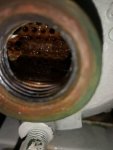
i believe also that if you find that as you a slow down to idle and you see the temps rising quite high then you for sure need to clean the heat exchangers. You can either acid clean them or open the end and rod clean them. This is what mine looked like at end last season 91F25B4B-7EA4-406C-9983-4F84909C7AFE.jpeg
 
I am certainly no expert on all this but reading the above it seems pretty clear to me that your engines are not overheating and the issue is the electronic signalling for some reason. If your engine is overheating ie the coolant getting too hot then you will see the coolant overflow in your engine room floor. With the temperatures you are recording you should be getting alarms and messages to stop the boat. If not then clearly I would think you are fine. Very disconcerting though.
PS As Starfire said I took them off and properly descaled them and checked the O rings and pressure tested them. It is quite a messy job but you should find that solves your problem. My s58 runs at 82 just like JRudge when clean and no fouling. With the block I had above the running temperature rose to 87/88 and if I pushed the revs to 2000 even higher. The big problem came when I slowed down to idle when the temps got really high for a while. I do mine now every three seasons at least.
 
Theses days I tend to wait until I see 60 on the gauges and digital read outs before getting it up on the plane .
To speed this up I push a bow wave at 1000 rpm . 5 mins tops after leaving the marina entrance .
After a day @ anchor in the Med heat they are already there for he return trip .

The sea temps play a small part , they are about 26 and rising where we are in the Med .

I suspect mine trickle down to empty at shut down ...the main coolers are pretty high up in relation to the WL .I can hear them trickle away if go in the ER after shutdown for up to 1/2 hr .Guess it depends on the final position of the impellers, The pumps are mounted very low just at or above the WL .The top of the strainer , the last inch is above the WL and after shutdown a air gap appears by next morning .Is say they are about 10 inches tall .At start up that gap under the perspex lid fills up solid to the under sides of the Perspex .
I guess the position of the cans is so I can remove the lid without sinking the boat ....if the seacock is jammed open ?
Or see the system by morning has drained down to the 1 inch below the lid level ?

My WoT or higher rev running shows no increase in jacket temps 84/85 , but the oil temps rise proportionally .

I mentioned the marina manoeuvres after a run out to maybe establish if thats another way of accessing the coolant system health without having to risk alarms / overheating at the other end ?

As said mine drop off loosing 4 or 5 degrees by the time I do my lines .
Thinking ( happy to understand) does that tell you the range headroom , span of the system?
So if mine started to not drop off when returning to a berth, stayed up at 84/85 then maybe the impeller vanes are loose / warn etc .
I have access to coolant inlet pressure on the pumps anyhow and do compare them , as with other stuff they rise and fall with the rpms and are identical.
Also got “fart pipes “ to give a little back pressure relief with the underwater exhausts .....so when untying the stern lines it nice to physically see / hear water trickling our at stern corners ......bit like when you turn your geny on .Theres always that nagging doubt , is the pump chucking water out , or is it just gas ?

Back to Op s problem ....he really needs to see the real temps one way or another , one day !
 
PS As Starfire said I took them off and properly descaled them and checked the O rings and pressure tested them. It is quite a messy job but you should find that solves your problem. My s58 runs at 82 just like JRudge when clean and no fouling. With the block I had above the running temperature rose to 87/88 and if I pushed the revs to 2000 even higher. The big problem came when I slowed down to idle when the temps got really high for a while. I do mine now every three seasons at least.
Arh the Idle rise ....thats what I was enquiring about ....interesting . Is that a better / safer prognostic indicator??
Saves an overheat incident ?

posts have crossed .
 
Last edited:
Arh the Idle rise ....thats what I was enquiring about ....interesting . Is that a better / safer prognostic indicator??
Saves an overheat incident ?

posts have crossed .
I am a technical buffoon so don’t follow my instinct generally ?. However my observation is that if when you see idle rise after running the boat hard or every time you start to slow to idle then there is something not right and usually it is the exchanger not working properly. For sure if you see coolant in your engine bay floor the engines have been too hot and the overflow has put it there. In my case at the end of last year my engines ran fine at my cruising speed ie 18 knots but the temperature rose from constant 82 where they normally run to constant 86/7. Then when I slowed to idle the temps rose above 90 which make me feel very uncomfortable. Took off the exchanger end cap and greeted with what you saw above. Now they run at 82 at my normal cruise speed and if I push to 2200 rpm rise to 86. So hopefully ok for another two years!!!
 
with my engine (VP D4) when everything is clean , the temps stay rock solid at 85C on the gauge (once up to temperature) , regardless of whether idling or hammering along at WOT (3500rpm).

I know when my heat exchanger is blocked because the temperature will go to 90C+ when running above 3000rpm. Even with a blocked heat exchanger it will sit at 85C all day as long as I keep revs below 3000rpm, but as soon as you go over 3000rpm with a blocked heat exchanger the temps start to go up.
 
Hello again..

I tried a test.. I dont know if it means something..

I was at 2300 wot.... 98C
Back to 1600.. 1200.. 900.. immediately.. 100C +!!

After that immediately I put neutral 1600... The temp fallen at 90C after some seconds!!!

Is it normal? I saw 100 because was heat soak? Or it means that the salt water isn't enough? And with neutral I sent a lot of water without the stress and the temp fallen..

One mechanic said that this means that the problem is impeller or water pump..
The other mechanic told me this is normal and all engines doing the same..

Your experience?
 
Hkikis ....I think we are going round in circles .
Those numbers are abnormal way out of range , too high.

Can you clarify if they are the gauge / dials of both sets ...fly and saloon ? Or one set ,presume fly helm ?
Or a laser / IR thermometer on the engines ?

Pity you can’t see “inlet water pump pressure “ to give an indication of the impellers health ?
 
To move forwards revisit post # 17 and buy a Infra red thermometer.

Volvo don’t fit “ inlet pump pressure “ measuring equipment .
MAN ( from approx 2002 do ) .Thought of you today as both sides of mine showed 2.4 bar at 1740 rpm .
Water temp was 84 each side , with sea temps now 28 in Liguria.
 
Top