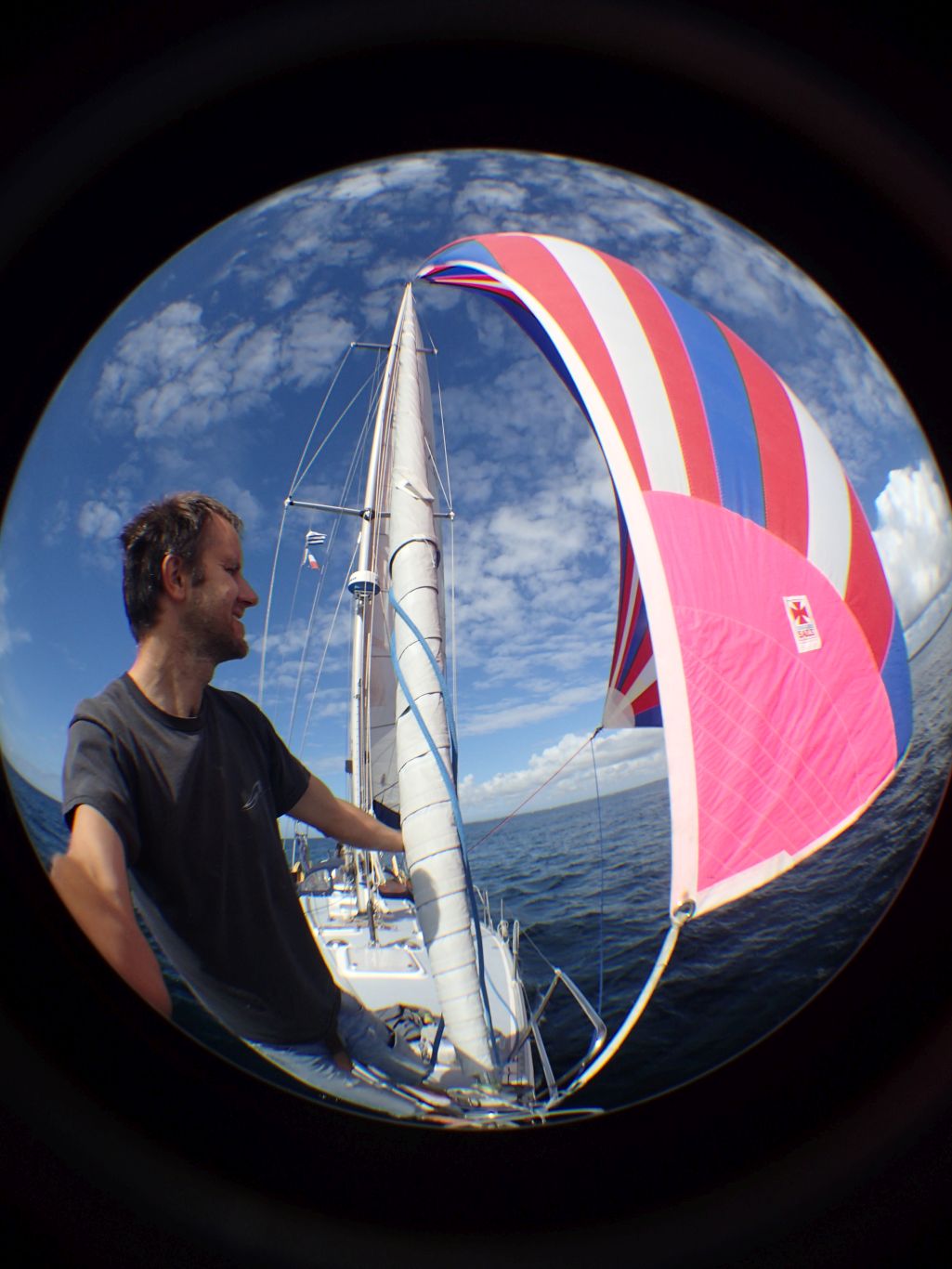
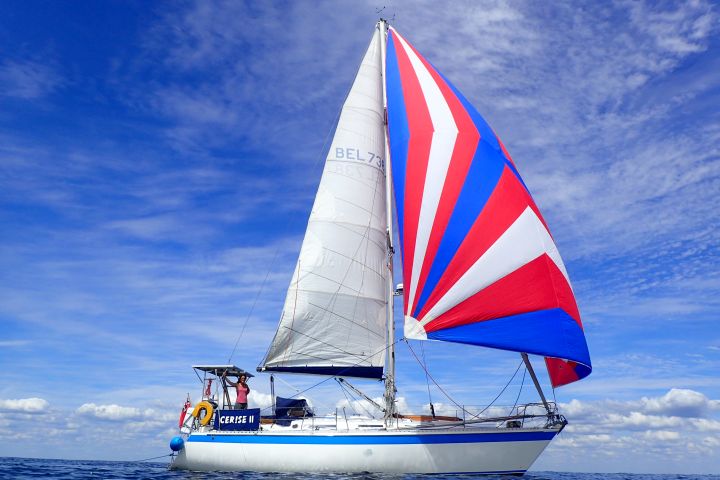
Cruising Chute

I'm a bit sceptical of tackers, I've have a few spinnakers moderately out of control in my time and I know how much a new luff foil costs. It's not designed tp be point loaded like that. If the forestay is slack, you risk bending the foil extrusion, if the forestay is tight, you risk putting a fuctun of tension on it with a big sideload 5ft up.
And it gains you what exactly?
 
Will look at adding to bow roller, should this be a fixed strop or pulley and line?
I’d be cautious about fixing the tack to a bow roller. You’ll first need to check that the roller is sufficiently well fixed to cope with the substantial upwards forces from the chute instead of the usual downwards force the roller is designed for.
 
The major pull is taken by the tack-line from the gadget to the deck. To bend a 12 metre hollow profile (that is supported axially by an 8mm tensioned forestay) through the application of a sideways pull (NOT a "point load" because the 'collar' is 15cms wide and is padded by the furled Genoa) that is applied 1,5 metres from its end would require quite a force.
What I "gain" is keeping the tack-line away from the pulpit. If necessary I can release the line from the collar so that it will go directly down from the tack to the round thimble that is just visible on the double strop, going round the lower rail but restricted from moving sideways by the vertical tube that joins the upper and lower rails of the pulpit.
 
Better than a snuffer is a top down furler but expensive

+1

My boat came with a snuffer, I used it couple of time single handed, then sold it on the the for sale section of this forum.

I found it much too dangerous to use single handed, requiring me to go on the foredeck with a big sail moving around.

I replace it with a top-down furler, once hoisted on the torque rope, I can handle a 2,000 sq ft asymmetric single handed with a top-down furler, without leaving the cockpit.

If a squall comes through, I can furl the asymmetric and leave it rigged, then unfurl it when it quietens down, or leave it rigged and furled until I'm anchored or back on the mooring. If the conditional are marginal, I'll furle the asymmetric when jibing, which reduces the chances of a tangle, it provides confidence I need to jibe the asymmetric, when I'd be reluctant to jibe, with a free flying sail.

Using the top-down furler on an asymmetric, gives me the confidence to use the sail frequently, whenever sailing off the wind, in light to moderate conditions, I didn't feel I could do that with a snuffer.
 
I’d be cautious about fixing the tack to a bow roller. You’ll first need to check that the roller is sufficiently well fixed to cope with the substantial upwards forces from the chute instead of the usual downwards force the roller is designed for.

Interesting thought. I only use mine in light airs but worth thinking about for insurance purposes if something does go wrong. Who'd be best qualified to make that call?
 
I’d be cautious about fixing the tack to a bow roller. You’ll first need to check that the roller is sufficiently well fixed to cope with the substantial upwards forces from the chute instead of the usual downwards force the roller is designed for.

We use the bow roller too but it's a good thought. It's the same fitting as the forestay so that should be fine but I should take a good look at the roller axle itself.
 
Me too! This is my version:

ZMfY0jS.jpg

Good pic. I was under the impression that no-one here had used the tacker-principle. Just wondering...is yours a symmetric or asymmetric?

I think ATN marketed the idea as a way of managing a symm without the pole. It can't offer as good a range of angles as the pole, but if it gets the sail in use on days when the singlehander doesn't fancy wrestling with the pole, it must be a good bit of kit to keep aboard.
 
Just wondering...is yours a symmetric or asymmetric?


Asymmetric.
Note that that the sail is mounted 'back to front' in the sense that the corner that is clipped to the tacker is the clew and not the tack (Note the angle of the sail corner). This was an experiment at my berth to see how the sail would set in case I wanted to sail downwind with the asy and the main used 'goose-wing'. It gives a 'horizontal' foot to the asy and this should avoid or reduce any tendency to roll. I think that it would work but I am waiting for spring to try it out.
 
Asymmetric.
Note that that the sail is mounted 'back to front' in the sense that the corner that is clipped to the tacker is the clew and not the tack (Note the angle of the sail corner). This was an experiment at my berth to see how the sail would set in case I wanted to sail downwind with the asy and the main used 'goose-wing'. It gives a 'horizontal' foot to the asy and this should avoid or reduce any tendency to roll. I think that it would work but I am waiting for spring to try it out.

Are the luff and leech of similar strength? I put a lot of strain on the luff when reaching and I'd worry about that strain on the leach - or would you reverse the sail if heading more up wind?
 
Are the luff and leech of similar strength? I put a lot of strain on the luff when reaching and I'd worry about that strain on the leach - or would you reverse the sail if heading more up wind?

That is a good point.
However, I believe that there is no difference in their construction, i.e., there is no 'luff line' or stronger tabling on the regular luff edge. At the moment I am at home because it is too cold outside (11 Co) for me to go down to the Marina.
 
Asymmetric.
Note that that the sail is mounted 'back to front' in the sense that the corner that is clipped to the tacker is the clew and not the tack (Note the angle of the sail corner). This was an experiment at my berth to see how the sail would set in case I wanted to sail downwind with the asy and the main used 'goose-wing'. It gives a 'horizontal' foot to the asy and this should avoid or reduce any tendency to roll. I think that it would work but I am waiting for spring to try it out.

But you don't sail with it back to front? And if so, what advantage does that give? Sorry if it seems a dumb question
 
But you don't sail with it back to front? And if so, what advantage does that give? Sorry if it seems a dumb question

On an asymmetric the luff and the leech are of different lengths, hence the name. The luff being the shorter of the two places the clew higher than the tack, which is fine for 'normal' sailing as in reaching.
As I explained in an earlier post (#28) what is shown in the photo was an experiment to bring the foot of the sail closer to the horizontal. This was done by reversing the 'clew' and 'tack' corners. The purpose of the experiment was the possible use of the asymmetric, flying on the opposite side of the mainsail, with both sails having their foot more or less level; my belief is that this could lessen any tendency to rolling when on a dead run.
I hope that I shall have the answer when the warm weather returns...

P.S. I do have a spinnaker but, since I usually sail solo, it is never used. No, I did not buy it; the boat came with two!
 
Last edited:
On an asymmetric the luff and the leech are of different lengths, hence the name. The luff being the shorter of the two places the clew higher than the tack, which is fine for 'normal' sailing as in reaching.
As I explained in an earlier post (#28) what is shown in the photo was an experiment to bring the foot of the sail closer to the horizontal. This was done by reversing the 'clew' and 'tack' corners. The purpose of the experiment was the possible use of the asymmetric, flying on the opposite side of the mainsail, with both sails having their foot more or less level; my belief is that this could lessen any tendency to rolling when on a dead run.
I hope that I shall have the answer when the warm weather returns...

P.S. I do have a spinnaker but, since I usually sail solo, it is never used. No, I did not buy it; the boat came with two!

Thanks. Sorry to misread the thread. I've no great expertise on this but believe barber hauling a foresail's sheet opens the top of the leech. That may help to reduce your rolling. Or maybe bearing off a bit on the great downwind tack. Just a thought. I've got both spinnaker and cruising chute but I don't use the spi for the same reason as you. With a son on board we've done it but the sons have other fish to fry nowadays so I'm generally a solo sailor.
 
Thanks. Sorry to misread the thread. I've no great expertise on this but believe barber hauling a foresail's sheet opens the top of the leech. That may help to reduce your rolling. Or maybe bearing off a bit on the great downwind tack. Just a thought. I've got both spinnaker and cruising chute but I don't use the spi for the same reason as you. With a son on board we've done it but the sons have other fish to fry nowadays so I'm generally a solo sailor.

Other way round
 
We were in a similar position with an asymmetric that came with the boat and no idea how it was rigged. (Not sure the previous owner ever used it.
First time we flew it was off the pullpit (in very light winds) took us 3 goes to get the corners in the right place. Corner marked T turned out to be for top not tack.
We now run the tack line from a ring on the aide of the bow roller through a loop on the pulpit so that it runs clear of the anchor. I can easily pull on the tack line by hand to take the load off this ring so I'm comfortable with the forces transferred to the pulpit.
We run the sheets through 2 blocks attached to the tow rail as far back as we can put them.
When you first hoist it just make sure your run all the lines the right way:
Lazy sheet round the front of the furler and tack.
If the spinnaker halyard is in the starboard aide and your hoisting on the port side the pass it round the front.

We keep the main sheeted in a bit more than ideal for the wind angle as we find this reduces the blanketing effect.

Just try it first in light winds and if it all goes wrong pull it back down, sort it out a d try again.

We don't have a snuffer and fly it with 2 of us. It is a bit of frantic sail graving getting it back down but works. Maybe worth trying at some point when conditions are benign in case the snuffer hangs up.

Enjoy flying it. Ours keeps us sailing when we would otherwise be going nowhere or motoring.
 
You can safely work out how to operate your spinnaker or chute without leaving your berth/mooring: It's common practice, when instructing on small keelboats, to reverse the boat on the mooring so that it is stern-to, then work away, raising and lowering the kite repeatedly. (Additionally a motorboat containing more trainees is tied alongside so that a number of people can participate). Light winds required!
This technique could be used safely with a bigger boat, the proviso being that the mooring should be robust enough. You can also do it on a pontoon if the wind is parallel to the pontoon, winding ship, if necessary, to get the wind aft.
Unlike a spinnaker, the cruising chute requires the wind to be at an angle to the stern. This can be achieved with the use of a bridle. With some nifty manipulation of two bridles you can simulate a gybe.
 
Last edited:
Top