Course to steer for crossing the channel

Rubbish.
You either have a navigation track which you want to follow make necessary adjustments to keep on that track or not. Letting the elements dictate where you go is not following a planned track it is just plotting the course you made good over ground. That is why you prescribe an S shaped course.

I understand your point of view and in some circumstance you are right. Depends on the situation. Remove all other considerations leaving just a course to steer to get to a destination and a full cycle of tide and the resulting current being on the beam.
Just by the basic laws of mathematics particularly vectors. The S is more efficient.
The significance depends on the relationship of speed of the vessel compared to the rate of drift.

Just a side consideration for a relatively slow vessel crossing a TSS. A constant course through the water is generally preferred over a constant course over the ground.
 
Don't forget to check that your predicted S-shaped course doesn't put you in a dangerous position.

At night I find it much easier to steer while reading the cockpit display (COG) than the compass (Heading), and so what I have done in the past is enter a series of 'virtual' waypoints along the calculated ground track. For each ~2 hour 'leg' you just have to aim for the next waypoint (have CtW on the display as well), and every so often check that your heading is correct.

This makes the helmsman's job really easy, but might well be overkill for a channel crossing.

Trust your calculations, and resist the temptation to deviate towards the straight line. It is disconcerting being swept at 45 degrees from the natural path.
 
Let's rephrase that. If I resubscribed to Navionics it can calculate a course to steer for me based on my location, time of day and destination?

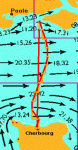
Assuming you meant 'can it' rather than 'it can' then no, as far as I'm aware - at least not one that will take tide/current into account. I still find it easier to do as CS suggests and go old school for tidal CTS estimation, still using ReevesFowkes too. The only addition I'd make to other comments is that I'll check my CTS at slack, usually about halfway when using the Needles channel. I use an hour by hour tidal proforma annotated with tide angle and strength so comparing my actual timings and position with the predictions is easy enough and adjust if necessary. Dont forget that tide is (quite a lot) stronger around the end of the Cherbourg peninsula and has some interesting eddies close in to the west.
 
Don't forget to check that your predicted S-shaped course doesn't put you in a dangerous position.

At night I find it much easier to steer while reading the cockpit display (COG) than the compass (Heading), and so what I have done in the past is enter a series of 'virtual' waypoints along the calculated ground track. For each ~2 hour 'leg' you just have to aim for the next waypoint (have CtW on the display as well), and every so often check that your heading is correct.

This makes the helmsman's job really easy, but might well be overkill for a channel crossing.

Trust your calculations, and resist the temptation to deviate towards the straight line. It is disconcerting being swept at 45 degrees from the natural path.

The COG lags behind course alterations, the compass doesn't. I really don';t understand how you find it easier to steer to a COG reading than a compass. I'd be looking at the visibility and lighting of the compass if it was hard to steer to it.

I rarely hand steer on passage anyway so its easy to glance at the compass now and again and make sure we are still on course.
 
Here's a simulated plot of a 12 hour trip mid-neaps-to-springs at 5 kts with a course of 180 degrees from the Needles
Note the tides are stronger on the French side.
ChannelCrossing.gif
In practice, I check my position about 2 hours out and recalculate a CTS
 
Rubbish.
You either have a navigation track which you want to follow make necessary adjustments to keep on that track or not. Letting the elements dictate where you go is not following a planned track it is just plotting the course you made good over ground. That is why you prescribe an S shaped course.

On a cross Channel passage, if you stick to a straight line over the ground, you are always, effectively making small course adjustments to 'fight' the varying tide.

Distance through the water will therefore be increased, and passage times longer than necessary.

It's more efficient, therefore, to do what most on here suggest. ie use a tidal stream atlas (or modern alternative), to plan a constant course to steer that deliberately describes an S-shape over the ground, but a straight line through the water (assuming it is clear of obstruction, of course),

Passage times and fuel usage will both reduce, though, as Tranona pointed out, the difference will be less noticeable if you can cruise at 20 knots, rather than 5 knots.

Anyway, it certainly ain't 'rubbish'!
 
Last edited:
On a cross Channel passage, if you stick to a straight line over the ground, you are always, effectively making small course adjustments to 'fight' the varying tide.

Distance through the water will therefore be increased, and passage times longer than necessary.

It's more efficient, therefore, to do what most on here suggest. ie use a tidal stream atlas (or modern alternative), to plan a constant course to steer that deliberately describes an S-shape over the ground, but a straight line through the water (assuming it is clear of obstruction, of course),

Passage times and fuel usage will both reduce, though, as Tranona pointed out, the difference will be less noticeable if you can cruise at 20 knots, rather than 5 knots.

Anyway, it certainly ain't 'rubbish'!

The OP originally asked if he should plot the S-curve in advance. In the unlikely event of me being asked to navigate a RN ship, this is something I might well do, but it is far too much hassle for general use, though, as has been said, I would look to see if my XTE, cross-track-error, took me into danger or somewhere I shouldn't be.

When crossing a shipping lane or TSS I would normally maintain a constant heading, irrespective of the COG.
 
The OP originally asked if he should plot the S-curve in advance. In the unlikely event of me being asked to navigate a RN ship, this is something I might well do, but it is far too much hassle for general use

Yes, I was replying only to the "rubbish" comment: like you, I've never plotted the s-curve in advance.
 
The OP originally asked if he should plot the S-curve in advance.

Aside from the benefit that such a curve would identify any possible obstructions (like the IoW) that the tide could theoretically sweep him onto, that is something I certainly wouldn't do "in advance". If he is half an hour early or late leaving, then out comes the eraser and a new curve has to be drawn. Likewise if the wind is stronger or weaker than expected (and hence boat speed not as per the plan).

Instead, I will work out the tidal flows in advance (often whilst still in port) and then, on arrival at my jumping off point - in my case either the Needles or Bembridge ledge - work out which of them will apply to my crossing and, from that, calculate the net tidal effect from that moment until my anticipated landfall time.

Too many variables to plot any curve "in advance".
 
Possible thread drift!

I was once told that the RN make hourly course adjustments to follow a straight line over the ground, rather than calculating a CTS to give a straight water track.

Does anyone know if that's true?

My Dad was a Navigating Officer in the MN (Royal Mail Lines) from the end of WW2 (on convoys in the Indian and Pacific Oceans) to mid-50's. He assures me that he and his MN colleagues would plan for an S curve.
 
Last edited:
The COG lags behind course alterations, the compass doesn't. I really don';t understand how you find it easier to steer to a COG reading than a compass. I'd be looking at the visibility and lighting of the compass if it was hard to steer to it.

Certainly the lighting on my steering compass is not amazing, but I think that the averaging effect (or "lag") of the COG display is actually an advantage. When steering through waves the heading constantly changes, and so as a helmsman you have to continuously maintain a mental average heading (spending as much time on one side of your line as the other). It should be possible to adjust the smoothing window for the COG display to give a responsive but stable value in most conditions, which personally I find reduces strain when hand-steering.

All this is irrelevant to the main topic, which is that the navigation for a channel crossing is not particularly taxing and should not put the OP off their trip.

Given that calculating a course to steer is not a massive task, I would suggest redoing it shortly before departure (e.g. the night before a morning start), using realistic speed estimates based on the up-to-date forecasts. By all means work out a plan in advance, but be ready to throw it out the window if conditions dictate (don't fall into the trap of thinking: I'll go tomorrow even though the forecast is better for the day after because I already have the tides worked out for tomorrow). Apologies if this is teaching you to suck eggs.
 
Certainly the lighting on my steering compass is not amazing, but I think that the averaging effect (or "lag") of the COG display is actually an advantage. When steering through waves the heading constantly changes, and so as a helmsman you have to continuously maintain a mental average heading (spending as much time on one side of your line as the other). .
I agree, and sometimes use means other than the compass to steer by. I have COG displayed ahead of me and sometimes this is actually easier than the compass, to which I would normally return from time to time if on such a passage. At night in boisterous conditions I have sometimes found that steering to the apparent wind was the only comfortable option.
 
Possible thread drift!

I was once told that the RN make hourly course adjustments to follow a straight line over the ground, rather than calculating a CTS to give a straight water track.

Does anyone know if that's true?

My Dad was a Navigating Officer in the MN (Royal Mail Lines) from the end of WW2 (on convoys in the Indian and Pacific Oceans) to mid-50's. He assures me that he and his MN colleagues would plan for an S curve.

A very good friend of my family. Got his 2nd officer FGN Certificate in 1939. He survived WW2 In the MN. He told me the never went in straight lines for very long. They Zig Zagged at random intervals by random amounts according to a clock. It made a days run to noon interesting. Station Keeping in a convoy required close attention. Especially at night when they were all darkened. The ship ahead would tow a marker they kept in sight.

Station keeping and the timed Zig Zaging was extremely important they would continue with this procedure even when the convoy was under attack. When a ship ahead of him was hit they would have to continue around it a regain their station. They were forbidden to stop or alter speed or course expect for emergency.

I would doubt the RN had such a precise policy. The frequency of positions and the determining of course to steer would depend on where they were. And what was appropriate at the time. The only RN ship I have ever been on the bridge of is HMS Belfast and its moored on the Thames. Even so I would imagine an RN ship keeps as accurate a plot going as they can with the best information available at the time.
Again if there was a fleet. station keeping might well take priority over specific position or course over the ground. Provided the ship was in safe water safe navigation would take priority over station keeping. Though of course there is the urban myth about the whole fleet going aground.

I wouldn't like to dispute what your dad said. I would say the topic of the S tide discussed by this thread is coastal navigation. Offshore crossing oceans tidal currents not an issue. Ocean currents were not predictable enough back in those days so rather than steer to offset the ocean current most navigators would use a simple DR and put the difference down to current or leeway. So is not so much an S just a curve.
 
Last edited:
I tend to wait until I'm clear of the Needles, stick the boat on a 190 track and then go downstairs, put the kettle on, and do any tide cals or whatever. At least then you have an accurate starting position and time. As Angele says, you can spend hours planning and plottin beforehand, and then find that your wife spends longer in Waitrose than you expected.
 
I wouldn't like to dispute what your dad said. I would say the topic of the S tide discussed by this thread is coastal navigation.

Thank you for your thoughts!

I may have misled by mentioning convoys.

I was asking my Dad, in response to this very thread, how he would have planned a cross channel passage.

On some of the old coal burners, his plans were based on average water speed of 5 knots, so his approach was much the same as mine now.
 
Aside from the benefit that such a curve would identify any possible obstructions (like the IoW) that the tide could theoretically sweep him onto, that is something I certainly wouldn't do "in advance". If he is half an hour early or late leaving, then out comes the eraser and a new curve has to be drawn. Likewise if the wind is stronger or weaker than expected (and hence boat speed not as per the plan).

Instead, I will work out the tidal flows in advance (often whilst still in port) and then, on arrival at my jumping off point - in my case either the Needles or Bembridge ledge - work out which of them will apply to my crossing and, from that, calculate the net tidal effect from that moment until my anticipated landfall time.

But as part of calculating the net tidal effect you presumably generate a series of offsets - pushed 3 miles west this hour, 2 miles east that hour, etc? If so, it's then hardly a chore to pick off these distances from the rhumb line and pencil a little cross at each.

I tend to wait until I'm clear of the Needles, stick the boat on a 190 track and then go downstairs, put the kettle on, and do any tide cals or whatever. At least then you have an accurate starting position and time. As Angele says, you can spend hours planning and plottin beforehand, and then find that your wife spends longer in Waitrose than you expected.

I do exactly the same. A cross-Channel trip always starts much the same for us - set off in the middle of the day after everyone has arrived, stowed their kit, provisioned the galley, etc etc. Sail from Southampton down to the western Solent and anchor for the night either outside Keyhaven or in Totland or Alum Bays, depending on the wind direction. Set off first thing the next morning, leaving the cook in bed. Any lumpiness as we go over the Bridge wakes him up to start frying bacon, and a sandwich generally appears out of the hatch shortly after we pass the fairway buoy. By the time I've eaten that, I've gained an idea of what sort of speed we can expect at least for the first part of the passage, and I'll go down to work out the proper course while he comes on deck for a fag.

Pete
 
Possible thread drift!

I was once told that the RN make hourly course adjustments to follow a straight line over the ground, rather than calculating a CTS to give a straight water track.

Does anyone know if that's true?

My Dad was a Navigating Officer in the MN (Royal Mail Lines) from the end of WW2 (on convoys in the Indian and Pacific Oceans) to mid-50's. He assures me that he and his MN colleagues would plan for an S curve.

It very much depends on circumstances, but I have been on ships where we kept to a predetermined track (with bubble times) to ensure that we arrived at port x or spot x at the exact time arranged. I have also been on ships where the OOD was required to 'stay inside this box and avoid using more than so many degrees of helm' (The latter to ensure that everything didn't go flying as we made a handbrake turn.)
 
Top
