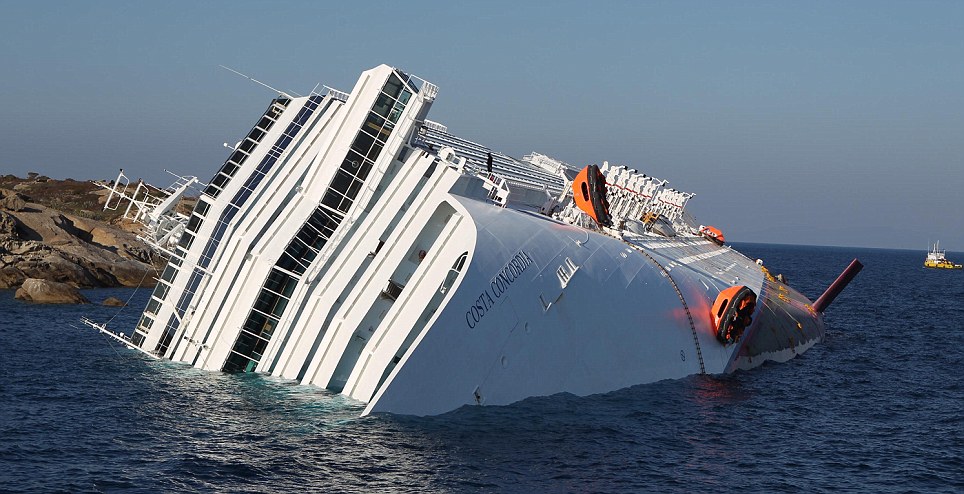
Costa Concordia (Titanic 2012)

The latest seems to be 2 people found alive, trapped inside; problem getting to them, presumably that will be overcome.

40 people still missing.

Captain charged with multiple manslaughter and abandoning ship while passengers still in peril.

Must have been absolutely terrifying.
Still doesn't seem the ideal way of getting the best co-operation from the captain, surely that can wait until the rescue is complete?
 
The story of dropping the port anchor to spin her seems to be true; looks like the chain leading over the side -

article-2086527-0F75B20E00000578-975_964x494.jpg
 
A friend just posted this in Another Place:

Same ship, same place, same time of day, last year...

http://video.corriere.it/nave-concordia-al-giglio-/9dfa5ea6-3e9b-11e1-8b52-5f77182bc574

It may be horribly simple.

Don't know how close to shore in that video but my theory at post #61 is looking a distinct possibility.

Possible sequence? The skipper intended to run up parallel to the east coast of the island, leaving both islets to port. Looks like plenty of deep water there. From the previous course of ~280 that would have needed a starboard turn of approx. 70 degrees (by eye). Somehow that was entered as a 50 degrees turn, heading for the inner islet, then by the time it was noticed it was too late to stop or avoid so he turned a litle more to starboard in hope he could "shoot the gap".

If you look here http://www.seanews.com.tr/article/ACCIDENTS/74284/Costa-Concordia-accident-navigational-error/, the point where that starboard turn was made is just about the right place for a clear run parallel to the coast and as close to the harbour as you would get on a straight line track right up the coast, leaving the islets close to port.
 
Last edited:
If you look here http://www.seanews.com.tr/article/ACCIDENTS/74284/Costa-Concordia-accident-navigational-error/, the point where that starboard turn was made is just about the right place for a clear run parallel to the coast and as close to the harbour as you would get on a straight line track right up the coast, leaving the islets close to port.

I am not sure where that .tr site took the route from.
1) marinetraffic.com shows waypoints that aren't fine grained enough to determine such route.
2) witnesses accounts apparently put the ship to the East of Le Scole which means the ship did not go through the narrow channel.

The fact is that:
(a) The ship and crew did that "sail-by" as a routine part of the cruise entertainment package.
(b) Depths in the area change rapidly, within a few meters, from safe to shallow because of underwater steep cliffs (I dived at that Island and it is like facing underwater vertical walls). This allows for (a) with low risk.

So my theory is that:
1) they had the route programmed into the Autopilot.
2) the officer(s) on the bridge relied upon GPS and Autopilot as they probably have done several times before
3) because of (2) and (a) their confidence made the officers sloppy
4) an unusually large GPS error and (b) took them off course just beyond the safety margins that they must have calculated and programmed. The error was sufficient for the ship to hit the rock that has always been there, only this time it was a lot closer. Too much closer. Alternatively sloppiness or distraction delayed reducing speed for the turn and sail-by, thus causing a larger turning angle (they were approaching at 15.4 kts).
5) When the bridge realized that they were too close, they disengaged the Autopilot, but it was already too late to correct, which explains why they hit aft.

My speculation is that (3) is possibly the main cause of the accident which is inexcusable because even the most inexperienced skipper knows that he cannot rely on GPS 100%.
 
Last edited:
Not very Titanic like, is it? From the headlines in the British Press one would think that the vessel was in the Atlantic and had hit an iceberg with great loss of life.
 
The president of Costa Cruises, Gianni Onorato, said the main task for the company was now to assist survivors and help repatriate them.

He said it was difficult to determine what had happened, but that the ship had experienced a blackout after hitting "a big rock".


That somehow does not ring true when you see the photos earlier in this thread with the lights blazing well after the collision.
 
haydude,

I can't imagine this 'sail-by' was part of the entertainment package, even if any of the passengers were looking outside, they wouldn't have seen anything.

The spectacle was the ship herself, seen from ashore.
 
Those who know him (I've just met him briefly) speak very highly of Onorato. In the industry we say that a ship has blacked out when power to the board from the main generators is lost.

With a hole that size in the engine room, she will have blacked out for sure, but the emergency generators, which are not located in the engine room, will have started automatically.
 
haydude,

I can't imagine this 'sail-by' was part of the entertainment package, even if any of the passengers were looking outside, they wouldn't have seen anything.

The spectacle was the ship herself, seen from ashore.

No need to imagine, that is from the accounts of officials. The Island itself also is quite a sight illuminated at night. They do not use dull yellow lights like in the UK there.
 
Top