Ian_Rob
Well-Known Member
When changing the coolant on the sealed side of a Volvo D1-30 is distilled water recommended or can I just use tap water?



I find this interesting as Anti-freeze or Coolant as some like to call it has 'cleaners' etc but of course really bad water can cause sludge.
But also I think it relevant that many engines use same waterways for raw water cooling as they do for closed systems ... the difference being that raw water cooling is recc'd to be lower temp to reduce salts / crud buildup in the waterways ..
Personally - why put in water when pre-mix is cheap enough ?
I'd be surprised if UK tap water has enough dissolved solids to cause a problem. This is a sealed system with periodic changes, not a boiler with a continuous supply where scale could build up.
Unless things have greatly changed "UK tap water"is very very far from being a homogenous and defined mix.I'd be surprised if UK tap water has enough dissolved solids to cause a problem. This is a sealed system with periodic changes, not a boiler with a continuous supply where scale could build up.

Yes, tap water is far too high in contaminants to use in sealed systems. It is not so much lime build up as interference with corrosion inhibitors. (This was my career for a while) Coolant water standards are just about as strict as battery water. This is the REASON coolant switched to pre-dilute--nearly all customers were using tap water instead of the specified water.I'd be surprised if UK tap water has enough dissolved solids to cause a problem. This is a sealed system with periodic changes, not a boiler with a continuous supply where scale could build up.
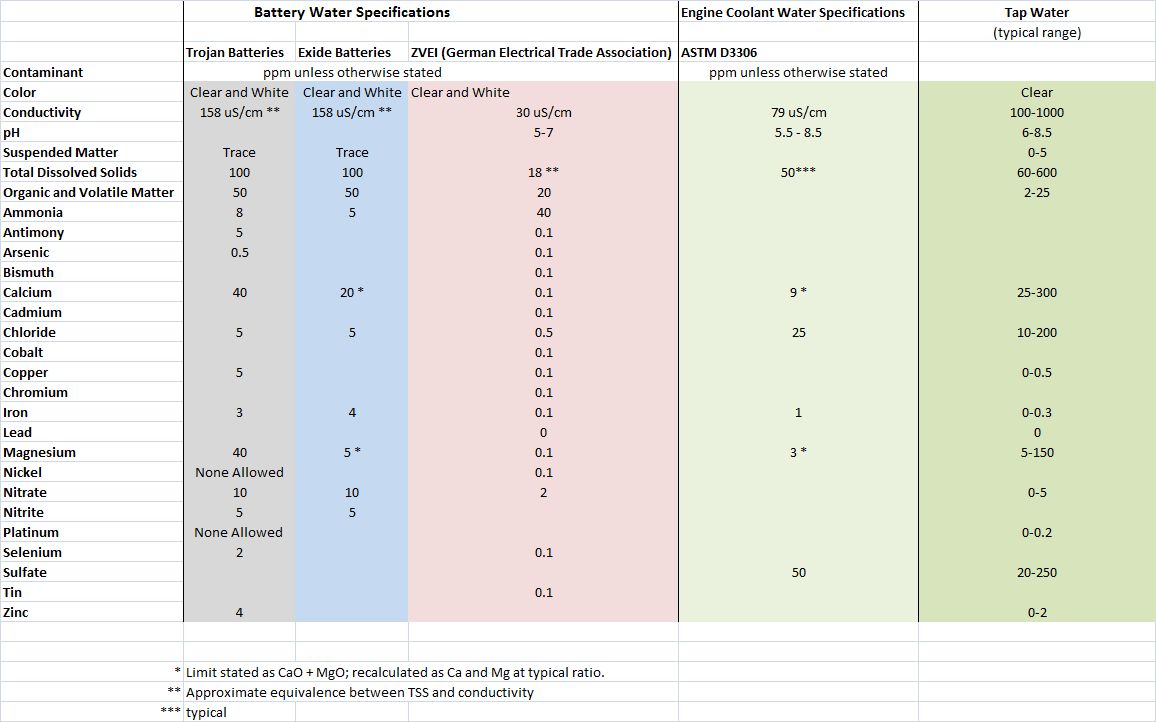

But US water is so dependent on local factors ..... and often sufficiently different to UK water even with UK differing standards.Yes, tap water is far too high in contaminants to use in sealed systems. It is not so much lime build up as interference with corrosion inhibitors. (This was my career for a while) Coolant water standards are just about as strict as battery water. This is the REASON coolant switched to pre-dilute--nearly all customers were using tap water instead of the specified water.
(The US and UK coolant standards committees merged 20 years ago. ASTM D3306 is also the basis for ISO coolant performance standards.)

Even in UK water composition varies a good deal. Hardness is measured in ppm of CaCO3 and can be higher than 180 in some parts of the country. Living in North Wales, when we first bought a dishwasher I checked with the local laboratory and was informed that ours was zero. I know of local people who top up batteries with tap water.But US water is so dependent on local factors ..... and often sufficiently different to UK water even with UK differing standards.
I hope you were not conducting your research while MTBE was leaching in many water tables of USA ??
Not trying to start an argument - but USA water and UK are generally different.
Well ... that just means he does not know. His practice was probably bad for his customers, just not enought to cause immediate come-backs. I'm sure he did not do controlled side-by-side testing. I did. The standard changed about 35 years ago. I was on the committee. That was when pre-dilute started to take over the market. Concentrate is generally only used for freeze point adjustments in very severe climates and after water flushing.I have no wish to dispute that deionised water is recommended. And as said deionised water is not expensive
View attachment 204395
However I spoke with a long term time served and now retired mechanic who serviced and repaired trucks for a living and he never heard of using anything other than tap water to dilute concentrated coolant.
My preference is to buy the concentrate and dilute it myself .

There is plenty of range in UK waters, post #7 highlights it well, as dictated primarily by the underlying geology of an area. Drinking water standards mostly relate to taste, smell and visuals, and contaminants which are hopefully all at low level (and not much of an issue for coolant water anyway). Distilled or reverse osmosis grade (i.e. shop sold) deionised water is the best option but tap water will suffice. Don't be tempted by full 'laboratory' grade 18.2 Mohm deionised water (if you can get it), it is quite acidic and may corrode.Not trying to start an argument - but USA water and UK are generally different.

Q please.Well ... that just means he does not know. His practice was probably bad for his customers, just not enought to cause immediate come-backs. I'm sure he did not do controlled side-by-side testing. I did. The standard changed about 35 years ago. I was on the committee. That was when pre-dilute started to take over the market. Concentrate is generally only used for freeze point adjustments in very severe climates and after water flushing.
Dilute it with DI water. Or don't follow the instructions at your risk. But I did the testing and I'm quite sure that tap water is harmful in mostcases. Only a little, but harmful. The only reason for concentrate is for freeze point adjustments.
There is plenty of range in UK waters, post #7 highlights it well, as dictated primarily by the underlying geology of an area. Drinking water standards mostly relate to taste, smell and visuals, and contaminants which are hopefully all at low level (and not much of an issue for coolant water anyway). Distilled or reverse osmosis grade (i.e. shop sold) deionised water is the best option but tap water will suffice. Don't be tempted by full 'laboratory' grade 18.2 Mohm deionised water (if you can get it), it is quite acidic and may corrode.
Possibly better than tap water but not as good as distilled / demineralised (this question has come up before). Whilst the moisture from the air should be relatively clean in 'land derived' elements such as calcium and magnesium as found in river water, the condensing process will have trapped materials from the atmosphere and they will be included in the condensate (e.g. SO2, CO2) and you'll also have dust from the atmosphere and residue from the condensing plates themselves incorporated in the condensate (aluminium probably).Q please.
Is the output from a domestic de humidifier a reasonable sub for distilled/demineralised waters?
...or likely "better" as a coolant than "tap water"?
Or local water is very very soft, and is slightly acidic I believe.
Not a large sample size, but ....Q please.
Is the output from a domestic de humidifier a reasonable sub for distilled/demineralised waters?
...or likely "better" as a coolant than "tap water"?
Or local water is very very soft, and is slightly acidic I believe.
 dehumidifier, AC, and tap water.
A conventional low silicate type , (sometimes called "inorganic acid technology") is the specified type for a D1-30 The Volvo product is green. Other manufacturers' products may be other colours. Read the description , dont rely on the colour alone. Diluted Volvo green is still green thoughBut is the ready made mix . Pink . Blue . Green for a volvo D1 30 ?