Conwy River and Strop / Swing mooring advice

Marceline

Well-Known Member
Joined
12 Sep 2020
Messages
386
Visit site
Hi and hoped to ask two main questions on here about Conwy as we've just moved there after 3 years on Menai Strait to a swing mooring on the river.

Bearing in mind we're still 'new' to sailing and I'm already making mistakes just hoped to ask some advice

Getting in/out of the long tidal river channel

Ours is a 24foot bilge keel sailboat with a 90cm draft and an outboard 5hp engine in a well. We'd read online that entry/exit is best 3hours either side of HW, but on Neaps it can be doable other times.

We brought the boat from Menai Strait on Tues bang on Neaps and managed to get in ok (though the sand bar in the channel 'delightfully' called The Scabs was about 1.3m clearance so think I should have waited for a higher tide).

It was a long entry though - motoring for over an hour. So one question to those who have been there is - if leaving at HW (or just before) - as 'newbs' is it doable to head straight out over the Conwy Sands rather than the long winding channel ? The drying heights look on the charts to be +4m near the channel so guessing timing (and local knowledge) is very importatnt here!

We love (and learnt) so much about sailing watching Mike's (Sailing Cos I Love It) videos over the years and remembered on one of his that he did head straight out over the sands (Heading 320degrees out of Conwy River) but just wanted to ask advice/timings/tides etc to consider
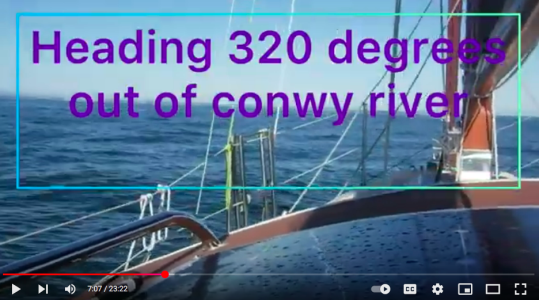
Screen Shot 2025-05-11 at 05.32.45.png


from one of his earlier videos

We can only daysail for now so I'm trying to plan various 6/9/12hour upcoming passage plans (just out into the bay sailing/heading to Puffin Island and back/around Great Orme to Llandudno and back etc). We were planning to mainly go out at Neaps for now just to get used to things then slowly move closer to Springs.

So any advice would be very welcomed as we def don't want to get things wrong/be unsafe etc
 
Last edited:
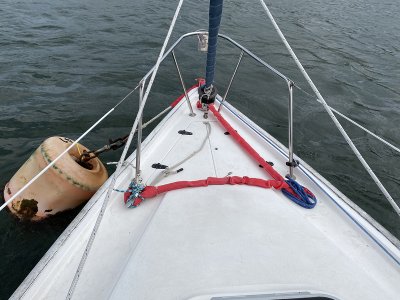
our second question is more general but tbh more urgent - we didn't know just how much more powerful/fast the tides were compared to Menai Straits here (we thought Menai was strong!)

Strop(s) and Swing Moorings advice

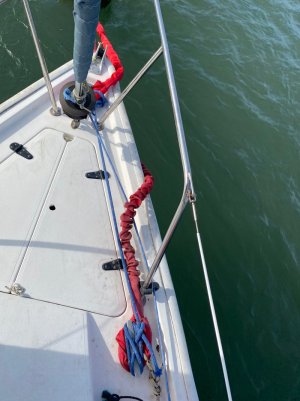
Back in Menai we had a swing mooring in a sheltered part of the Strait and had just one strop on there. It was quite long - 4metres! (and I'd thankfully got some very helpful advice in previous years as I bought it far too long but was suggested to try wrapping it around our three various cleats at the bow - one bow cleat and a pair of cleats aft of the anchor locker)

It looked like this:

IMG_0941.JPG


This worked ok and survived a few horrible storms last year. Tbh I would have liked to have get a chain strop, but our bow roller is a bit narrow and was told we should get a new wider roller which I wish I'd done but... for now its still the same setup - narrow bow roller and no fairleads, just the three cleats.


But now we've moved to Conwy (and its stronger tides) I was recommended to get two strops. I kept our previous years 4m (far too long) strop which I planned to use as a backup, and a new shorter 2.5m strop to be at the Bow cleat.

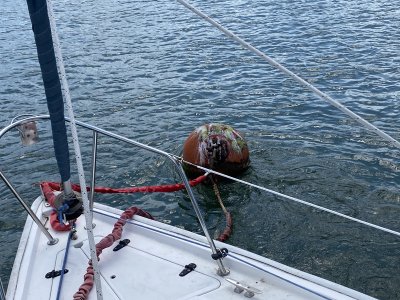
This was what I left it as on Tues - (and I stupidly forgot to put the new strop on the bow roller)

tues.jpg


but when we went back yesterday they'd both got alarmingly wrapped around each other and the mooring ball

I should have got a photo of them but I was too worried about them/tried to sort out asap.

What I think had happened was the long strop had got caught underneath the mooring ball, and then the shorter strop had then wrapped many times (about 8 or 10) around the longer stop and the boat was tight close to the mooring ball.

I managed to unwind the shorter strop then managed to free the longer one from underneath but I think this was a very bad situation I had got our boat in and I wasn't sure how best to try and solve it.

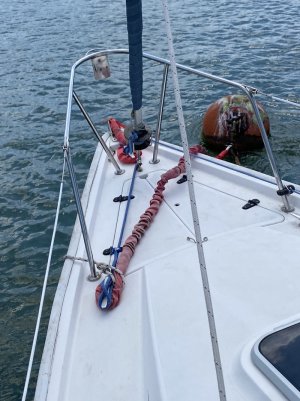
I ended up trying to make the long strop 'shorter' by putting this onto the portside aft cleat and this seemed to work but tbh I've been awake most the night thinking about how I might have possibly made it even worse.

This is how it was looking before we left:

IMG_3010.jpg


it looked better and matched the length of the shorter strop most the time but was still dragging in the water though when boat blown to port and not sure what I can do. Here's a couple of things I thought of though:

1) go back to one strop (maybe tie the longer strop in the meantime to the top of pullpit to lift it out the water or is that also a very bad idea?) until we can get the boat off the mooring to somewhere nearby and then remove one of them

2) wind the longer strop around the shorter one (not too tight or loose) so it wouldn't drag in the water and then put it on one of the back cleats once it gets to the bow roller?? Tbh I like this idea as we'd still have a 'backup' strop, but again not sure if I might be wrong about this too

3) should I get two equal length strops and put them onto those two 'aft of the achor locker' cleats - these were the ones I was using and they have various lengths - Amazon.co.uk

would very much welcome any suggestions as I think I need to get this sorted before it gets to springs/worse weather


IMG_3009(1).jpg
 
Last edited:
I had a mooring for several years close to the bridge, a couple of thoughts.
Perhaps have the second strop run with the main and also attached to the swivel so both move together and avoid winding around the buoy. The shackle to the mooring looks very rusty and not large perhaps another shackle to double up that one would give peace of mind.
The river runs very fast at times and can be dangerous in a dinghy so setting off needs to be carefully thought through as rowing straight to shore may be near impossible at times. Also be aware that under the bridge it may approach 7/8 knots at times.
 
Presumably you are hoping the long strop will be useful as a contingency if the short one fails for some reason? It seems most likely that failure would occur in poor conditions so imagine what happens if the short strop is no longer there and the boat is getting bounces around - if you are lucky the pullpit takes the load, but they aren’t usually well enough mounted to to fair leads. If it doesn’t survive does our forestay take all the load? In exactly the opposite direction from it was engineered for?

I’ve never seen anyone using uneven length strops. Double strops, as well as adding redundancy, allegedly* give a more comfortable ride for the boat with less yawing from side to side and reduce the load on your cleats.

Your only fairlead seems to be that small bow roller with a little bit of cord? To stop the strop bouncing out? Personally I would look at having two strops of equal length going to the two cleats just behind the pull pit with them approaching the cleats from behind the pullpit and adding extra chafe protection where it goes over the toe rail.

*I have seen this seem to work and sometime seem to make no difference - I think it requires to be the right length for your boat to work.
 
Last edited:
As said above, unequal length strops will lead to problems so the choice is one as thick as will fit over the bow roller or, two equal ones to the cleats but that's not ideal as no fairleads. Don't underestimate how bad Conwy can get on northerly winds and how strong the tide can be. I remember one bad night when 11 boats broke their moorings or strops, fortunately, we weren't one of them.

I would pull the long one on board so both are the same length from the bow to the buoy and tie it to the shorter one alongside the bow roller with some cord. Then cleat it off to remove the slack.
 
Even sheltered spots in the strait (rowen bay, menai bridge) can get pretty brutal at times so if you've survived there then the river shouldn't present too many problems.

Perhaps get in touch with a local rigging company for advice? TJ rigging are pretty helpful and obviously know the river.
 
Many thanks everybody - this is very helpful/welcome/important advice and all very appreciated - especially with how strong the currents are there and the sad/real unfortunate events that had befallen other boats there when things get rough (we saw the awful after effects of the horrible Northerly storm back in Jan where a few boats/pontoons had been wrecked)

I'm hopefully getting back to the boat tomorrow after work and so I'll try the various suggestions with what I currently have there and then get a few photos/plan what to do next. But yes, think I need to get this sorted properly.

Just on Skylark's adding some farileads suggestion - would that be a tricky job (as guessing there'll be considerable loads on those) - or is it more finding a place where we can drill down through the hull and (hopefully accessable through inside the anchor locker) be able to then bolt on the underside ?

Similarly - is replacing the bow roller for a larger one so it can take a thicker/heavier chain strop a tricky job or should I wait until end of season and try and get that sorted when back in the boatyard ?
 
Many thanks everybody - this is very helpful/welcome/important advice and all very appreciated - especially with how strong the currents are there and the sad/real unfortunate events that had befallen other boats there when things get rough (we saw the awful after effects of the horrible Northerly storm back in Jan where a few boats/pontoons had been wrecked)

I'm hopefully getting back to the boat tomorrow after work and so I'll try the various suggestions with what I currently have there and then get a few photos/plan what to do next. But yes, think I need to get this sorted properly.

Just on Skylark's adding some farileads suggestion - would that be a tricky job (as guessing there'll be considerable loads on those) - or is it more finding a place where we can drill down through the hull and (hopefully accessable through inside the anchor locker) be able to then bolt on the underside ?

Similarly - is replacing the bow roller for a larger one so it can take a thicker/heavier chain strop a tricky job or should I wait until end of season and try and get that sorted when back in the boatyard ?
Skylark????
It looks like you could access suitable places through the anchor locker but fairleads would need to be mounted on blocks to lift them above the toerails. Should be an easy job and strong using bolts right through the deck.
 
ah I'm such a dozy idiot - sorry Vyv_Cox !! I'm still half asleep from long drive back yesterday from visiting parents :sleep:

cheers so much and I'll do some youtube research on how to do those jobs
 
Have a look at boats down the river on swinging moorings, mine (the pictured one, its outside Conwy Marina) has two strops that do not go through fairleads, are 2.1m long, have chafe protection, and I sleep soundly knowing the've gone through two major storms and some minor ones with no sign of stress. I bought the biggest size lines that the cleats would cope with.

I now seem to be suffering from "cleat envy" though having looked at those mirror polished ones you linked to!
 
ah cheers so much Tzu - thats good to know and thanks for your suggestion

we noticed the boats closer to where we are seemed to have one strop (and guessing they may well be chain strops given they're bigger boats than ours) but thats good to know your setup and that it works well - we'll try and look more at the various other boats on their moorings (y)

ps - lovnig the arch on your boat very much - is that a Hunter ? I really loved crewing on a boat with a similar arch last year - thought it was a very practical/elegant/safe feature for a cockpit for many reasons
 
I think you could add fairleads each side slightly forward of the cleats. Then take two equal length strops forward to the buoy as a bridle. Do not use a single strop passed through the ring on the buoy; this will chafe through in no time. Attach each strop to the buoy with its own shackle.
I'd want a hard eye spliced into the strops to prevent chafe.

I have twin strops made from one piece of Polysteel (a UV-resistant polypropylene rope that floats), eye splice at each end and a hard eye Brummel spliced into the middle to shackle to the buoy. I have a cat now, but my previous 24 footer sat better to twin strops than to one, and the floating line makes picking up so much easier.

My top tip for twin strops is to have a bit of light line tied to one, with a snap hook to attach it to the other. Attach them as you let go, and you only have to fish for one line when you come to pick up.
 
thanks Stemar - liking the idea of a snap hook for the 2nd strop (rather than a 2nd pickup buoy) a lot

Will look into the Polysteel strops too and yours and many others posts on this thread has been an interesting read thanks

Polysteel vs Nylon mooring lines

One thing I'm wondering about - I'm currently looking into adding some farileads and found some useful looking ones, but I am not sure where best to source some wooden blocks to raise the fairleads should we add them

I've done a few searches for 'Marine timber' and blocks and found this company, but are there any other suppliers people can recommend to get two blocks for this?

Hardwood Blocks
 
thanks Stemar - liking the idea of a snap hook for the 2nd strop (rather than a 2nd pickup buoy) a lot

Will look into the Polysteel strops too and yours and many others posts on this thread has been an interesting read thanks

Polysteel vs Nylon mooring lines

One thing I'm wondering about - I'm currently looking into adding some farileads and found some useful looking ones, but I am not sure where best to source some wooden blocks to raise the fairleads should we add them

I've done a few searches for 'Marine timber' and blocks and found this company, but are there any other suppliers people can recommend to get two blocks for this?

Hardwood Blocks
In that discussion, I said, I considered hard eyes to the riser, but eventually knotted the rope tightly to a shackle so it'll be the shackle to riser join that moves, rather than the hard eye to shackle. In fact, having two separate lines meant they regularly got themselves tangled round each other and the riser, which shortened their lives considerably, My second iteration was a single line with a Brummel splice and hard eye in the middle was much better in that respect, as there's effectively a single, quite stiff line for the first foot or so, which means less tangling and abrasion. Adding some old fire hose means that abrasion is virtually non-existent, and the line has lasted longer than my first try, and is still in near-perfect condition.

As for hardwood blocks, teak is the theoretical ideal, but anything that's reasonably rot-resistant would do. I've used Sapele, oak and mahogany salvaged from an old door on my boats. Just beware of so-called mahogany from DIY stores. Real mahogany is virtually impossible to find, and some of the substitutes aren't very rot resistant.
 
I've done a few searches for 'Marine timber' and blocks and found this company, but are there any other suppliers people can recommend to get two blocks for this?

Hardwood Blocks

Try your local timber merchant, they may have some off cuts. I've used Sapele for various external jobs and once machined down some hardwood window sill retrieved from a skip but no idea what it was.
 
Looking online for fairleads I liked the look of these kinds (seems to double as a cleat?) and came as a pair but would having 5 cleats at the bow be a bit much ?? :)

Osculati Scandinavian Boat Fairlead/Cleat Mirror-Polished AISI316 (per Pair) - 40.137.85
We fitted these Osculati Mushroom cleats as close to the bow as possible to help with moorings, and have been brilliant. https://www.osculati.com/en/11281-40.173.16/mushroom-shape-bollar-aisi316-160-mm
Can be used as a fairlead, and unlike the closed type can cope with huge "Queen Mary" sized pick up strops when necessary.
Generally we run from there across to existing mooring cleat on opposite side.
If leaving boat and risk of huge waves use a bit of light rope across top to tie in and avoid any risk of popping out - but much much easier doing that (and probably entirely unnecessary) than threading through the semi closed type.
Also act as secondary bow cleats in marinas - sometimes gets better angle, and in winter avoids single point of failure.
As you can tell, very highly recommended.
 
Top