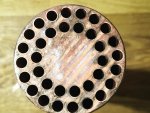
Cleaning heat exchanger stack

eddystone

Well-Known Member
Joined
18 Aug 2013
Messages
1,936
Location
North West Devon
Visit site
I am about to service an indirectly cooled diesel for the first time, previous experience being with raw water cooled engine with no heat exchanger. Although the engine, a Beta, has not yet reached 50 hours I'm wondering more generally what fluids are OK to clean the stack with without causing damage - would one use a normal household descaler like Vyakal or something more aggressive? Also, I presume a toothbrush or pipe cleaner rather than a wire brush?
 
After less than 50 hours, I can't imagine that the heat exchanger is anywhere near needing descaling. By all means have a look at it, but that's about all it's likely to need.
 
Agreed if he has an effective prefilter but its not a bad discipline to make sure it's clean and clear of debris periodically. While you are at it check the waterways are clear and the pump impeller is in good condition too. agree it should not need descaling though and if you have an airline handy blow though the holes. Don't poke though the holes with anything that can break though. I usually use a stout piece of insulated cable.....
 
I use a round file or small phillips screwdriver to get the worst of it out, and then give it a kettle de-scalent for a few minutes. Don't find a need for a wire brush.
 
I am about to service an indirectly cooled diesel for the first time, previous experience being with raw water cooled engine with no heat exchanger. Although the engine, a Beta, has not yet reached 50 hours I'm wondering more generally what fluids are OK to clean the stack with without causing damage - would one use a normal household descaler like Vyakal or something more aggressive? Also, I presume a toothbrush or pipe cleaner rather than a wire brush?

I have similar annual engine hours on my Beta and leave checking the exchanger to every two years. Have found no problems with this, so agree with post #2.
What I find in the lower tubes is often some residue from the anode, which sits upstream the stack in engines made prior to about 2011.
If your engine is newer, the zinc is on the downstream side, which I suspect might further lengthen the service interval.
I have found a mild household descaler overnight fully satisfactory.
 
I am about to service an indirectly cooled diesel for the first time, previous experience being with raw water cooled engine with no heat exchanger. Although the engine, a Beta, has not yet reached 50 hours I'm wondering more generally what fluids are OK to clean the stack with without causing damage - would one use a normal household descaler like Vyakal or something more aggressive? Also, I presume a toothbrush or pipe cleaner rather than a wire brush?
Based on my experience, if you have a water strainer and you have never lost a fragment of a waterpump impeller then I would not do anything until at least 500 hours unless you have an overheating problem.

www.solocoastalsailing.co.uk
 
At 50 hours, I would suggest leaving well alone. It is extremely unlikely it will need cleaning, and there is a chance you will cause damage during inspection. I would leave it alone.
 
As above but check the anode every 50 hours / mid season when the engine is new. It will settle down later.

I bought new anodes for my engine, which was a fine idea, right up until I discovered that the indirectly cooled ones don't have anodes ... I now however now have a small stock of Volvo Penta anodes for the raw water cooled version ...
 
I bought new anodes for my engine, which was a fine idea, right up until I discovered that the indirectly cooled ones don't have anodes ... I now however now have a small stock of Volvo Penta anodes for the raw water cooled version ...

:) I wasted ages looking for the anode on my old 2003T engine!
 
Based on my experience, if you have a water strainer and you have never lost a fragment of a waterpump impeller then I would not do anything until at least 500 hours unless you have an overheating problem.

www.solocoastalsailing.co.uk
I can follow that but think the service regime specifies checking the anode and stack every year or 250 hours whichever is sooner. My engine was commissioned in August 2018 and had its initial 25 hour service carried out professionally in May last year at about 20 hours.
 
I think it's worth doing every year if only to make sure the end caps, bolts and stack don't get stuck in place by any minor corrosion. I never use any chemicals on the stack, they shouldn't be necessary, just poke through each tube with a bit of electrical cable or similar.
Put it back together with a smear of silicone grease on the O rings and bolt threads.
 
My last boat had a Beta which I fitted new in 2003. The heat exchanger needed cleaning every year (sometimes before the end of the season) due to the residue from the pencil anode clogging it up.

I seem to recall some other forumites with Betas (but not all) experienced similar problems. I imagine Beta will have overcome this with newer engines but it was a regular task each year for me.
 
I am about to service an indirectly cooled diesel for the first time, previous experience being with raw water cooled engine with no heat exchanger. Although the engine, a Beta, has not yet reached 50 hours I'm wondering more generally what fluids are OK to clean the stack with without causing damage - would one use a normal household descaler like Vyakal or something more aggressive? Also, I presume a toothbrush or pipe cleaner rather than a wire brush?

To (hopefully) answer your question with part of a post from a few months ago:
I eventually tried my local plumbers supply merchants and they had a few products for flushing radiators etc, and one de-scaler actually meant for heat exchangers!! This product is called DISINEX and is made by FACOT chemicals who are based at:
Facot Chemicals S.r.l.
26010 CAPRALBA (CR) – Italy – Via Crema,44
Tel. +39 0373 45.06.42 – 45.06.43 – Fax +39 0373 45.07.51
www.facotitalia.com

The UK agents for Facot are:
Anglo Nordic Burner Products LTD
12-14 Island Farm Avenue, West Molesey, KT8 2UZ, UK
Paul Barber | Senior Technical Sales
+44 (0) 208 979 0988
paulbarber@anglonordic.co.uk
www.anglonordic.co.uk

Disinex costs a lot less than "marine de-scalers" and as it is made purposefully for de-scaling heat exchangers is presumably safe to use. IIRC it cost 5 euros per litre from my local plumbers supply shop.
As to whether you need to it at 50 hours, is your shout!

Alan.
 
I used a brick cleaner for my heat exchanger. It was a lot older than yours but came up like new!
 

Attachments

  • 69A625FE-B6CD-478A-BC25-E669ECC68B29.jpeg
    69A625FE-B6CD-478A-BC25-E669ECC68B29.jpeg
    305.3 KB · Views: 7
For higher hours cleaning,when the concern is more about debris than deposits, have a look at the ' How to clean and unblock a tubestack' video by Beta Marine on You Tube.

While considering Beta engines it may be worth noting that in the current model installation manuals ( in my case for the 16, 2015 ) they have increased the minimum water level to exhasust water injection point from 250mm to 300mm. This in itself is not comforting if you plot or incline a photo of your transom at 15 degrees or over and consider where the injection point or the antisyphon valve actually lies.
 
Last edited:
Plain old vinegar. My boat is on the Blackwater, where the water is like a primordial soup. I’ve had a Beta 16 and a Nanni equivalent (Same Kubota engine). Each season I remove the stack and the end caps, then place them in a Tupperware dish, fill it with vinegar and leave overnight. The vinegar dissolves most of the scaling and softens the rest to an easily removable state. Next day a gentle prod through of the tubes with a long thin screwdriver clears them to a new condition.
 
Top