
Cheapest current tablet that’ll run navionics w/ AIS?

There are a lot of tablets on the market which don't have GPS.
Sometimes, apparently similar tablets may or may not have GPS.
Retailers often don't even know, reviewers don't seem to care.
 
Samsung Galaxy Tab A, running Navionics - my navionics subscription also runs on my Samsung S20 phone and my other Samsung S4 Tablet.

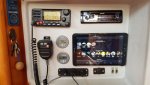
I have a WiFi NMEA2000 router which allows navionics to receive depth info from my Seatalk1 devices, GPS position from my NMEA0183 Plotter and AIS info from my VHF.

Get a cellular version and you get weather apps, internet, and the entire Google Play Store - it becomes your boats entertainment, information, and communications hub as well as a plotter.

20190601_132306.jpg
 
I happily run Navionics on a Lenovo Tab M10 tablet, cost approx £120. Navionics also runs perfectly on my Moto G6 'phone ( very much a budget offering but seems to do everything ).
The tablet is good, but having a chart on my 'phone in my pocket turns out to be incredibly convenient.
 
"There are a lot of tablets on the market which don't have GPS.
Sometimes, apparently similar tablets may or may not have GPS.
Retailers often don't even know, reviewers don't seem to care. "
The vast majority of Android 'phones and tablets have GPS, and all the respectable ones have their specification easily googlable ( is that a word ? ) on t'net.

Apple devices often don't. Grrrrrrrrrrrrr
 
I happily run Navionics on a Lenovo Tab M10 tablet, cost approx £120. Navionics also runs perfectly on my Moto G6 'phone ( very much a budget offering but seems to do everything ).
The tablet is good, but having a chart on my 'phone in my pocket turns out to be incredibly convenient.
The thread isn't about just running Navionics, that does not seem to be demanding.
It's about running navionica with AIS over wifi.
Which seems to be more demanding.
 
"It's about running navionica with AIS over wifi.
Which seems to be more demanding. "

Nope ! They all have WiFi and Navionics takes care of handling AIS. I can't say that they absolutely ALL work, but I'd be astonished if any current Android tablet failed.
 
You could also try London Chartplotters they will to a totally configured tablet with software and charts, not sure about Navionics though
I tried that and ended up wasting my money....

I have a lenova tablet that is great with open cpn and Visit My Harbour raster charts, and also I use Navionics on my waterproof hammerproof 5inch android phone (it has fallen 7 feet into the bilge with 2 feet of water/oil) and also an Android touchscreen car radio see this project My COVID-19 Lockdown Project: 10” Android Car Stereo to Navionics Chart Plotter
 
Why would you choose a safety critical device, such as a charting platform, based on cheapest price?
That is an odd observation. Surely a chart plotter is just an aid to navigation rather than "safety critical"? Navionics runs just as well and reliably on my £110 Lenovo as it does on my £1000+ Garmin. What money buys you is daylight visibility and more features to link the chart plotter to other boat systems. Your position on the chart and display of things around you which are essential to safe navigation are exactly the same irrespective of the cost of the device.
 
Why would you choose a safety critical device, such as a charting platform, based on cheapest price?

Two things:

There is a 'sensible price point' for most commodities that provides good performance and longevity: above the cheap rubbish and below the Veblen bling. For a tablet that's about £120 - £150 from Lenovo or Samsung. For a smartphone it's about £150.

We have a paper chart for the big picture, a tablet on the chart table with Navionics ( probably OpenCPN next year as the AIS display is superb ) where screen brightness and waterproofing are not an issue, and a 'phone in my pocket with Navionics. Next year Mrs Mate will have Navionics on her 'phone as well. That seems to me to provide a huge redundancy with constantly updated charts at an incredibly low cost.
 
Why would you choose a safety critical device, such as a charting platform, based on cheapest price?
Its a good challenge. In industry a lot of safety (meaning avoiding injury and death) is based around preventing risk situations and incidents meaning one safe system that works without workarounds that inevitably lead to problems. On boats the same should apply, but the nature of the environment and the lack of prescribed standards (thankfully) means far greater importance on "what if" and plan B, C etc.
So a good philosophy is to have several ways to access charts and your position with the ultimate paper, hand bearing compass and pencil in case all else fails.

I have four independent chart systems (Raymarine, tablet, phone and paper). Each has its merits (Navionics is up to date for example). Price does not necessarily equate to reliability with electronic devices and in fact more expensive can mean faster battery drain and operational complexity, something I don't need on a dark night!
 
" So my question is - have Garmin done as good a job with Navonics on Android as their IOS version?

Short answer - yes. It is simply one the best and easiest to use Navigation apps I've come across, and has the benefit that the charts are always up to date (provided you have the subscription, of course). It works well on our cheapy (£120 Vankyo) tablet, my wife's top of the line phone, and my mid-line phone all the same. We had ours connected to all the instrumentation and AIS via WiFi with zero issues at all over the last 12 months.


Why would you choose a safety critical device, such as a charting platform, based on cheapest price?

The answer can be - redundancy. If you have one device, you have one single point of failure. For the same price as an iPad, I could buy 5 or 10 tablets that are perfectly capable for the low demands of the Navionics app. With a GPS, compass, binoculars and paper chart on board you then have so many different redundancies. For coastal sailing (the vast majority of use-cases), it could equally be argued as others have that this is a 'nice to have' and is not really safety critical. But given that these can be had for low cost, there really is no entry barrier so why not...
 
Navionics runs fine on Android and adding AIS via WIFI works fine too. Almost every time i install a modern MFD with WIFI the customer asks me for a recommendation for a tablet. Whist there are many that will do the job and i've used a few Lenovos with success, i suggest a Samsung Galaxy. I never suggest iPads as i don't see any benefit in paying the extra cost for an onboard tablet.

I have never, ever, had a customer come back to me and complain that the tablet will not do what it's supposed to do. (i don't supply any tablets).

Personally, i have a Garmin MFD at the helm, networked to depth, AIS, sonar, wind etc, plus a below deck autopilot. I have the Garmin Active Captain app' on a Samsung tablet and a Galaxy S8. I can use the app' stand alone, which gives me a couple of backups, or i can use it in "Helm" mode, which mirrors the MFD, so i see depth, wind, AIS etc and can control the autopilot and do anything i could do from the plotter itself. Both devices do this perfectly well.
 
Last edited:
Yep, agreed. IMO, the key is getting one with a bright enough screen. And by the time you do this, the processing power is more than enough.
Maybe an ex military grade Panasonic Toughbook is the way to go?

The screen can be read in broad daylight, it is guaranteed to survive being dropped 2M, it can be used as a laptop or tablet, it is built to survive a harsh nautical/outdoor environment.

You can buy a "refurbished" CF19 for around $300.

Marine Toughbook with GPS & nautical charts - Navigation Laptops

https://www.youtube.com/results?search_query=Toughbook+for+navigation
 
Last edited:
Maybe an ex military grade Panasonic Toughbook is the way to go?

The screen can be read in broad daylight, it is guaranteed to survive being dropped 2M, it can be used as a laptop or tablet, it is built survive a harsh nautical environment.

You can buy a "refurbished" CF19 for around $300.

Marine Toughbook with GPS & nautical charts - Navigation Laptops

https://www.youtube.com/results?search_query=Toughbook+for+navigation

They will not run Navionics (which is what this thread is about).

The MFD app's which allow mirroring and/or synchronising of the MFD with a tablet also will not work on anything other than iOS or Android.

If you want to run Open CPN and you're happy with the spec's of the older toughbooks, go for it. Do note though, that to get a half decent model you will need to spend double your $300
 
I happily run Navionics on a Lenovo Tab M10 tablet, cost approx £120. Navionics also runs perfectly on my Moto G6 'phone ( very much a budget offering but seems to do everything ).
The tablet is good, but having a chart on my 'phone in my pocket turns out to be incredibly convenient.
Same choices I made. Not regretted them.
 
Why would you choose a safety critical device, such as a charting platform, based on cheapest price?
Not really safety critical by any stretch of the imagination. In the aviation industry systems on a plane are a 5 out of 5 (although usually less, given the windows on the plane) and air traffic control a 3/5. Charts on a boat might score 1/5 for safety critical if you’re being generous, but I’m pretty sure the official definition would consider them outside of critical systems entirely. It’s been a couple of years since I read the docs though. As I recall nuclear safety critical uses the same definition and scale.
 
Why would you choose a safety critical device, such as a charting platform, based on cheapest price?
I wouldn't say it's safety critical, assuming it's not your only means of plotting (it shouldn't be!)

As late as 2014 I've sailed on a couple of Tankers trading worldwide that didn't have any sort of plotter (let alone an approved ECDIS system).
So it was paper charts all the way...
Though we did have the benefits of things like a gyrocompass, radar, a proper chart table and a reasonably stable platform to do it all on. Which makes it a lot easier and more accurate than a typical yacht setup!

One did have a laptop with a GPS dongle and a pirate copy of the transas worldwide charts though :D
 
Top