
Chartplotter at the binnacle

I think what many of us were saying is that with proper electronics, most sailors stop using the compass, not that everyone should stop using it. It’s just progress, people stopped using lead lines and logs when electronics replaced them and this is no different.
If you go back through my posts - you will see that I fall into that category ...

When I sail across baltic ... primary is the plotter and back-up tablet in terms of course maintained. Autohelm in use to relieve me of having to sit holding the tiller.
I do have paper charts .. but they stay in their folders ... BUT once in the Stockholm or Finnish Archipelago - I have the charts as they provide a far better overall pitcture of what we want to do there.
The Compass of course quietly goes about its business ... unused but not forgotten.

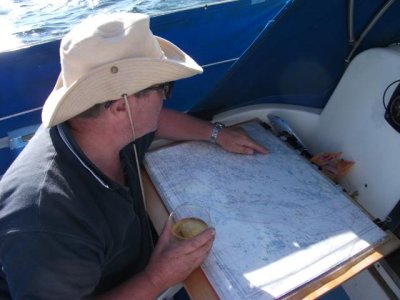
DSCF4352.JPG

DSCF4354.JPG

Studying the Swedish Archipelago charts .... (I have the Finnish set as well).
 
Back in the 80s and 90s there was no viable civilian GPS. Our boat (an Albin Vega) had a large collection of charts, lovingly maintained and updated by my dad. They lived in plastic holders and were stored under the mattress on the starboard bunk. The chart table was too small, being more of a chart shelf, so they ended up on the table which took up 90% of the saloon.

Whenever it was pi$$ing down and blowing hard, (which it did quite a lot in Scotland) I had to helm in my lifejacket and oilies with a towel wrapped round my neck to try and stop the rain getting in. The autopilot back then was voice controlled, dad shouted and I took the helm. My dad was up and down the companionway steps like a yoyo with handheld compass round his neck .... couldn't afford to get the charts wet, and bringing them into the cockpit meant they might get ripped or blown over board. The boat had no bimini, and the tiller was too far from the forward end of the cockpit, so a sprayhood wouldn't have helped either.

Funnily enough I don't miss any of it. I'm more than happy to use my plotter, autopilot, radar, sonar, AIS, and all the other modern conveniences ... I keep an eye on where the boat is going, but even in wind and rain it is far more relaxed than the 80s.
 
We can all recite extremes and circumstances to 'prove' our point.

My point in post #61 photos - was to illustrate the art of general overview and planning. I first went on boats when 5 yrs old .. my Father being in CAA (BoT) in those days - had various charts from aircraft ! And of course the relevant Solent area books. For years that was how we got about in various boats as a family ...
Later I joined the MN and trained as a Deck / Navigating Officer ... a passion instilled in me from my Father. I still have that passion today. I watched navigation evolve from Sextants, RDF, Loran, Decca etc - to Tranist and then just as I was leaving ships in 1989 - the promise of GPS .. By then I had also bought my first boat .. and splashed out on a Decca machine ... plans of crossing channel - but never did with that boat.
Various boats and locations later - I'm now Baltic based and with a number of boats ...

The Admiralty charts have been consigned to storage at home ... rarely coming out now. Only when nostalgia or wanting to describe a cruise / passage to another person. BUT the chart packs of Sweden and Finland are still an important part of the on-board inventory and for good reason.

Despite having good plotters and tablets for electronic navigation - they fall short in one arena .. general overview and planning ... zooming in / out / scrolling never compertes with having adjacent chartlets of the packs in front of you ... no scrolling .. no zooming .. just plain well presented detail you can run your finger / pencil long .. from one chartlet to the next ... and still see the overall plan.

I can sit where I am now .. (need to clear the desk though !) and have same chartlets out and 'dream' about next years cruise .. devising interesting route while still having destination visible on chart ...

If you try same with a plotter - you lose so much essential detail of depth etc due to the zooming out ..

I accept and appreciate that my scenario of the Swedish Islands as example is my way of working and not for some ... but as I meet so many CA members who cruise the same waters - guess what - near all of them carry the same chart sets for same reason ... when you are in an area that has ~30,000 rocks / islets / islands etc .... I suggest that chart set is a good set to have.
 
I think you’re projecting your own preferences into best practices. I find using electronics to dream and plan perfectly easy. I don’t use my plotter I use my phone and laptop, but it’s a long time since I got a paper chart out.
Everywhere we sailed this year was new to us after April.
 
I think you’re projecting your own preferences into best practices.

We’ve also gone from (paraphrasing):

“A long passage will soon show the folly of relying on electronic charts”

To (again paraphrasing):

“Paper charts are essential for showing your mate where you’re dreaming of going next”

I think the bit that people took exception to was the implication that charts are in any way essential nowadays. They are simply a relic of history that old men pine over.
 
Charts are not “a relic of history”. The reason that UKHO withdrew, withdrawing of charts, is that there is a need for them. Sure ECDIs is used on many large vessels, but not all. I recently was part of a commission team for a new Drill Ship, built in Korea and delivered to USA, which used charts. This was a state of the art drilling vessel in most instances of technology. It had one ECDIS and therefore was not insured for paperless navigation. The owner will be upgrading to two ECDIs in the future. ECDIS is expensive to buy and maintain, requires good cyber security to operate and power hungry, compared to buying and using charts, hence mini ECDIS was in place for smaller vessels. Most of the small UK commercial fleet have not bought into mini ECDIS in any significant numbers. Many of these vessels use paper charts which are a low cost option for the limited areas of operation that they work in. While I believe that paper charts will be withdrawn eventually the UKHO announcement was found to be premature which is why they are not currently withdrawing paper charts and have delayed until “after 2030”. It could be dealt with very quickly if the ridiculous OTT specification was dropped for certain categories of vessels. No, gold plating, is alive and well in the UKHO, RIN and RYA, when the evidence of successful, safe navigation on consumer plotters is evident.
 
While I agree they aren’t a relic of history, the main reason they are needed is that the committee approach to their electronic replacement has taken two decades too long and still isn’t ready. The lack of sales though, indicates that in the recreational realm at least paper charts just aren’t being used.
 
I think you’re projecting your own preferences into best practices. I find using electronics to dream and plan perfectly easy. I don’t use my plotter I use my phone and laptop, but it’s a long time since I got a paper chart out.
Everywhere we sailed this year was new to us after April.

And you are not projecting your own preferences ??
 
We’ve also gone from (paraphrasing):

“A long passage will soon show the folly of relying on electronic charts”

To (again paraphrasing):

“Paper charts are essential for showing your mate where you’re dreaming of going next”

I think the bit that people took exception to was the implication that charts are in any way essential nowadays. They are simply a relic of history that old men pine over.

That paraphrasing is unfair and gives wrong impression.

The long passage part - was regarding reliance on electronics that can fail for many reasons.

The paper charts and dreaming ... of course thyey are not essential .. you make your own choice. But as I posted later - I find paper charts easier to have a general overview when planning.
 
I'm sure we all do things differently, for various reasons.

As far as electronics go i have two Garmin MFDs at the upper helm with two 10.4" Android tablets at the lower helm, which can pair with the MFDs or act as stand alone plotters. The tablets are permanently connected to power, so always fully charged. We also have an additional Android tablet, 2 laptops, 2 phones and a mini PC connected to a 40" TV via HDMI. All devices have their own GPS and charts. The MFDs and tablets are powered by the domestic batteries but can be powered by the engine batteries if need be. The laptops can be charged from AC, domestic batteries or engine batteries and the PC is AC only. AC is supplied by a 3Kw inverter or a 12Kva generator. The autopilot and various other devices are on a N2K network, powered separately to everything else.

I can't think of a scenario where i could lose all of those devices, unless the GPS satellites fall out of the sky. If that happens i still have paper charts and steering/handheld compasses onboard. Can't remember the last time i used the paper charts though.

As for passage planning, that's done on the PC/40" TV with the resulting route sent to the phones, tablets and MFDs courtesy of Garmin Active Captain.
 
And you are not projecting your own preferences ??
No, just observing what’s happened. If people were using paper charts they’d be buying paper charts. They aren’t and so paper charts were very nearly withdrawn. The only reason for the reprieve was there was no replacement available for coded boats, otherwise they’d be gone.
 
electronics that can fail for many reasons.
In theory, yes. As can paper in a wet environment.
In practice neither fail often enough to be a problem and anyone leaving their local harbour likely has at least one backup. Those of us going further have many backups. It’s just not the same argument these days like it was 20 years ago.
 
Charts are not “a relic of history”. The reason that UKHO withdrew, withdrawing of charts, is that there is a need for them. Sure ECDIs is used on many large vessels, but not all. ……….While I believe that paper charts will be withdrawn eventually the UKHO announcement was found to be premature which is why they are not currently withdrawing paper charts and have delayed until “after 2030”. It could be dealt with very quickly if the ridiculous OTT specification was dropped for certain categories of vessels. No, gold plating, is alive and well in the UKHO, RIN and RYA, when the evidence of successful, safe navigation on consumer plotters is evident.
Whilst it is probably fair to say this of UKHO and MCA (who have mandated only very expensive official ECS for their Small Vessel Electronic Charting System (specifically banning more affordable alternative charts such as Navionics, C Map etc), what if any basis have you for suggesting “gold plating” of standards is “alive and well” in RIN or RYA?
The people I have spoken to at RIN and RYA have been pushing for pragmatic approaches and safe methods of using affordable electronic navigation tools.
 
We can all recite extremes and circumstances to 'prove' our point.

My point in post #61 photos - was to illustrate the art of general overview and planning. I first went on boats when 5 yrs old .. my Father being in CAA (BoT) in those days - had various charts from aircraft ! And of course the relevant Solent area books. For years that was how we got about in various boats as a family ...
Later I joined the MN and trained as a Deck / Navigating Officer ... a passion instilled in me from my Father. I still have that passion today. I watched navigation evolve from Sextants, RDF, Loran, Decca etc - to Tranist and then just as I was leaving ships in 1989 - the promise of GPS .. By then I had also bought my first boat .. and splashed out on a Decca machine ... plans of crossing channel - but never did with that boat.
Various boats and locations later - I'm now Baltic based and with a number of boats ...

The Admiralty charts have been consigned to storage at home ... rarely coming out now. Only when nostalgia or wanting to describe a cruise / passage to another person. BUT the chart packs of Sweden and Finland are still an important part of the on-board inventory and for good reason.

Despite having good plotters and tablets for electronic navigation - they fall short in one arena .. general overview and planning ... zooming in / out / scrolling never compertes with having adjacent chartlets of the packs in front of you ... no scrolling .. no zooming .. just plain well presented detail you can run your finger / pencil long .. from one chartlet to the next ... and still see the overall plan.

I can sit where I am now .. (need to clear the desk though !) and have same chartlets out and 'dream' about next years cruise .. devising interesting route while still having destination visible on chart ...

If you try same with a plotter - you lose so much essential detail of depth etc due to the zooming out ..

I accept and appreciate that my scenario of the Swedish Islands as example is my way of working and not for some ... but as I meet so many CA members who cruise the same waters - guess what - near all of them carry the same chart sets for same reason ... when you are in an area that has ~30,000 rocks / islets / islands etc .... I suggest that chart set is a good set to have.
"We can all recite extremes" ... like the Swedish islands you mean? :ROFLMAO: (y) .... but seriously, wind and rain while sailing are hardly extremes, but each to their own. Everything you have described is preference. At home I have a PC with 3 large widescreens, it works fine for dreaming of future cruises.

People generally stick with what they are used to and see no need to change, so to find a group that agrees with a traditional point of view isn't either difficult, or proof of anything really - its just an instance of the logical fallacy "Argumentum ad Populum". There are plenty who will swear by pencil, paper, compasses and eyeballs, and who prefer to navigate that way, which is fine, because in the past, we had no other choice, and we made it work.

If something works, that's great, doesn't mean it is better (define better?), or safer, or more convenient, .... the logical fallacy of tradition is also at play here (Argumentum ad Antiquitatem), this reasoning argues that something is true, good, or right, simply because it has been done or believed for a long time ("We've always done it this way"). It's an informal fallacy because the age or custom of a process isn't necessarily proof of its validity in a modern context.

My approach in similar situations to what you describe is simply to use auto-route (under motor). Tell the plotter where I want to end up and it plots a route in seconds. Then I review the route, starting at the beginning, scrolling along to see if it has inadvertently ignored the boats draft, or got too close to an obstacle (which I haven't seen it do yet), and if I don't like the way it has taken me, I move, remove, or add waypoints accordingly. With a large touch screen it is easy to zoom and scroll and delete or create waypoints. Is it better than large paper charts? - that's purely a matter of opinion because both produce a satisfactory result.

Once finished planning the route, I can zoom out to a satisfactory overview and mirror the chart table plotter to the TV in the saloon. Then I just press "go to route" and let the autopilot take over - it steers along a corridor, keeping me out of trouble, and beeping every time it is approaching a waypoint so I can check around before allowing the change of course. Everyone can see in real time where we are along the route, where we are going, and our arrival time (which is constantly updated in real time too.)

The plotter screen at the helm is big enough to do a split display, zoomed in for detail next to zoomed out for overview, but I usually leave it zoomed in so the detail is available. Anyone with any sailing interest brings a copy of Navionics with them too, and I also have a Tablet and a Phone with it installed on board - so no single point of failure, and as with all sensible yachtsmen, I have paper charts too as the ultimate backup should the apocalypse happen.

The electronic chart data is always up to date as one of the first things I do when getting to the boat is to check for chart updates over the marina WiFi. The data is not just from the normal verifiable sources, it is also crowd-sourced from everyone who sails the area and has capable equipment, data is then verified through a combination of automated processing, comparison with authoritative data sources, and expert human review. It is updated constantly, and the data is used in the future production of both electronic and paper charts - but paper charts are out of date as soon as they leave the printer. I remember my dad sticking updates onto the charts, and we would almost inevitably find them at some point, unstuck and tucked away at the bottom of the charts transparent plastic holder - oops.

I'm pretty certain small boat navigational preferences are generational, stick with tradition because that is what is established, and it's easy to justify. Phrases like "they don't make 'em like they used to" are the last refuge of people feeling challenged by, or uncomfortable with change, and in the majority of cases it's actually a good thing we don't make things like we used to - if we did we would never learn from past mistakes or benefit from improvements in materials, automation of manual tasks, or even the advent of GPS.

It's perfectly possible to embrace the benefits technology can bring, the biggest hurdle is understanding in detail what new tech can and can't do, and judging the viability - new is not necessarily better, just as old is not necessarily better. Both approaches work, but just as I would get fed up with paper, pencils, compass, etc, you wouldn't be happy without a paper chart to peruse .... so we'd both be miserable with the others preferences.

That's life, neither approach is right or wrong.
 
I Like paper charts.... Hence buying a Yoman; Actually a badged Autohelm Navplotter.. My boat is quite small, and I am unlikely to cross oceans now, or need to worry about connecting the auto helm to the system..

About water resistance of charts..
Way back, in Falmouth Bay, we (bro and I) were paddling about in the dinghy, as no wind and our cruiser was drifting. Noticed something white, so went for a look. A chart, of the Carib.... Finally found around 10 other ones.
So, they were, then, on decent (cartridge?)paper and the ink safe. Dried out nicely and we kept them . All of the Carib. Bit curious as to why they were dumped?

Might add, most of my offshore trips were pre GPS. So old school nav.

Oh.. local guy bought a nice 54ft boat from the yard up the road.. Ran into a reef in the South area... Seems it was not on the data base.. Lost the boat and they compensated him..
 
Last edited:
, what if any basis have you for suggesting “gold plating” of standards is “alive and well” in RIN or RYA? ….

The RYA's reluctant acceptance of the current standard for small vessels. I acknowledge the efforts that the RYA made during the consultation, but they should have been far more vociferous including a rejection of the current MGN as unsuitable for small commercial boats. In my opinion the RYA should have used the evidence from the leisure, consumer sector use of MFDs / Plotters and demonstrated that safe navigation is possible using these devices, and that most users have back up systems. Therefore, by accepting the current MGN on the subject they are accepting of the gold plating. In addition the RYA "Digital First" initiative has resulted in a meaningless change to the syllabus. I would guess that just about all sailors use a consumer market navigation system and never use paper charts or plot positions. The RYA have failed to represent the reality of leisure sailors and vociferously pushed to have these systems recognised for navigation. Their final stance could have been a rejection of the MCA MGN as unsuitable.

RIN really have not done much to support the position I take on consumer, leisure plotters. Their Electronic Navigation Book is fine but again, could have been better written to support the non commercial area highlighting not only the cost advantages, but that many use official hydrographic data and have regular updating features. The two editions the book support the UKHO / MCA position. I do accept that the book is general in nature but it is aimed at the small boat market, and in particular the leisure sailor. Hence, once again, supports the UKHO / MCA OTT gold plating.

The reality is that there is a risk of being forced into an expensive, and unnecessary technical specification for electronic navigation systems that is simply not needed and the RYA and RIN are doing little to challenge that. In the small boat sector, there is no difference between my leisure boat and a charter boat, or a small fishing boat, or a work boat, when it comes to safe navigation, so why the need to support such OTTd gold plating when very likely the majority of leisure sailors are using consumer market navigation system that do not comply with the MCA MGN on the subject.
 
... People generally stick with what they are used to and see no need to change, so to find a group that agrees with a traditional point of view isn't either difficult, or proof of anything really - its just an instance of the logical fallacy "Argumentum ad Populum". There are plenty who will swear by pencil, paper, compasses and eyeballs, and who prefer to navigate that way, which is fine, because in the past, we had no other choice, and we made it work.

If something works, that's great, doesn't mean it is better (define better?), or safer, or more convenient, .... the logical fallacy of tradition is also at play here (Argumentum ad Antiquitatem), this reasoning argues that something is true, good, or right, simply because it has been done or believed for a long time ("We've always done it this way"). It's an informal fallacy because the age or custom of a process isn't necessarily proof of its validity in a modern context. ...

This is not what I experience. There is a near universal adoption of mobile phones and access to information via the internet. Similarly all the boats I see, all have some form of plotter. In fact, I think the opposite of what you propose has always been at play and folks of any age, move with the times. There are always vociferous outliers.
 
I think you’re projecting your own preferences into best practices. I find using electronics to dream and plan perfectly easy. I don’t use my plotter I use my phone and laptop, but it’s a long time since I got a paper chart out.
Everywhere we sailed this year was new to us after April.
For the first time ever, we left our paper charts at home. We had been carrying a huge wad of charts for years and found ourselves using them less and less. With navionics on both tablets, the 12 inch Raymarine Axiom in the cockpit and Open CPN on the PC, we just don't use paper anymore. It's so easy to use electronics displays to view the cruising ground. The 16" display on the PC in the nav station helps but it's still perfectly viable on a 10" tablet
 
Why bother with a compass ? Why not just reference the sun or stars position in the sky for orientation ?

Your post is fine for promoting autotrack from a plotter ... but its fine until power on board fails ....

I have actually had a situation where battery bank died .... meaning running engine to top it up every 2hrs or so ... on an 18hr rough passage ... the tiller-pilot was first victim of the banks problem .. so hand steering except while engine charged up battery bank .....
A combo of plotter display and compass was order of the day ... (this was on the same boat as the two compasses already mentioned).
I could not run engine continuous as the fuel level was not sufficient having not been able to top up tank in departure harbour. we had ample fuel if engine was not required for passage ....

As they say : Sh** happens.
I'll give an anecdote to add something to consider with regards to how important the compass can be.

I was sailing from Riga back to the UK a few years ago, in the autumn when the weather is often boisterous. It's a couple of days and nights from there to Holtenau at the entrance to the Kiel Canal. My compass light wasn't working (turned out the circuit breaker had failed, but I didn't know it at the time).

It was a heavily overcast and therefore pitch black night, with a strong North wind and lumpy sea. It was raining and I had my cockpit enclosure up, so sails not visible unless you step out of the cockpit. It was about 03:00 and the rest of the crew was sleeping. Suddenly my entire N2K network went down, including the autopilot.

I grabbed the wheel -- fortunately I was behind the helm -- but how to steer? The night was as dark as a black cat in a coal bin. I could not let go of the helm to get a flashlight to peer out to look at the sails, even. I did my best by feel, but I couldn't tell what was straight, and what was turning. There followed an involuntary gybe, which thank God didn't break anything. I realized I would likely gybe back, so tried to get the formerly lazy end of the mainsheet car control line onto its winch, not quite making it, which resulted in a broken finger. Finally I managed -- by feel -- to get the boat hove to so I could wake the crew and try to sort something out.

This mess, which could easily have turned into a disaster, would not have occurred if I had been able to see the compass.

Compass, windex, telltales -- modern electronics do not replace any of the basic stuff.

What concerns my network -- another lesson learned. At the time I had an ultrasonic N2K wind transducer at the top of the mast, which had required me to pull N2K cable up to the top of the mast, which required the use of a field connector at the top. I had tied this down well (I thought) and had enclosed it all in a "telecomm wrap", but in the rough seas, the connector somehow started banging against the inside of the mast, and shorted out. An N2K network will not tolerate a dead short at one of the devices -- it brings the whole network down. Needless to say I no longer have N2K cabling up my mast.
 
For the first time ever, we left our paper charts at home. We had been carrying a huge wad of charts for years and found ourselves using them less and less. With navionics on both tablets, the 12 inch Raymarine Axiom in the cockpit and Open CPN on the PC, we just don't use paper anymore. It's so easy to use electronics displays to view the cruising ground. The 16" display on the PC in the nav station helps but it's still perfectly viable on a 10" table
I roam too far to keep paper for everyplace I go, much less keep it all updated.

So I have reluctantly joined the electronic navigator's club. I do that on a large monitor at the nav table, with a minicomputer and OpenCPN. There are pluses, and definite minuses to passage planning with electronics vs. paper.

You are not seaworthy, however, if you have the risk of having no cartography at all if your main network goes down, or you don't have an internet connection, etc. I use an entirely separate set of cartography on an entirely separate system, from the main nav system. Single point of failure remains with electrical power supply, but I have four separate battery banks so a lot of redundant ways to keep the power on for my nav computer.

If I sailed in a more limited area, I would definitely keep paper charts, at least for backup.
 
Top