
Chartplotter at the binnacle

I think what many of us were saying is that with proper electronics, most sailors stop using the compass, not that everyone should stop using it. It’s just progress, people stopped using lead lines and logs when electronics replaced them and this is no different.
If you go back through my posts - you will see that I fall into that category ...

When I sail across baltic ... primary is the plotter and back-up tablet in terms of course maintained. Autohelm in use to relieve me of having to sit holding the tiller.
I do have paper charts .. but they stay in their folders ... BUT once in the Stockholm or Finnish Archipelago - I have the charts as they provide a far better overall pitcture of what we want to do there.
The Compass of course quietly goes about its business ... unused but not forgotten.

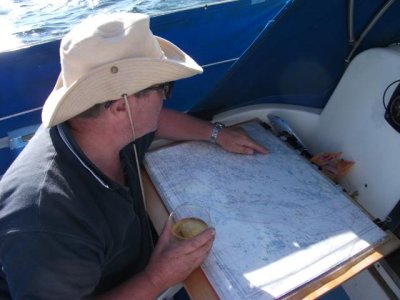
DSCF4352.JPG

DSCF4354.JPG

Studying the Swedish Archipelago charts .... (I have the Finnish set as well).
 
Back in the 80s and 90s there was no viable civilian GPS. Our boat (an Albin Vega) had a large collection of charts, lovingly maintained and updated by my dad. They lived in plastic holders and were stored under the mattress on the starboard bunk. The chart table was too small, being more of a chart shelf, so they ended up on the table which took up 90% of the saloon.

Whenever it was pi$$ing down and blowing hard, (which it did quite a lot in Scotland) I had to helm in my lifejacket and oilies with a towel wrapped round my neck to try and stop the rain getting in. The autopilot back then was voice controlled, dad shouted and I took the helm. My dad was up and down the companionway steps like a yoyo with handheld compass round his neck .... couldn't afford to get the charts wet, and bringing them into the cockpit meant they might get ripped or blown over board. The boat had no bimini, and the tiller was too far from the forward end of the cockpit, so a sprayhood wouldn't have helped either.

Funnily enough I don't miss any of it. I'm more than happy to use my plotter, autopilot, radar, sonar, AIS, and all the other modern conveniences ... I keep an eye on where the boat is going, but even in wind and rain it is far more relaxed than the 80s.
 
We can all recite extremes and circumstances to 'prove' our point.

My point in post #61 photos - was to illustrate the art of general overview and planning. I first went on boats when 5 yrs old .. my Father being in CAA (BoT) in those days - had various charts from aircraft ! And of course the relevant Solent area books. For years that was how we got about in various boats as a family ...
Later I joined the MN and trained as a Deck / Navigating Officer ... a passion instilled in me from my Father. I still have that passion today. I watched navigation evolve from Sextants, RDF, Loran, Decca etc - to Tranist and then just as I was leaving ships in 1989 - the promise of GPS .. By then I had also bought my first boat .. and splashed out on a Decca machine ... plans of crossing channel - but never did with that boat.
Various boats and locations later - I'm now Baltic based and with a number of boats ...

The Admiralty charts have been consigned to storage at home ... rarely coming out now. Only when nostalgia or wanting to describe a cruise / passage to another person. BUT the chart packs of Sweden and Finland are still an important part of the on-board inventory and for good reason.

Despite having good plotters and tablets for electronic navigation - they fall short in one arena .. general overview and planning ... zooming in / out / scrolling never compertes with having adjacent chartlets of the packs in front of you ... no scrolling .. no zooming .. just plain well presented detail you can run your finger / pencil long .. from one chartlet to the next ... and still see the overall plan.

I can sit where I am now .. (need to clear the desk though !) and have same chartlets out and 'dream' about next years cruise .. devising interesting route while still having destination visible on chart ...

If you try same with a plotter - you lose so much essential detail of depth etc due to the zooming out ..

I accept and appreciate that my scenario of the Swedish Islands as example is my way of working and not for some ... but as I meet so many CA members who cruise the same waters - guess what - near all of them carry the same chart sets for same reason ... when you are in an area that has ~30,000 rocks / islets / islands etc .... I suggest that chart set is a good set to have.
 
I think you’re projecting your own preferences into best practices. I find using electronics to dream and plan perfectly easy. I don’t use my plotter I use my phone and laptop, but it’s a long time since I got a paper chart out.
Everywhere we sailed this year was new to us after April.
 
I think you’re projecting your own preferences into best practices.

We’ve also gone from (paraphrasing):

“A long passage will soon show the folly of relying on electronic charts”

To (again paraphrasing):

“Paper charts are essential for showing your mate where you’re dreaming of going next”

I think the bit that people took exception to was the implication that charts are in any way essential nowadays. They are simply a relic of history that old men pine over.
 
Charts are not “a relic of history”. The reason that UKHO withdrew, withdrawing of charts, is that there is a need for them. Sure ECDIs is used on many large vessels, but not all. I recently was part of a commission team for a new Drill Ship, built in Korea and delivered to USA, which used charts. This was a state of the art drilling vessel in most instances of technology. It had one ECDIS and therefore was not insured for paperless navigation. The owner will be upgrading to two ECDIs in the future. ECDIS is expensive to buy and maintain, requires good cyber security to operate and power hungry, compared to buying and using charts, hence mini ECDIS was in place for smaller vessels. Most of the small UK commercial fleet have not bought into mini ECDIS in any significant numbers. Many of these vessels use paper charts which are a low cost option for the limited areas of operation that they work in. While I believe that paper charts will be withdrawn eventually the UKHO announcement was found to be premature which is why they are not currently withdrawing paper charts and have delayed until “after 2030”. It could be dealt with very quickly if the ridiculous OTT specification was dropped for certain categories of vessels. No, gold plating, is alive and well in the UKHO, RIN and RYA, when the evidence of successful, safe navigation on consumer plotters is evident.
 
While I agree they aren’t a relic of history, the main reason they are needed is that the committee approach to their electronic replacement has taken two decades too long and still isn’t ready. The lack of sales though, indicates that in the recreational realm at least paper charts just aren’t being used.
 
I think you’re projecting your own preferences into best practices. I find using electronics to dream and plan perfectly easy. I don’t use my plotter I use my phone and laptop, but it’s a long time since I got a paper chart out.
Everywhere we sailed this year was new to us after April.

And you are not projecting your own preferences ??
 
We’ve also gone from (paraphrasing):

“A long passage will soon show the folly of relying on electronic charts”

To (again paraphrasing):

“Paper charts are essential for showing your mate where you’re dreaming of going next”

I think the bit that people took exception to was the implication that charts are in any way essential nowadays. They are simply a relic of history that old men pine over.

That paraphrasing is unfair and gives wrong impression.

The long passage part - was regarding reliance on electronics that can fail for many reasons.

The paper charts and dreaming ... of course thyey are not essential .. you make your own choice. But as I posted later - I find paper charts easier to have a general overview when planning.
 
I'm sure we all do things differently, for various reasons.

As far as electronics go i have two Garmin MFDs at the upper helm with two 10.4" Android tablets at the lower helm, which can pair with the MFDs or act as stand alone plotters. The tablets are permanently connected to power, so always fully charged. We also have an additional Android tablet, 2 laptops, 2 phones and a mini PC connected to a 40" TV via HDMI. All devices have their own GPS and charts. The MFDs and tablets are powered by the domestic batteries but can be powered by the engine batteries if need be. The laptops can be charged from AC, domestic batteries or engine batteries and the PC is AC only. AC is supplied by a 3Kw inverter or a 12Kva generator. The autopilot and various other devices are on a N2K network, powered separately to everything else.

I can't think of a scenario where i could lose all of those devices, unless the GPS satellites fall out of the sky. If that happens i still have paper charts and steering/handheld compasses onboard. Can't remember the last time i used the paper charts though.

As for passage planning, that's done on the PC/40" TV with the resulting route sent to the phones, tablets and MFDs courtesy of Garmin Active Captain.
 
And you are not projecting your own preferences ??
No, just observing what’s happened. If people were using paper charts they’d be buying paper charts. They aren’t and so paper charts were very nearly withdrawn. The only reason for the reprieve was there was no replacement available for coded boats, otherwise they’d be gone.
 
electronics that can fail for many reasons.
In theory, yes. As can paper in a wet environment.
In practice neither fail often enough to be a problem and anyone leaving their local harbour likely has at least one backup. Those of us going further have many backups. It’s just not the same argument these days like it was 20 years ago.
 
Top