Charging battery powered tools

...a lot of donated battery power tools in their inventory, some of them quite good brands ..
Unfortunately they don't seem to have batteries for most of them.
Battery powered hand tools can be given a useful second life by the simple expedient of connecting a two core cable to their battery terminals and crocodile clipping the other end of said cable to a car/boat battery.
The very best tool I've found for drilling S/steel is an 18v battery drill, powered by a 12v battery.
 
You can now get a 240v, 4 1/2" grinder for £40ish, reasonable quality too. Disposable at that price.

I keep my brushless cordless grinder for "best", certainly don't sacrifice that to cut stone or grind sh1tty keels etc.
OK, thats certainly of interest.

Quick Google shows quite a few, including a Bosch for under 20 quid, surprising (assuming it isnt fake) though I guess it wont be Bosch;s best

I'd probably keep it for "best", though, and use a library one for the shitty keels.

OT but I'll need a better lung protection solution. Separate goggles and mask, even with an exhaust valve, seem to steam up almost immediately in Scotland and then I cant see a thing under the boat.
 
Last edited:
Pneumatic Needle guns were the mainstay of steel work prep on rigs and MN ships. Legions of the blighters, often working as a gang. I dare say there's a few on here who have spent many happy days/weeks/months with one as a deck apprentice?

As an Engineer Cadet, I spent much time trying to maintain/fix the guns...deck lads used to bu99er them up deliberately, so as to avoid work 🤨.

I most certainly do remember them .... and my ears do especially !! Imagine the noise on a steel deck over tanks .....

They really played havoc with your wrists with the vibration and if a needle broke - UGH !!
 
Battery powered hand tools can be given a useful second life by the simple expedient of connecting a two core cable to their battery terminals and crocodile clipping the other end of said cable to a car/boat battery.
The very best tool I've found for drilling S/steel is an 18v battery drill, powered by a 12v battery.
Thats of interest too, and would reduce my reluctance to buying a cheapo one, which I did maybe 30 years ago (so different tech). 12V battery failed almost immediately, but I never got around to fitting it with jump leads as intended.

I had wondered if the difference between 18V and 12V would be a problem.
 
Battery powered hand tools can be given a useful second life by the simple expedient of connecting a two core cable to their battery terminals and crocodile clipping the other end of said cable to a car/boat battery.
The very best tool I've found for drilling S/steel is an 18v battery drill, powered by a 12v battery.

Exactly ....

Tip : Do not throw away the old battery - the drill / tool was designed to be 'balanced' with it fitted ... so open it up .. disconnect the batterys from the contacts .. put the external power cable in via a hole to the contacts and close up - plug back into tool.

Here's a video of my putting an old LiPo battery into an old drill .... once I find my LiPo's not flying my models so well - I repurpose the batterys to flashlights ... other uses where amp draw is less ... they last years like that !!


The video shows using a 4S battery ... which is max 16.8v ... it actually proved to be just a bit too much - especially that a LiPo can discharge at very high amp rates ... so I later changed to a 3S battery 2200mAh (12.6v max).
Of course once changed to LiPo - I only charge it with a proper LiPo charger .....
 
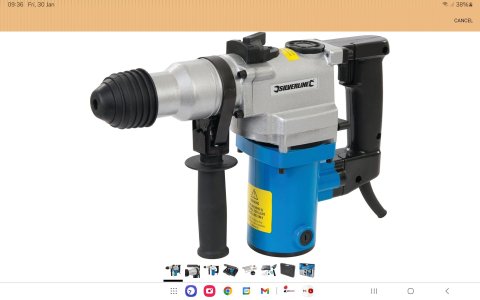
I borrowed a library wired SDS Makita and some chisels to try on the inside of the steel bilge keels.They had one with a charger and two batteries which I wouldnt hsve minded trying but it was significantly heavier. Quite a long walk from bus stop to yard, uphill on the way back. Also got an angle grinder with a couple of disks, but these are sanding (60 and 80 grit) and probaly not aggressive enough. Ill see what I can find.

I use disks made from aluminium cans for light rust removal and the application of aluminium to the surface (with a drill. There may not be clesrance to do this safrly with an sngle grinder).

Disks made from tin cans should be more aggressive, though not so easily scrounged up or made, so I havnt tried it so far.
 
Top