billskip
Well-Known Member
It's very much at home hereabouts then....AI, it literally makes things up.

It's very much at home hereabouts then....AI, it literally makes things up.

It's called hallucinating, that's what we say when the ai makes up stuff again. But as I said, nust explaining, not defending. I don't approve of it either.It’s orders of magnitude more important to do those things with AI, it literally makes things up. For instance it would mention that central pin just because many conversations do, it has no clue about specific model details.

USB-PD can ONLY be provided by a special power supply. You can feed these 12v or 24v and they will convert the voltage up or down as required by the PD protocol. Feeding the power supply with 12v does NOT limit you in any way.Unless you have a fancy 12v power supply that will pump the voltage USB-PD is limited to 27W on a 12V system (9V at 3A) is the maximum supported power without upping voltage. The expensive power supplies with a brick like the Belkin or Lenovo can up voltage for additional power but almost no USB sockets for install on a boat go over 27W per port for this reason.
MacBooks and most Surface laptops are fine with this and consume about 13W in use but heavy usage such as video production will up that on any device.
140W might not be required. I wonder what would be the minimal to support MacPro 16". 13W as someone said previously?USB-PD can ONLY be provided by a special power supply. You can feed these 12v or 24v and they will convert the voltage up or down as required by the PD protocol. Feeding the power supply with 12v does NOT limit you in any way.
This one, for example: Amazon.co.uk
Will give you 140 watts PD. Plug it into a 12v lighter socket. It costs only £28.
It depends what you are doing with the laptop! I can run 15" MacBook Pro from a 20W charger so long as I am gentle/careful what I am doing! Try processing video etc and you'll consume more than it can put out (so will draw on the battery). For "light domestic" duties, keeping the screen brightness low, closing apps you aren't using and probably turning off bluetooth and making sure if Wifi is being used its got a good signal, and you aren't plugging lots of accessories in to the USB ports and then closing the screen whenever not in use you can get away with it on 20W maybe less, and charge the battery slowly. That should mean you can even push it to brief periods of harder work. If the OP is trying to do paid work, with any heavy processing, then he wont want to be skimping, although 140W seems exceptional, but if he likes to work from the battery alot then it would be handy to have a really fast charge.140W might not be required. I wonder what would be the minimal to support MacPro 16". 13W as someone said previously?

Not correct. USB-PD works on various voltages - 5, 9, 15, 20, 28, 36, 48. In all of these the standard limit is 3A, which is set by the connectors and cable size, hence increasing voltage to increase power. There is an addition to the spec to allow 5A but this is far from widely used or standard. At 5V (standard USB) this means 15W is the limit, while at 9V 27W is the limit and so on.USB-PD can ONLY be provided by a special power supply. You can feed these 12v or 24v and they will convert the voltage up or down as required by the PD protocol. Feeding the power supply with 12v does NOT limit you in any way.
This one, for example: Amazon.co.uk
Will give you 140 watts PD. Plug it into a 12v lighter socket. It costs only £28.
You are missing the fact that most PD power supplies are capable of stepping the voltage UP.Not correct. USB-PD works on various voltages - 5, 9, 15, 20, 28, 36, 48. In all of these the standard limit is 3A, which is set by the connectors and cable size, hence increasing voltage to increase power. There is an addition to the spec to allow 5A but this is far from widely used or standard. At 5V (standard USB) this means 15W is the limit, while at 9V 27W is the limit and so on.
With a 12V supply, you can happily fit a car type USB socket which will drop the voltage to 5V or 9V and supply up to 27W per port of USB-PD power within the specifications. I have several of these USB-PD sockets on board https://www.amazon.co.uk/dp/B09534JNNT which are limited by input voltage but absolutely are PD ports.
As I correctly said, the fancy adapters with power bricks will step up the voltage from the 12V to provide higher power, but this means more electronics, more cost, more size, and more heat. It also means that your 12V cigar socket must have fuses and cabling rated to supply the max power at 12V or it becomes a fire risk, and that includes the socket itself. The device you linked is like the Belkin/Lenovo I mentioned and ONE of the ports seems to step up the voltage to 28V or 36V (unclear since they claim 90W) while the other two are limited based on input voltage to 24W (again, this seems random and doesn't align to the spec). They're a good option, but when compared to using the standard AC adapter with a small inverter are not really worth the cost, and aren't more efficient.
No I’m not, that was literally the point of both of my postsYou are missing the fact that most PD power supplies are capable of stepping the voltage UP.

OK, but you wrote this: "Unless you have a fancy 12v power supply that will pump the voltage USB-PD is limited to 27W on a 12V system (9V at 3A) is the maximum supported power without upping voltage. The expensive power supplies with a brick like the Belkin or Lenovo can up voltage for additional power but almost no USB sockets for install on a boat go over 27W per port for this reason."No I’m not, that was literally the point of both of my posts

More than likely it would be enough. I've run an Intel MacBook Air off a 15W USB-C car adaptor and it charged in use - I'm pretty sure part of the point of Apple's adoption of AppleSilicon (i.e. the M1, M2 etc ARM chips) is that it's more efficient than Intel, so I doubt a MacBook Pro would draw much more. I found with the 15W adaptor that the battery would drop to 90% when I was running Gimp (like Photoshop) and then it would fill up again between jobs. It would stay at 100%, once charged, when used for normal browsing etc.140W might not be required. I wonder what would be the minimal to support MacPro 16". 13W as someone said previously?
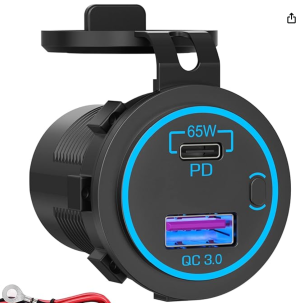
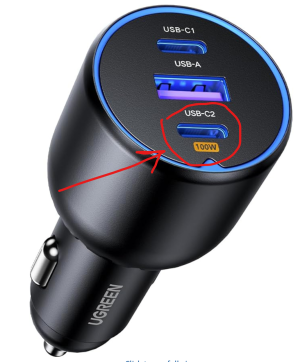
Two of those are big adapters, not ports to install. The first might do 65W with a 24V supply but otherwise unlikely. It’s literally the same part I have but with “65” aspirationally written on it.OK, but you wrote this: "Unless you have a fancy 12v power supply that will pump the voltage USB-PD is limited to 27W on a 12V system (9V at 3A) is the maximum supported power without upping voltage. The expensive power supplies with a brick like the Belkin or Lenovo can up voltage for additional power but almost no USB sockets for install on a boat go over 27W per port for this reason."
"Almost no USB sockets for install on a boat go over 27W per port. . . " -- On the contrary almost ALL of them do. And I linked power supplies with no "brick", which can plug into a cigar lighter, which go up to 140W. And I linked a "brick" one from a quality maker, Belkin, which can be easily used on a boat, which gives 100W and cost £27. I myself am using one which gives 65W and cost £8, which has been powering my nav computer for a couple of years now.
What you wrote might have been true a few years ago, but time has moved on. The only reason why I bother with this discussion is I wouldn't want others reading your post to be put off by the idea that it's futile to find an economical DC power supply for PD laptops and suitable for boats -- that is absolutely not the case. You can power even a quite powerful laptop from the boat's DC power system, and not expensive.
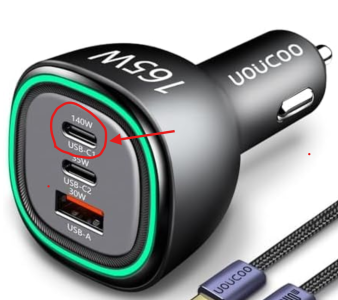
The devices depicted in the attached photos are literally the first three that came up in an Amazon search for "12v PD chargers". The last one gives 140W and costs £12.
..... but only the artificial bit ....It's very much at home hereabouts then....

I'd love to see Big Clive measure the actual power available. I've been cynical about power claims ever since firms like Amstrad used "peak instantaneous music power" or similar instead of RMS.The devices depicted in the attached photos are literally the first three that came up in an Amazon search for "12v PD chargers". The last one gives 140W and costs £12.
So I own the 65W one and my power-hungry HP work laptop feeds happily off it. It produces 58W on my USB tester. I believe it's doing 3A @ 20v.Two of those are big adapters, not ports to install. The first might do 65W with a 24V supply but otherwise unlikely. It’s literally the same part I have but with “65” aspirationally written on it.