Catching Jibsheets

If your sheets catch on the inner forestay, you could try putting one of those clip on plastic tubes, split along the length over it when not using an inner jib. It rotates on the wire allowing the sail and sheets to pass more easily.
 
On my forward lower shrouds I use 15mm pvc rigid electrical conduit, it keeps well for 5-7 years, 2m length costs like 1-2 euro. Leave top and bottom open so rain can flow along wire.
I first tried those white flexible plastic sort-of slit hoses, they accumulated a lot of black crud along the wire, probably not good for the steel but surely a mess to clean.
 
On my forward lower shrouds I use 15mm pvc rigid electrical conduit, it keeps well for 5-7 years, 2m length costs like 1-2 euro. Leave top and bottom open so rain can flow along wire.
I first tried those white flexible plastic sort-of slit hoses, they accumulated a lot of black crud along the wire, probably not good for the steel but surely a mess to clean.
Yes, that's what I used and it worked well.

Another thing that helps is to tie the bowlines at the clue (if that's what's used) so they don't hook onto the shroud.
 
Shroud rollers are the thing to use. They spin around the wire and have an air gap so no build up of crud etc. Ok they are not really cheap more expensive than electric conduit but there again they do the job really well and last a long long time. Available from many chandleries just search on internet.
 
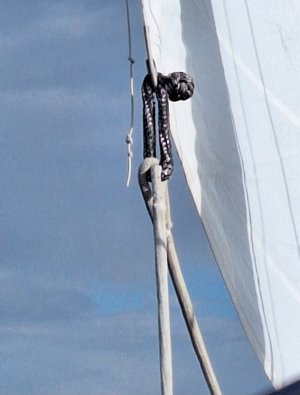
I just set my hank on jib up with this - a thick dyneema soft shackle and spliced ends in the jib sheets. Main reason was to avoid concussion when handling the sail in strong winds! It catches much less. Considering changing my roller genoa to this as well.

Splicing old 14mm rope is a slow battle.

Screenshot_20250408_112143_Gallery.jpg
 
On my last boat, I used a simple cow hitch, as I had a single line for my genny sheet. Current boat has eye splices and a hard shackle, but I really ought to put a soft one there, though TBH, I'm unlikely to be going forward when the genoa's unfurled.
 
I would not fit conduit or any other close fitting tube. They exacerbate dampness and risk increasing corrosion in swages on the end fitting, which I experienced. Also I ended up with load of green slime growing inside and on the rigging wire. If used they are not fit and forgetting and you should slide up and clean out from time to time.

On my inner forestay, the Genoa sheets hang when tied with a bowline. When the staysail is hoisted, they don't hang up. However, to solve the issue the cow hitch works well. On an older yacht I sailed, they used a stopper knot on the end of the sheets at the clew, which also worked, but the clew needs to be small enough to allow that.
 
Then put some splayed timber blocks on the corners to lead the sheets over the corners of the panels
This ^^^

For cleats you can buy expensive things called cleats boots - which PBO had a diy version of using a pin of plumbing pipe and shock cord. My ever growing todo list has 3d printing some prettier equivalents. As DDB says you need to make it impossible for the sheet to go under the corners, Probably overpriced commercial solutions available but wood or plastic waste pipe and a heat gun should make it possible to make something to smoothly guide the line over the obstruction.
 
I definitely try a double length sheet cow hitched on to the clew before you do anything else.

Made a huge difference to our boat, overlapping Genoa rarely gets snagged, previously it was pretty much 50/50 especially in light air.
 
I definitely try a double length sheet cow hitched on to the clew before you do anything else.

Made a huge difference to our boat, overlapping Genoa rarely gets snagged, previously it was pretty much 50/50 especially in light air.
I have used that in the past but although it works well it isn’t possible with that system to reverse the sheets to even out wear.
 
I definitely try a double length sheet cow hitched on to the clew before you do anything else.

Made a huge difference to our boat, overlapping Genoa rarely gets snagged, previously it was pretty much 50/50 especially in light air.

Instead of double length sheet, cow hitched in the middle - but building on the idea.

We sourced hollow braided dyneema, most rope manufacturers can supply, with a diameter the same as the sheet. Milk each single sheet into the braid, one from each end. Leave a gap, about 100mm, between the two, now buried, sheet ends. Using dyneema braided fishing line sew the sheets into the dyneema braid.

Cow hitch the sheets using the 'empty' part of the braid. Because the braided dyneem that is being cow hitched is 'empty' the knot flattens

Dyneema is naturally slippery.

It is difficult to detach the sheets, the knot tightens and flattens like concrete. Most ideas on yachts involve compromises.

Jonathan
 
I definitely try a double length sheet cow hitched on to the clew before you do anything else.

Made a huge difference to our boat, overlapping Genoa rarely gets snagged, previously it was pretty much 50/50 especially in light air.
Funny you say that. I have used the cow hitch method for many years .

I changed this season to a rope shackle and whipped single eye. You might have something there.

.
 
I definitely try a double length sheet cow hitched on to the clew before you do anything else.

Made a huge difference to our boat, overlapping Genoa rarely gets snagged, previously it was pretty much 50/50 especially in light air.
Tried the same approach on my boat. Worked better than 2 sheets and 2 bowlines but I still have an issue of the sail hanging up either on the radar or the bottom of the spinny pole mounted in the front of the mast.
 
I would not fit conduit or any other close fitting tube. They exacerbate dampness and risk increasing corrosion in swages on the end fitting, which I experienced. Also I ended up with load of green slime growing inside and on the rigging wire. If used they are not fit and forgetting and you should slide up and clean out from time to time.

.

Our stays are 4 mm, we use 1 1/4 inch pipe, only needed to be 18 inches high, plenty of drainage and airspace :)
On our foredeck cleats, two wooden wedges with curved outer ends held together round the clear by bungy cord. Cost about 50p.
 
Top