Carbon monoxide going off - possible causes?

Thanks for your tips. I charged them one at a time and two of the three domestic batteries caused the CO alarm sitting on top of the battery in the cupboard to alarm within 10 mins. One domestic and the engine battery seem OK.

All four of these are Exide Dual ER350 flooded cell batteries.

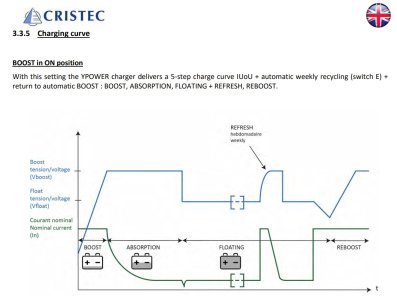
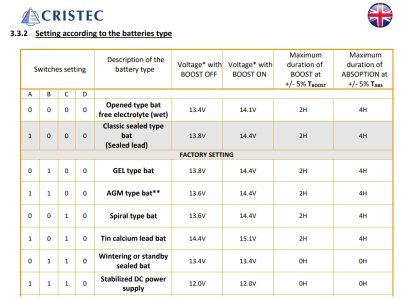
The charger is a Crystec 12v/40A powered by shore power and the dip switches were in the factory default position. My question is, are the Exide Dual ER350, what Crystec refer to as "Opened type bat free electrolyte (wet)" or "Classic sealed type bat (Sealed lead)". The default position for boost is also ON.

The BM2 is showing a charging voltage of 14.4v. I had a cheap multimeter I keep on the boat but don't trust it's accuracy (it read 16.5v open circuit voltage on all the batteries), will check tomorrow with my Fluke meter. As mentioned, the dealer told us the 2016 boat had new batteries when we bought her last year so I wonder if that was a fib or there is something wrong with the settings/the ER350s.

EXIDE Dual ER350 | Exide

https://www.cristec.fr/english/wp-content/uploads/sites/4/2022/01/YPO-manual.pdf
crystec.jpg
crystec2.jpg
 
Looking at Exide's website and Tanya for possible replacements, the battery comes with a optional vent tube. In my case, these are still coiled up and taped to the side of each battery so the gas must just escape from the hole in the centre side of the top plate. On a boat, I wonder if these should be vented via a longer pipe to say the rear underfloor locker area which is a lot more draughty than the sealed up cabin when the boat is locked up.

If I'm looking at a new/better charger and possibly 4x new batteries as well, then maybe this is the jump to lithium? There may be a problem with physical space since Beneteau squeezed all four batteries nicely together in one of the cabins and the same or smaller physical size will be a deciding factor.

Is it normal for boat batteries under charge to vent sufficient hydrogen to trigger gas alarms? Even the Nereus WG200 alarm booklet says "off gassing of batteries eg when heavily charged or overcharged may cause the unit to alarm. If this occurs, check the ventilation of the battery compartment".
 
Looking at Exide's website and Tanya for possible replacements, the battery comes with a optional vent tube. In my case, these are still coiled up and taped to the side of each battery so the gas must just escape from the hole in the centre side of the top plate. On a boat, I wonder if these should be vented via a longer pipe to say the rear underfloor locker area which is a lot more draughty than the sealed up cabin when the boat is locked up.

If I'm looking at a new/better charger and possibly 4x new batteries as well, then maybe this is the jump to lithium? There may be a problem with physical space since Beneteau squeezed all four batteries nicely together in one of the cabins and the same or smaller physical size will be a deciding factor.

Is it normal for boat batteries under charge to vent sufficient hydrogen to trigger gas alarms? Even the Nereus WG200 alarm booklet says "off gassing of batteries eg when heavily charged or overcharged may cause the unit to alarm. If this occurs, check the ventilation of the battery compartment".
Lots of boats have batteries under sofas or berths, unvented and don't set Co alarms off.

I did have a Co alarm that kept going off with 4x Trojan T105s under a sofa. A new alarm stopped that happening.

If everything else seems normal it's worth spending a few quid on a new Co alarm to try it ?
 
Lots of boats have batteries under sofas or berths, unvented and don't set Co alarms off.

I did have a Co alarm that kept going off with 4x Trojan T105s under a sofa. A new alarm stopped that happening.

If everything else seems normal it's worth spending a few quid on a new Co alarm to try it ?
The problem is that the the fairly new battery CO alarm (Fire Angel type) is backed up by a Nereus dual LPG/CO alarm with the CO sensor under the sofa in the saloon near the heater vent. The Nereus is a well made £400 bit of kit and in the most recent event (alerted to me by the marina), both the wall mounted battery powered alarm and the powered Nereus devices had gone into alarm.

Nereus are calling me back with the PPM of H that will trigger the CO alarm as they are aware that this is a cause of false triggers but assured me that the levels at which it alarms are a tiny % of that required for combustion/explosion.

Gas Detector Alarms for Boats - WG200-LC

Maybe it's the unseasonal hot weather, maybe it's the Crystec battery charger gone out of calibration? Going to take some more accurate & comparative measurements tomorrow inc the charge voltage when the batteries are being replenished by the alternator.

I'm starting another 3 week cruise next week so will monitor the situation.
 
They are not, they are sealed lead acid

I agree, i'd want them to float at 13.4, but with 14.4v boost, which doesn't exist.

A better charger would be a good move.
I think 'sealed' in this context implies VRLA type batteries, which being recombinant typically accept a 13.8V float charge?
The Exide batteries in question are flooded with vents, an open battery even if it's 'maintenance free' and not designed to be topped up.

I can't find Exide's recommendation for charging, but this doc:

https://www.exidegroup.com/cn/en/document/marine-battery-solutions
describes the battery as
•low gas emission.
•To be installed in special container'

while the 'Dual AGM' types are :
•Internal gas recombination
• No location constraints (cabin safe)

So my guess is previous owner has skimped on battery replacement. And not adjusted the charger to suit.
 
I think 'sealed' in this context implies VRLA type batteries, which being recombinant typically accept a 13.8V float charge?
The Exide batteries in question are flooded with vents, an open battery even if it's 'maintenance free' and not designed to be topped up.

I can't find Exide's recommendation for charging, but this doc:

https://www.exidegroup.com/cn/en/document/marine-battery-solutions
describes the battery as
•low gas emission.
•To be installed in special container'

while the 'Dual AGM' types are :
•Internal gas recombination
• No location constraints (cabin safe)

So my guess is previous owner has skimped on battery replacement. And not adjusted the charger to suit.
If you can't top them up they are not open !

They obviously have a vent, but they are supposed to be low gassing and as they can't be topped up they should not be subject to high enough charging voltages to cause gassing.

As i said previously, the float voltage would be better set to 13.4v
 
The problem is that the the fairly new battery CO alarm (Fire Angel type) is backed up by a Nereus dual LPG/CO alarm with the CO sensor under the sofa in the saloon near the heater vent. The Nereus is a well made £400 bit of kit and in the most recent event (alerted to me by the marina), both the wall mounted battery powered alarm and the powered Nereus devices had gone into alarm.

Nereus are calling me back with the PPM of H that will trigger the CO alarm as they are aware that this is a cause of false triggers but assured me that the levels at which it alarms are a tiny % of that required for combustion/explosion.

Gas Detector Alarms for Boats - WG200-LC

Maybe it's the unseasonal hot weather, maybe it's the Crystec battery charger gone out of calibration? Going to take some more accurate & comparative measurements tomorrow inc the charge voltage when the batteries are being replenished by the alternator.

I'm starting another 3 week cruise next week so will monitor the situation.
Try the open type bat setting, 13.4v would be a better float voltage.

A battery monitor would be useful. A Victron Smart Shunt works well and will keep some history so you can see if anything is overcharging the batteries.
 
There is a NASA BM2 installed. If I am going to start swapping anything and replacing batteries, I will need to think about a lithium/3kva inverter set up first.

A motorhome forum has posts of people pulling the centre cap off these batteries to top up.

I plan to speak to the dealer who fitted the batteries and Exide this morning.
 
Top