Can you parallel two flexible water tanks?

contessaman

Well-Known Member
Joined
29 Oct 2009
Messages
823
Visit site
I've had enough of my fresh water tank thats formed as part of my keel and hull. Osmosis flavoured water doesn't appeal to me anymore!

Chopped the baffles out of the tank and flowcoated the inside smooth... Ready to install a flexible tank inside . Only thing is original tank was 400 litres. The plastimo flexible tank is 200 litres. So I was thinking about two of them inside the tank space , side by side. Y piece in the filler pipe to both of them and ditto the outlets connected together to feed one pipe to the pump .

Has anyone done similar? Any pitfalls or advice ?

I can't see that anyone makes a 400 litre flexible tank and two separate ones will sort of perform the function of a baffle and limit the sloshing about I thought...
 
I fitted a flexible tank in series with a fixed tank using one filler into the fixed tank and a ball valve from there to the flexible tank. Drew from the fixed tank and topped up from the flexible by opening the valve. worked well. No reason why it should not work with 2 flexible tanks.
 
I've had enough of my fresh water tank thats formed as part of my keel and hull. Osmosis flavoured water doesn't appeal to me anymore!

Chopped the baffles out of the tank and flowcoated the inside smooth... Ready to install a flexible tank inside . Only thing is original tank was 400 litres. The plastimo flexible tank is 200 litres. So I was thinking about two of them inside the tank space , side by side. Y piece in the filler pipe to both of them and ditto the outlets connected together to feed one pipe to the pump .

Has anyone done similar? Any pitfalls or advice ?

I can't see that anyone makes a 400 litre flexible tank and two separate ones will sort of perform the function of a baffle and limit the sloshing about I thought...
Flexible tanks long term seem to be trouble. I would coat with WRAS approved paint refit the baffles and stay with a rigid 400 litre tank
 
I have two 100l flexible tanks. They do not have internal baffles. If your 200l tanks are also baffle free, I would consider strapping them down well, so that you cannot get a (modified) free surface effect as the boat pitches and rolls. I also have a piece of thin polypropylene carpet between the tank and hull to make sure there is no abrasion.

And finally, very shortly I am going to put valves across the outlets of both tanks to select one tank at a time, to prevent total loss of fresh water from over-enthusiastic people cleaning the galley....
 
We have 2 inflexible tanks, 200l each, under the sole in each hull. They are identical tanks in the same location. We have isolated each tank (from the other) and draw from one tank at a time - like Sarabande we don't want two contaminated tanks. Isolation is a simple valve. We did find that when the 2 tanks were interconnected we could not draw that last 75 litres from one tank - and never worked out why. We can now pump out each tank almost completely. Our pump is about 2m from each tank and about 1m above the take off point.

Like Geem I have heard stories of people damaging flexible tanks simply because the tanks move and the abrasion causes leaks. With the water sloshing about in the tank I cannot see how you would easily stop them moving.

Jonathan
 
I did think about keeping the tank as fixed and painting or expoxying it , this has been done before, but because of the shape you cant get to about 1/4 of it I'd litteraly have to chop the boat to pieces. Really it's gross ...no matter how much I cleaned it or sterilised it the water always had a vinegary Sulphur taste

I like the idea of bags as they can be replaced every few years to keep it all fresh. Regarding failure rate maybe I was lucky but my boat previous to this had a single bag in the keel space when I bought it , I presume it was the plastimo as it had the tough blue outer coating. Anyway, I had that boat 7 years and filled and used the water hundreds of times and it was still fine when I sold it.

Would definitely agree they need to be secured and padded from the hull with something.

Has anyone done what I said and paralleled up the fillers and outlets? I can't do series as that would necessitate one tank higher than the other , if I use two they'd be side by side...

Although some of your posts have got me thinking maybe I would be better with valves and independence at least if one bag burst I wouldn't lose all my water on an ocean passage. I do have a small fixed tank fed by a watermaker though, under the starboard berth for drinking water and this just feeds the galley via a hand pump so it wouldn't be curtains if I lost if the main tanks failed on a passage
 
I've just thought, what about instead of valves , each tank has its own pressure pump and then the outlet of these two pumps feed into the manifold that drives the coldwater and calorifier feed? Or would the fact that the pumps wouldn no doubt kick in at slightly different pressures cause chaos and empty one tank before the other? Suppose they could be switched electrically though so I could chose which tank to draw from.
 
My boat was built with 2 x 200 litre flex tanks in parallel. No problems at all although as others have said no matter how careful you are you eventually get leaks from small pinch areas on the inners. They are however cheap and easy to fix. Worth having isolator valves on each tank. Mine have individual fillers but could be filled through one although the cross connection would be a bit slow.
 
I replaced the leaking metal tank with two plastimo flexible bags fitted either side of the propshaft. They were originally plumbed as one for the galley and one for the heads. I twinned them to get continuity of supply to both outlets. No problems in the last 15 years, and they don't seem to move about. I have removed them a couple of times to give them a good clean out with Milton after the water left in went stale, which was something that you can't do with a fixed tank.
 
I have five Plastic flexible tanks all of which have sealed breathers. The outlets are all connected in parallel to a main feed/drain via valves to each tank (I used fish tank valves which are cheap).
When filling, all the valves are opened and filling stops when the deck filler overflows.

Once full, one valve is left open. As the pumps (one each for hot and cold - don't ask - complicated) suck on the tank, it collapses until it is completely empty. The extract connection is in the middle of the length and the tank sits in a shallow bilge. As each tank is exhausted, I connected another.

Ingress of air is fatal to this system and the deck filler needs to be securely sealed. I did have problems with the lastimo tank valves as the sealing arrangement was a bit suspect.
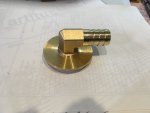
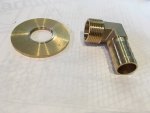
I replaced them with these;-
IMG_1431.jpgIMG_1430.jpg
with (rectangular, to enable entry) backing plates inside the tank. With 6mm core diameter O rings, they seem to do the job. The other connections used normally as air vents, were sealed in a similar fashion.
 
My Vancouver has 3 flexible tanks above the keel They are connected together by connecting pipes close to the bottom of the tank. The exit pump also comes from near the tank bottom. The filler pipe is also near the bottom of the tank. Has worked well for 30years. As others have said all 3 bags just collapse as the water is sucked out
David MH
 
My Vancouver has 3 flexible tanks above the keel They are connected together by connecting pipes close to the bottom of the tank. The exit pump also comes from near the tank bottom. The filler pipe is also near the bottom of the tank. Has worked well for 30years. As others have said all 3 bags just collapse as the water is sucked out
David MH
How many miles have you done in the last 30 years? Violent movement of the boat making the bag tank move a lot and will vastly reduce the life compared to sitting in a marina or on a mooring. A bag tank being moved a lot chafes far move quickly. If you tell me you have done couple of circumnavigations I will be impressed?
 
My mileage has been small. I agree that bags on long distance sailing yachts are not the best. I do have sacrificial mats under and around the the tanks to reduce the chafe. If I was going to do long distance I would likely replace the flex tanks with plastic tanks such as Tektanks.

David MH
 
If you've got 2 separate tanks that are a doddle to switch over, that'll be a safer option if one develops a small leak, or you fill one (for whatever reason) with 'dirty' water, they're isolated from each other. This is standard for many circumstances where water preservation is important.
 

Other threads that may be of interest

Top