Can Anyone help with a Circuit, Please?


.
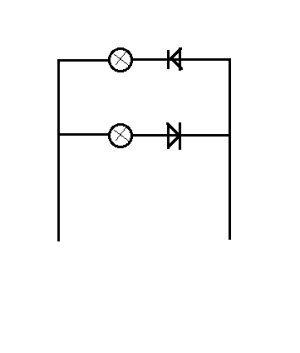
I think there is a way of doing the diode switching even is the light isn’t polarity sensitive. It appears possible with 4 diodes, maybe with just 2 on the negative connection to the fitting.

Your circuit will work when the lights ARE polarity sensitive but maybe not if they are not.

What I described in #12 will work for filament bulbs or led lights which are not polarity sensitive
1706993143236.png
 
.


Your circuit will work when the lights ARE polarity sensitive but maybe not if they are not.

What I described in #12 will work for filament bulbs or led lights which are not polarity sensitive

View attachment 171743
Sorry, my typo there. I was trying to find a way for Polarity Sensitive LEDs on this particular common neg/ L1L2 positive wiring using just 2 core, since you have already described how to do it for non polarity sensitive LEDs.
 
Thanks everyone, I've got it working at home using this.
I think there is a way of doing the diode switching even is the light is polarity sensitive. It appears possible with 4 diodes, maybe with just 2 on the negative connection to the fitting.

View attachment 171732
It also worked with 4 diodes but, obviously, 2 give a lower voltage drop, so no advantage to 4.

Now all I have to do is work out the best way to make reliable weatherproof connections for everything. Plan A is to to solder the diodes to the tiny wires coming out of the light and protect with heatshrink, then connect to the two-core with heatshrink crimp connectors.
 
Thanks everyone, I've got it working at home using this.

It also worked with 4 diodes but, obviously, 2 give a lower voltage drop, so no advantage to 4.

Now all I have to do is work out the best way to make reliable weatherproof connections for everything. Plan A is to to solder the diodes to the tiny wires coming out of the light and protect with heatshrink, then connect to the two-core with heatshrink crimp connectors.
And a few wraps of self amalgamating tape?
 
Thanks everyone, I've got it working at home using this.

It also worked with 4 diodes but, obviously, 2 give a lower voltage drop, so no advantage to 4.

Now all I have to do is work out the best way to make reliable weatherproof connections for everything. Plan A is to to solder the diodes to the tiny wires coming out of the light and protect with heatshrink, then connect to the two-core with heatshrink crimp connectors.

Out of interest, what diodes are you using?
.
 
1N4004G. It's what my local electronics component shop had. I would have preferred Shotkky diodes, but the only ones they had were signal diodes, with a tiny current capacity. They might (just) have done the job, but 'might just' isn't something I want at the top of my mast.
 
1N4004G. It's what my local electronics component shop had. I would have preferred Shotkky diodes, but the only ones they had were signal diodes, with a tiny current capacity. They might (just) have done the job, but 'might just' isn't something I want at the top of my mast.
It’s possible the light is internally regulated to 5v or 9v etc and may dump the excess potential from a 12v supply anyway, so the slightly higher dropped voltage from a standard 1N4*** may be irrelevant
 
After all this and getting the light working with diodes, I can't find a suitable switch to match the ones on the panel. :-(

A friend has suggested using the mast itself as the negative return. It's a GRP boat and the rig is electrically isolated from the batteries and engines. Can anyone see a problem with that?
 
After all this and getting the light working with diodes, I can't find a suitable switch to match the ones on the panel. :-(

A friend has suggested using the mast itself as the negative return. It's a GRP boat and the rig is electrically isolated from the batteries and engines. Can anyone see a problem with that?
I personally wouldn't. You will still have bits of wire linking sections up and every joint is another place for a fault to occurr.
 
After all this and getting the light working with diodes, I can't find a suitable switch to match the ones on the panel. :-(

A friend has suggested using the mast itself as the negative return. It's a GRP boat and the rig is electrically isolated from the batteries and engines. Can anyone see a problem with that?
Not a good idea to use the mast for carrying any current.
 
After all this and getting the light working with diodes, I can't find a suitable switch to match the ones on the panel. :-(

A friend has suggested using the mast itself as the negative return. It's a GRP boat and the rig is electrically isolated from the batteries and engines. Can anyone see a problem with that?
Can you keep the existing switch for on/off, and add an additional discrete switch for choosing tri or anchor?
 
Last edited:
After all this and getting the light working with diodes, I can't find a suitable switch to match the ones on the panel. :-(

A friend has suggested using the mast itself as the negative return. It's a GRP boat and the rig is electrically isolated from the batteries and engines. Can anyone see a problem with that?

I may have missed but what is the current switch like and how many positions and can you show the pic of the current connections
 
After all this and getting the light working with diodes, I can't find a suitable switch to match the ones on the panel. :-(

A friend has suggested using the mast itself as the negative return. It's a GRP boat and the rig is electrically isolated from the batteries and engines. Can anyone see a problem with that?
If the switches are the pull / push type I found some very similar on ebay a few years ago. Unfortunately my ebay order history doesn't go back far enough.
 
After all this and getting the light working with diodes, I can't find a suitable switch to match the ones on the panel. :-(

A friend has suggested using the mast itself as the negative return. It's a GRP boat and the rig is electrically isolated from the batteries and engines. Can anyone see a problem with that?
What switches do you have Steve ?
 
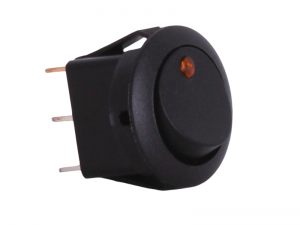
My current switches are like these.

onoff-round-mini-rocker-switch-with-amber-light-12v.png

I've only found one listing for a double pole on off on one, and they're out of stock.
 
I would use that switch to drive 2 relays one to switch the tricolour and the other to drive the anchor

!2Vdc would be connected to the center terminal of the switch and one relay would be connected to the one outer terminal and the other relay connected to the other outer terminal

The negative would be connected to the both relay negative

The + and negative connected to the 2 poles relay input the outputs would go to the twin wires to the lights reversing the polarity
 
I did wonder about a relay, but wasn't anxious to add the extra current. Nosing around the internet, it does seem that relays are available that draw a few ma, so I'd still be better off than the original light with its bulb, They're designed to be mounted on a PCB, but I suppose I could solder the wires directly or, perhaps better, use a bit of stripboard, which I reckon would be more robust.
 
I would use that switch to drive 2 relays one to switch the tricolour and the other to drive the anchor

!2Vdc would be connected to the center terminal of the switch and one relay would be connected to the one outer terminal and the other relay connected to the other outer terminal

The negative would be connected to the both relay negative

The + and negative connected to the 2 poles relay input the outputs would go to the twin wires to the lights reversing the polarity
This will not work because the switch is a simple on/off switch. The third terminal is for the LED negative.
 
Top