Bulb primer in diesel line

Primer bulbs have been fitted to millions of cars, Peugeot/Citroen used to fit them to just about every diesel. Not so much with common rail i suspect. They usually last for decades, so for the OPs to fail in just two years, something is odd. Perhaps a cheapo bulb, or one not designed for diesel ?
 
Last century Volvo used similar lift pumps on most small engines but with different diaphragms depending on fuel used ie either petrol or diesel which would suggest to me the same allowance should be to pump bulbs
 
Primer bulbs have been fitted to millions of cars, Peugeot/Citroen used to fit them to just about every diesel. Not so much with common rail i suspect. They usually last for decades, so for the OPs to fail in just two years, something is odd. Perhaps a cheapo bulb, or one not designed for diesel ?
They still fit them to the 2010 3008 engine, (which is used in the Volvos, who do not fit a primer )

In the Peugeot it is a hard plastic that feels it is about to split at any moment, but works a treat....mine is 14 years old at this stage, only used when the fuel filter is changed, but so much handier than fussing about with a vacuum pump or oil extractor.
 
I bleed my fuel lines using suction from a big syringe with a fat O ring over the tip. I remove the secondary filter bleed screw, push the syringe down over the bleed screw hole and suck out the air.
In my system it has proven to be a very simple and quick method requiring no permanently installed extra components.
 
Just wondering if bulbs are not provided from the beginning because some regimes consider the rubber not sufficiently fire proof. That and possible rubber deterioration seem to be the only down side to fitting a bulb. Of course they are almost universal in outboard engined boats with remote fuel tank. Perhaps fire is not considered so much there being open and outside. ol'will
Hmm.. My fuel lines are all rubber, is this not normal?
 
Hmm.. My fuel lines are all rubber, is this not normal?
Having all flexible fuel hose is common. If they are marked with the appropriate ISO rating ( ISO 7840) then they are suitably fire proof. I have never see a priming bulb that has a similar fire proof rating.
 
Last edited:
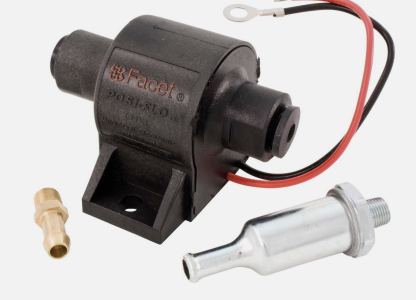
Yep it just lets the fuel pass through... This is the type that I have ( at least it looks like it.) I saw the reference to a dry prime height of 300mm my tank is 800 deep and the pump has no trouble lifting via a primary filter and from a half full tank. (It never occurred to me that it would have a lower ability to lift than the engine lift pump)..

I selected it because it looked like one which was fitted to my boat when I bought it in 2005.

Facet Posi-Flow Low Pressure 12v Fuel Pump Kit 1.5 To 4.0 Psi Up To 150 Bhp | eBay

Might just be me, but I would prefer one without the inline filter. My tank goes to a Racor with great accessibility, very easy access and I carry tons of spare elements. I want any crap to end up in there, and not some a little filter that looks very easy to block, is possibly fiddly to change and that I have no spares for. So the next question is, do these pumps deal ok with the typical debris and crap that ends up in the bottom of the fuel tank? Or, would it be better after the Racor. (I suspect the latter). Either way, I don't really need or want a third filter in the fuel supply line. Two is plenty.
 
Might just be me, but I would prefer one without the inline filter. My tank goes to a Racor with great accessibility, very easy access and I carry tons of spare elements. I want any crap to end up in there, and not some a little filter that looks very easy to block, is possibly fiddly to change and that I have no spares for. So the next question is, do these pumps deal ok with the typical debris and crap that ends up in the bottom of the fuel tank? Or, would it be better after the Racor. (I suspect the latter). Either way, I don't really need or want a third filter in the fuel supply line. Two is plenty.
There is no filter in the pump. My primary filter is under my sole, and the fuel is sucked through this and blown through a second filter on the engine, just as it is by the main engine lift pump.

Both filters are spin-on from iveco vans. I treat my fuel like my car, only buy from road garages, only use road diesel and check for water in the filters once or twice a season. (I also extract a few liters from the base of the tank using a small electric oil change pump, when I am doing an oil change, I let this stand in a plastic bottle for a few days and if it's clean and water free it goes back in and I don't worry about what's in the filters...they are probably good for 50,000 miles on a van...
 
Top