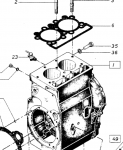
Bukh DV20 - Coolant Drainage Plug

A_Sails_Pace

Well-Known Member
Joined
13 Jan 2022
Messages
93
Location
East Coast - The Crouch
Visit site
Re Bukh DV20 - I'm out of the water and wish to drain the raw water from my cooling system entirely (the water currently held in the engine block). I think I have located the drainage plug/bolt. It seems to be directly above my oil filter though on the stbd side of the engine. I was wondering if this is the correct plug? and if so, are there any tips on how to drain it without running the risk of soaking the oil filter casing/area. The plug appears to be on the side of the engine block in such a way that if you open it, it'll run down the outside of the engine as opposed to coming out from an over-hanging position so you can just get a funnel or bucket under there.

I have seen a few older threads with some links for pictures that have since expired unfortunately, and I have heard this isn't the only drainage point, but the manual doesn't seem to support this? Or at least I don't think. I want to drain the raw water for the next few months whilst we're out of the water. We're not allowed to run the engine in the yard so this would be my only option I believe.

Whilst I'm here, I was also wondering. What's the difference between leaving the raw water inside the system until I'm back in the water (with heating option preventing freezing), and being in the water throughout the winter sailing about with the same salt water in the system?

A.S.P
 
Last edited:
Re Bukh DV20 - I'm out of the water and wish to drain the raw water from my cooling system. I think I have located the drainage plug/bolt. It seems to be directly above my oil filter though on the stbd side of the engine. I was wondering if this is the correct plug? and if so, are there any tips on how to drain it without running the risk of soaking the oil filter casing/area. The plug appears to be on the side of the engine block in such a way that if you open it, it'll run down the outside of the engine as opposed to coming out from an over-hanging position so you can just get a funnel or bucket under there.

I have seen a few older threads with some links for pictures that have since expired unfortunately, and I have heard this isn't the only drainage point, but the manual doesn't seem to support this? Or at least I don't think. I want to drain the raw water for the next few months whilst we're out of the water. We're not allowed to run the engine in the yard so this would be my only option I believe.

Whilst I'm here, I was also wondering. What's the difference between leaving the raw water inside the system until I'm back in the water (with heating option preventing freezing), and being in the water throughout the winter sailing about with the same salt water in the system?

A.S.P
I normally take the y feed pipe out to drain the engine , this allows for checking the feed pipe holes for blockages.
my drain point is seized, if it was free I guess a pipe would allow the drainage water to miss the filter
 
That is the plug, yes water does drain down the side of the block and round the oil filter, it wont do the filter any harm. What sort of space do you have under the engine, does it drain direct into the bilge. if it does then you just pump out the water from the bilge. I have made up a permanent flexible drain line from the block outlet it is stowed upright when the engine is in use with a stopper in the end , when I want to drain down I unplug in a lower the end down into a bowl. Taking the y feed pipe out of the block is not very easy as it is behind the flywheel, it can be done but I do not think that point will drain all the water out as you can see into the cavity and there is a lot of it below the y pipe exit.
David MH
 
That is the plug, yes water does drain down the side of the block and round the oil filter, it wont do the filter any harm. What sort of space do you have under the engine, does it drain direct into the bilge. if it does then you just pump out the water from the bilge. I have made up a permanent flexible drain line from the block outlet it is stowed upright when the engine is in use with a stopper in the end , when I want to drain down I unplug in a lower the end down into a bowl. Taking the y feed pipe out of the block is not very easy as it is behind the flywheel, it can be done but I do not think that point will drain all the water out as you can see into the cavity and there is a lot of it below the y pipe exit.
David MH
. I think it would be best to run the engine with the bypass pipe blocked off and thermostat removed and let it suck up coolant through the block or pump it through with a pump.
 
Last edited:
Re Bukh DV20 - I'm out of the water and wish to drain the raw water from my cooling system entirely (the water currently held in the engine block). I think I have located the drainage plug/bolt. It seems to be directly above my oil filter though on the stbd side of the engine. I was wondering if this is the correct plug? and if so, are there any tips on how to drain it without running the risk of soaking the oil filter casing/area. The plug appears to be on the side of the engine block in such a way that if you open it, it'll run down the outside of the engine as opposed to coming out from an over-hanging position so you can just get a funnel or bucket under there.

[...]
Early models of the DV10/20 had a drain cock fitted [see item #23 below for DV20]. You could always replace the drain plug with one and connect a length of hose to it to drain straight into the bilge.

1668370968991.png
 
Last edited:
That is the plug, yes water does drain down the side of the block and round the oil filter, it wont do the filter any harm. What sort of space do you have under the engine, does it drain direct into the bilge. if it does then you just pump out the water from the bilge. I have made up a permanent flexible drain line from the block outlet it is stowed upright when the engine is in use with a stopper in the end , when I want to drain down I unplug in a lower the end down into a bowl. Taking the y feed pipe out of the block is not very easy as it is behind the flywheel, it can be done but I do not think that point will drain all the water out as you can see into the cavity and there is a lot of it below the y pipe exit.
David MH

Thanks David. Allowing it to drain direct into the bilge is certainly an option actually. Though you know what it's like, initially you just want to prevent any leakage and try and get it all into a container etc. Thanks for clarifying I've located the correct outlet/plug. Cheers.

A.S.P.
 
I used to tape a suitable sized plastic bag below the drain plug on our DV24 when draining it . The bag collected the water and stopped it going into the bilge. IIRC about 2 Liters came out.
I would fill the raw water part of the engine with antifreez after draining it by opeing the thermostat housing and pouring it in there as this is the highest point of the raw water on the engine. As advised many years ago on this forum. Its nice to check the thermostat as well.
 
My Sole Mini 34 has a drain plug with a hole through it so when you undo it a few threads the coolant comes out through the hole. I don't know what it would be called but I simply force a length of hose over it and drain into a container. None gets to the bilge.
 
Having located and opened the drain plug/bolt there is no water coming out. I can see a little build up of some sort matter (salt is my guess). It’s mushy and it crumbles away when scraped. I’ve cleaned some out but there’s still some deep and I’m quite conscious of pushing what’s remaining of it into the actual system. Not really sure whether it’s best left or not.
 
Last edited:
Having located and opened the drain plug/bolt there is no water coming out. I can see a little build up of some sort matter (salt is my guess). It’s solid and I’ve cleaned some out but there’s still some deep and I’m quite conscious of pushing what’s remaining of it into the actual system. Not really sure whether it’s best left or not.
It is already in the system. Poke it out with a wire, or thin screw driver. No point in leaving it there.
 
You can't do much harm. You are at the bottom of the cylinder jacket. Get a screwdriver and start scratching away at the stuff. Hopefully, you will be rewarded by a flow of water - keep poking with the screwdriver to dislodge as much stuff as possible. This is a job that should be done every year.
 
You can't do much harm. You are at the bottom of the cylinder jacket. Get a screwdriver and start scratching away at the stuff. Hopefully, you will be rewarded by a flow of water - keep poking with the screwdriver to dislodge as much stuff as possible. This is a job that should be done every year.

Thanks. Yeah, think I’ve managed to get a nice flow without pushing any back inside. It’s my first year owning the boat (first time prepping it for winter) but will certainly whack it on the annual list. Cheers
 
Thanks. Yeah, think I’ve managed to get a nice flow without pushing any back inside. It’s my first year owning the boat, but will certainly whack it on the annual list. Cheers
I think that if you post an enquiry on the forum you will get advice on a cleaner which will help shift that crud blocking the waterways. I have not used any myself, as I have a 2 part system. I also run fresh water through it every year prior to lay up, finishing off with an antifreeze mix.
However, The forum is full of experience on these matters
 
For the last trip of the season (mooring to boatyard lift - out) I connect the cooling water inlet to the galley water faucet. The engine thus washes itself with nice clean fresh water. Pull the drain plug first thing when ashore and you don't even get cold hands! No need for antifreeze. There is another large drain plug under the exhaust manifold - I undid this once but nothing came out, so I haven't bothered to do it again. While messing around at the back of the engine, put in a new anode, too. The plug for that is above the throttle lever.
 
@neil_s & @Daydream believer

I'll certainly run some fresh water through it in future. We came out of the water prematurely/hurriedly, and we're not allowed to run the engine in this yard. May have to enquire to see if we can be granted a few minutes for this reason and run some fresh water through it.... and thanks Neil, anode is on the list as well (fuel filters this weekend).

Much appreciated, fellas.
 
A couple of tips about the engine anode on the DV20 you may find useful.
The anode is a small pencil type which screws into the brass plug at the back of the block. Spanner access to the plug is not easy and it can be difficult to see the plug. I find a 22mm ring spanner is the easiest tool to use and you can then feel it onto the plug. There is not much clearance are around the sides of the anode and calcium build up in the water cavity can mean that when you come to take out, if it is not well used, the anode unscrews itself from the plug so the plug comes out without the anode. Buhk UK ( when they were in Poole) said not to worry the zinc will corrode away and the screw will just sit in the water passage where there is plenty of room. I usually nip the anode and the plug up tight with mole grips before I fit a new one. Also it is a good idea to clean out the calcium build up around the anode aperture with a screwdriver, especially the side nearest the engine centerline, each time you change the anode.
David MH
 
Top