Building a lithium battery

If you’re aware of “those and one or two others” why would you say a drop in lithium battery is £500? It’s misleading and unhelpful don’t you think? Of course you can spend more on a ‘premium’ brand, same with AGM eg Lifeline, Rolls and so on.
Because then he can continue to peddle the line that upgrading to lithium is very expensive and only worth it if you have specific needs.

Anybody holding out for cheaper lithium batteries will, of course, still find that the other changes they may wish to make still have to be paid for. The batteries are already cheap enough that it's these changes which will be responsible for most of the additional cost.
 
It seems if I want to charge a lithium battery from an alternator, I need a fairly expensive battery-to-battery charger? This looks like two hundred of my imperial British pounds?

Or is there a cheaper way? Something I'm not getting about hybrid lead/lithium banks?
 
If you’re aware of “those and one or two others” why would you say a drop in lithium battery is £500? It’s misleading and unhelpful don’t you think? Of course you can spend more on a ‘premium’ brand, same with AGM eg Lifeline, Rolls and so on.
I explained why - and the quality ones do.. In one breath you are moaning about the short life of your "cheap" LA batteries, but prepared to consider "cheap" lithium with an unknown record. Maybe I have seen too many cheap products fail to live up to their promise.
 
It seems if I want to charge a lithium battery from an alternator, I need a fairly expensive battery-to-battery charger? This looks like two hundred of my imperial British pounds?

Or is there a cheaper way? Something I'm not getting about hybrid lead/lithium banks?
Sorry Kelpie for thread drift but it seems to have gone this way anyway. And thanks for the update; in different circumstances I would have followed your example🙂

I wouldn't recommend li to everyone but it works well for us on a small scale. We have two 100Ah li bats charged from a B2B charger set in a standard (?!) la starter bat setup. We will have an inverter to run an induction hob and kettle soon. Plus 200W solar.

We cruise for three months a year in higher latitudes. The speed of li charging combined with the long summer days and short bursts of engine use mean that we rarely drop below 80%. However, the inverter should bring that down! In cruising the lesser visited routes the problems with non-standardisation of gas supplies are exacerbated. So our hybrid cooking balance lets us (even with my temporary bodge) live away from civilisation for longer. Again, that is all relative🤓

Cost of li upgrades incl ALL (bats to kettle) hardware: about £1300.
Reward: much less concern about finding charging facilities and someone to fill the Calor gas bottles!
Worth it for us 😄
 
I'd imagine with the above setup, it's imperative to have the start battery in good nick, you can't bimble around with old batteries until they don't work any more.
 
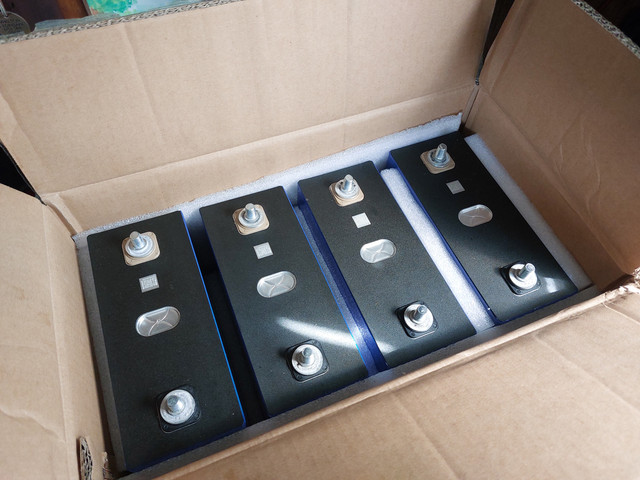
After more than two years of excellent service from my DIY 271Ah LiFePO4 pack, I've decided to upgrade and build a second pack.
This time round the cells are slightly different, 280Ah with M8 studs instead of M6 threads.
I specified the same BMS- JBD 200A- but again it's slightly different, with reduced depth of heatsink fins and paired M5 threaded connections, instead of the single larger connections of the previous one.

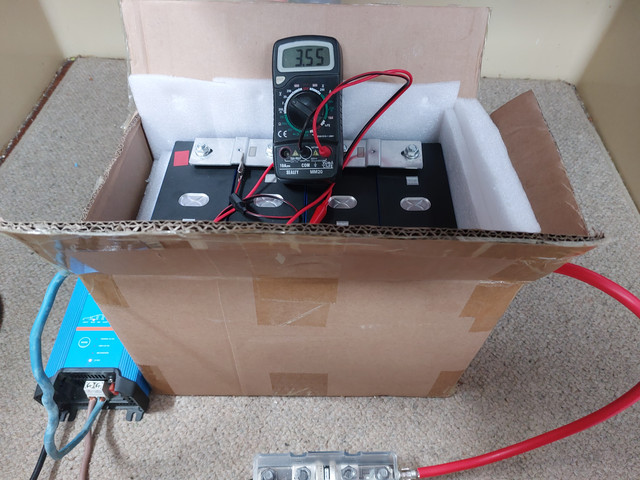
Building the pack second time round is definitely faster and easier. To start with, I put the pack together along with an old spare BMS, and set it up with a 30A charger. Got a fair few Ah in before one of the cells hit 3.55v, at which point I stopped and put the cells in parallel, then resumed charging using a variable power supply set to 3.6v. I left it like that for a few hours, then reverted to 12v configuration and the bigger charger. This time everything was much better balanced and I was able to take all four cells up to 3.5v together.
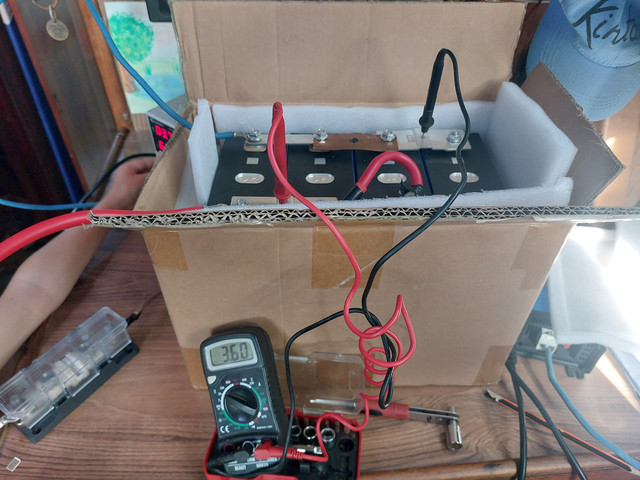
Finally I put the cells back in parallel and carefully brought them up to 3.6v with the power supply.
Some people say you should balance at 3.65v but frankly I was running out of power and was keen to call it a day. Hopefully they'll be happy at that. I'm doing all of this using the inverter running off the previously built battery, and a good chunk of today's solar has gone in to the new battery instead of my actual house bank. There are some downsides to life at anchor without a generator.

Next step is to make up the end plates and threaded rod to physically hold the cells together. You don't want any movement between them damaging the studs. I'll mount the BMS on one of the end plates. Then a few cables to make up (easy with a £30 hydraulic crimping tool) and install.

A question for those in the know- the new BMS is designed to take two cables in each side. I think my options are to:
- run a pair of smaller cables, forming a Y, in to a single terminal at one end.
- run a pair of cables and stack the terminals
- ignore one of the connections and just use a single thick cable

I'm thinking the first option is likely the best, but I'm not all that happy about running small cables in parallel. However the individual cables would still be treated higher than the main fuse, so I guess it's ok?

And talking about fuses... I'm thinking of joining the two batteries at the fuse connector, using it as a bus bar. Is there any reason to also have individual fuses on each battery?

Final question. Presently, the MPPTs connect straight to the battery (on the positive side). If I leave that as-is, will I end up with one battery charging preferentially? It seems unlikely given that they're connected by heavy cable.


The cells upon arrival


Charging as a 12v pack


Final top balance in parallel
Kelpie,

Thanks for your posts. But getting back on track

You mention that the new batteries are different to the old. Technology moves on (and possibly quickly with Lithium). You specifically mention that the new batteries have studs, M8 studs vs the old that were M6 threads. If one is given the choice - was this change important and why? Did you choose this or was this how the old and new batteries were supplied. One change would be that now, in your case, all the old M6 eyes will not fit the M8 studs - but that is a minor nuisance. I assume the poles, both M6 and M8 are stainless. You can now change the studs and make them longer (or higher) increasing their capacity but I have read, on a previous thread here, that there are recommendations on the number of connectors to a pole (and its not many) - and I forget the number.

Jonathan
 
On small scale Lithium or Lithium not used 'much'. Here at every caravan, camping, 4x4 show (where lots of kit is suitable for marine application, fridges for example) there is a strong Lithium presence. I have no idea of the uptake. I don't know what level of education is given to those who opt the Lithium route but suspect its all very simple. Most caravans, motor homes sit at home and are used for the odd weekend or the annual holiday - not unlike most yachts.

Not many people here live in a caravan nor motor home. So the lithium is for occasional use - and I assume the costs are not excessively in favour of Lead - or people would not be promoting Lithium (as caravan shows cost money and exhibitors will want a return).

Jonathan
 
Last edited:
Kelpie,

Thanks for your posts. But getting back on track

You mention that the new batteries are different to the old. Technology moves on (and possibly quickly with Lithium). You specifically mention that the new batteries have studs, M8 studs vs the old that were M6 threads. If one is given the choice - was this change important and why? Did you choose this or was this how the old and new batteries were supplied. One change would be that now, in your case, all the old M6 eyes will not fit the M8 studs - but that is a minor nuisance. I assume the poles, both M6 and M8 are stainless. You can now change the studs and make them longer (or higher) increasing their capacity but I have read, on a previous thread here, that there are recommendations on the number of connectors to a pole (and its not many) - and I forget the number.

Jonathan
I don't think it makes much difference. You just get sent whatever they have in stock.
I guess the bigger studs are a bit more robust.
It doesn't matter at all that it's different to the first battery, I'm not swapping it out so I'm making up new leads anyway.
Unlike a lead acid battery, you don't tend to add oodles of extra connections directly on to lithium- you want everything to connect after the BMS (which is on the -ve) and fuse (on the +ve)
 
I don't think it makes much difference. You just get sent whatever they have in stock.
I guess the bigger studs are a bit more robust.
It doesn't matter at all that it's different to the first battery, I'm not swapping it out so I'm making up new leads anyway.
Unlike a lead acid battery, you don't tend to add oodles of extra connections directly on to lithium- you want everything to connect after the BMS (which is on the -ve) and fuse (on the +ve)
As far as i'm concerned, there should only be battery cables on the batteries, everything else comes off of busbars.
 
It seems if I want to charge a lithium battery from an alternator, I need a fairly expensive battery-to-battery charger? This looks like two hundred of my imperial British pounds?

Or is there a cheaper way? Something I'm not getting about hybrid lead/lithium banks?
Yes there is an alternative and its the long wire method rather than a DC>DC charger. Wire the alternator to a hybrid bank of LFP and LA in parallel with a long wire. This has resistance and will limit the output of the alternator so stopping it over heating particularly at lower revs when there is reduced air flow. When first set up you need to measure the alternator temperature to ensure you have the wire long enough. Once that is established then your good to go. The FB Group Bei Facebook anmelden champion this and other new ideas like Lithium and should be consulted for the details. Just don't mention it to the Americans.

I did briefly think about this idea and then went down the DC>DC route because as said its not the major charging source for us and a Victron charger enables me via the app to switch on and off the DC>DC charger at will. We were away for 19 days in September and the weather was extremely variable. Solar generated 28kWh and the alternator through the DC>DC charger an additional top up of 3kWh, about 7 hours of charging.

The comments about additional costs and as Paul recommends use bus bars to keep it all neat is valid. Heavy copper wire is getting expensive. I managed to pick up a second hand but unused Victron Lnyx Power In, which with a quick conversion makes a brilliant dual bus bar and fuse box all in one unit. However, people like Blue Sea and Victron also do separate bus bars. Add some like the cube type from 12v Planet or the NH type from Bimble solar to finish off the install if the price of class T fuses is too much.

Victron 150 Amp DC bus bar, 4 terminal, tin plated copper, with ABS plastic cover

DC Fused Disconnect 1-pole NH00 or NH000 size, M8 fixings, 160A DC max
 
I'm watching with interest as I ran my domestics down to 11v over 3 days at anchor last weekend, so I'm very interested in improving capacity.

I currently have 2, 56AH LA batteries for the port engine and domestics, plus a 60AH LA for the starboard engine. How upset would those batteries get if I put them into one bank, and got a, say 40AH to start the starboard engine?
That's not a particularly large battery set up though I think you have a catamaran so understand weight is an issue and 4 or 5 lead acid batteries unacceptable, A 120Ah LFP battery is 3/4s of the weight of a 85Ah battery something brought home to me recently when I was moving them both about. A single 200Ah LFP would give you a huge increase in capacity for days even during inclement weather.

Use one existing 56Ah battery for each engine assuming in good condition and take a feed off one engine to supply a new domestic bank.
 
I don't think it makes much difference. You just get sent whatever they have in stock.
I guess the bigger studs are a bit more robust.
It doesn't matter at all that it's different to the first battery, I'm not swapping it out so I'm making up new leads anyway.
Unlike a lead acid battery, you don't tend to add oodles of extra connections directly on to lithium- you want everything to connect after the BMS (which is on the -ve) and fuse (on the +ve)
I have not found an American recommendation for Lithium batteries but believe, possibly erroneously, that there is a specification of a maximum of four connections to a, lead, battery post.

Not only separated by a common language.

I vaguely recall on a previous Lithium thread the specification or recommendation was mentioned.

A quick search came up with this:

Avoiding Boat Electrical Mistakes

and after a further search

Making Correct Battery Connections | BoatTEST

It would need pretty tall post to get more than 4 connectors on a 'common' post.

Jonathan
 
Last edited:
As far as i'm concerned, there should only be battery cables on the batteries, everything else comes off of busbars.

+1

After being through two FLAs internal shorting incidents and not being able to easily remove/discount the batteries I now route my LifePO4 through T-class fuses and isolators that goto a busbar.

I prefer these as you can connect smaller loads and the larger battery terminals to the same bar, and it has a good lid;

Stanew 300A Bus Bar Box Heavy-Duty Module Design Power Distribution Block with 2xM10,6 X M5 Studs Terminal 48V DC

Cheaper on Aliexpress and there are different versions (more/less bolts)
 
I explained why - and the quality ones do.. In one breath you are moaning about the short life of your "cheap" LA batteries, but prepared to consider "cheap" lithium with an unknown record. Maybe I have seen too many cheap products fail to live up to their promise.
sigh.
 
That's not a particularly large battery set up though I think you have a catamaran so understand weight is an issue and 4 or 5 lead acid batteries unacceptable, A 120Ah LFP battery is 3/4s of the weight of a 85Ah battery something brought home to me recently when I was moving them both about. A single 200Ah LFP would give you a huge increase in capacity for days even during inclement weather.

Use one existing 56Ah battery for each engine assuming in good condition and take a feed off one engine to supply a new domestic bank.
We only had one engine start battery, common motor vehicle battery - independent of the house bank. We would start one engine, let it run for a few moments, then run it in neutral at around 2.500 revs and then start the second engine and then turn the revs down.

The house bank was 2 x 200 amp/hr

Jonathan
 
Yes there is an alternative and its the long wire method rather than a DC>DC charger. Wire the alternator to a hybrid bank of LFP and LA in parallel with a long wire. This has resistance and will limit the output of the alternator so stopping it over heating particularly at lower revs when there is reduced air flow. .....
Using a resistance in series with the alternator is crude.
Say the alternator is 14.4V

IF the resistance is high enough to limit the charge current to say 1C, 30A when the Lifepo is at 10% SOC, it should give battery volts of about 13.34V so dropping just over a volt call it 1/30th on an ohm.
When the battery is half charged, the battery volts will rise to 13.7 or so, and the resistance will reduce the current to 20A. This gets worse as you get over 80%, you might as well have Lead/Acid from a 'charge acceptance' point of view.
If you want to protect the alternator at lower states of charge than 10%, it just gets silly.

Buck/Boost DC-DC converters are available cheaply as modules on ebay, £15 or less gets you 20A, with current and voltage limiting. But do you trust these things?
 
Using a resistance in series with the alternator is crude.
Say the alternator is 14.4V

IF the resistance is high enough to limit the charge current to say 1C, 30A when the Lifepo is at 10% SOC, it should give battery volts of about 13.34V so dropping just over a volt call it 1/30th on an ohm.
When the battery is half charged, the battery volts will rise to 13.7 or so, and the resistance will reduce the current to 20A. This gets worse as you get over 80%, you might as well have Lead/Acid from a 'charge acceptance' point of view.
If you want to protect the alternator at lower states of charge than 10%, it just gets silly.

Buck/Boost DC-DC converters are available cheaply as modules on ebay, £15 or less gets you 20A, with current and voltage limiting. But do you trust these things?

Higher charge acceptance of LFP at lower voltages compared to lead-acid is one of the defining features of the chemistry.
 
Last edited:
Higher charge acceptance of LFP at lower voltages compared to lead-acid is one of the defining features of the technology.
Indeed, it's a big attraction for me, if I use 20Ah in 24 hours, and have an hour's motoring with a 55A alternator, I should be able to put back a lot more charge into say 40Ah of Lithium than I could into my existing 110AH lead acid, because the lead acid will be at say 70% SOC and taking under 10A and falling.

But that's easily spoilt if you can't feed the Li enough volts for it to take a decent charge rate as it gets up to 70/80/90% SOC. It seems you want 14.6 at the battery to get 0.5C charging, (to 90% SOC) and there will be voltage drop at 15A

There is also the attraction of it being OK to leave if for the next week or more at say 50% SOC, whereas with the Lead, we want to get back to 100% charge reasonably soon. To top up a lead/acid with 20Ah, you need to harvest maybe 30Ah from the solar, and that can take a long time this weather, in a location that's a bit shaded.

I'm not really committed to this yet. I think sorting a decent battery monitor will give me a lot of info.
My existing Lead/Acid house battery seems to do most of what I want (at least when there's some solar to prop it up!) bit it's old. If I buy a new one I don't want to abuse it and kill it in 2 years or less.
I don't see myself converting wholly to Lifepo because that would imply 'going large' to function as a back-up start battery. That may be up for debate as and when prices drop.
 
But that's easily spoilt if you can't feed the Li enough volts for it to take a decent charge rate as it gets up to 70/80/90% SOC. It seems you want 14.6 at the battery to get 0.5C charging, (to 90% SOC) and there will be voltage drop at 15A

The charge curve of LFP is remarkably flat. I don't know anyone who would contemplate 14.6 volts as a target voltage. 13.8 volts is much more common. 14.6V was bandied around in the first decade of LFP but views have changed through experience.
 
The charge curve of LFP is remarkably flat. I don't know anyone who would contemplate 14.6 volts as a target voltage. 13.8 volts is much more common. 14.6V was bandied around in the first decade of LFP but views have changed through experience.
I think this is the difference between resting voltage and voltage under charge at a rate of about 0.5C.

Not everyone is trickle charging a big bank with limited power.
 
Top