Building a lithium battery

I think this is the difference between resting voltage and voltage under charge at a rate of about 0.5C.

Not everyone is trickle charging a big bank with limited power.
Why do you need a higher voltage if you are charging above 0.5C?
 
Indeed, it's a big attraction for me, if I use 20Ah in 24 hours, and have an hour's motoring with a 55A alternator, I should be able to put back a lot more charge into say 40Ah of Lithium than I could into my existing 110AH lead acid, because the lead acid will be at say 70% SOC and taking under 10A and falling.
Anyone who uses a mere 20ah in 24 hours and considers fitting Lithium is mad.
 
Why do you need a higher voltage if you are charging above 0.5C?
That's 0.5C as in 10A for a 10Ah battery.
All batteries have more volts on the terminals when charging and less volts when discharging.
As far as I can see 0.5C is a standard rate to charge a LiFePO4 reasonably fast, the max charge current often being about 50% more.
This is typical data:

"Correct charging method of LiFePO4 Battery pack​


It is recommended to use the CCCV charging method for charging the LiFePO4 Battery pack, that is, constant current first and then constant voltage. Constant current recommended 0.3C. Constant voltage recommendation 3.65. That is, 0.3C current charging during the constant current process. When the battery voltage reaches 3.65V, use 3.65V voltage constant voltage charging. When the charging current is lower than 0.1C (or 0.05C), stop charging, that is, the battery has been charged. full. When you use a constant voltage power supply to charge, it also depends on the charging current. It is recommended not to charge with too high a voltage. After adjusting the voltage, ensure that the charging current is below 0.5C, which is good for the battery.


Generally, the charging upper limit voltage of LiFePO4 Battery is 3.7~4V,""

You can use a lower voltage in the CV stage, but the current will drop quickly as the resistance is low.
Data does seem to vary slightly from maker to maker, which may be a matter of slightly different chemistry, or different temperatures?
 
That's 0.5C as in 10A for a 10Ah battery.
All batteries have more volts on the terminals when charging and less volts when discharging.
As far as I can see 0.5C is a standard rate to charge a LiFePO4 reasonably fast, the max charge current often being about 50% more.
This is typical data:

"Correct charging method of LiFePO4 Battery pack​


It is recommended to use the CCCV charging method for charging the LiFePO4 Battery pack, that is, constant current first and then constant voltage. Constant current recommended 0.3C. Constant voltage recommendation 3.65. That is, 0.3C current charging during the constant current process. When the battery voltage reaches 3.65V, use 3.65V voltage constant voltage charging. When the charging current is lower than 0.1C (or 0.05C), stop charging, that is, the battery has been charged. full. When you use a constant voltage power supply to charge, it also depends on the charging current. It is recommended not to charge with too high a voltage. After adjusting the voltage, ensure that the charging current is below 0.5C, which is good for the battery.


Generally, the charging upper limit voltage of LiFePO4 Battery is 3.7~4V,""

You can use a lower voltage in the CV stage, but the current will drop quickly as the resistance is low.
Data does seem to vary slightly from maker to maker, which may be a matter of slightly different chemistry, or different temperatures?

10 amps for a 10ah battery is 1C. I agree with the correct charging method but I don't push to 3.65 volts per cell - it gives little extra capacity but improves longevity of the cells. 0.3 C is my maximum since it is quick without generating excessive heat. I charge to a target voltage of 13.8 volts reaching that entirely during the bulk (constant current) stage. Then the charger stops - I don't need a constant voltage stage. The most that LFP ever needs is about 30 minutes of constant voltage (absorption) for cell balancing but by charging at a lower rate my balancing is generally complete by 13.8V. This is now a pretty common charging protocol. My solar controllers are set a bit higher at 14.2 volts to speed things up a bit but in practice they don't reach this end point before dark.
 
This is typical data:

Not in the size and charging methods most of us are using on boats. For example watch the charging voltage and current of a solar panel via an MPPT and it will be constantly changing as the MPPT searches for the best set point. Slightly rocking of our yacht at anchor makes a huge difference. The alternator charging via a DC>DC charger will also start off with a lower voltage at the battery and progressively increase, flat lining and then a last sharp increase as it goes above 3.5v per cell.

There is no way I am going to try and charge at 3.7 - 4.0 volts per cell. 3.45 - 3.5v per cell is a much better limit to stop charging to ensure long battery life.

Worth noting I can't reach 0.5c with both solar and alternator charging. Even adding shore power charging it will be less. This isn't a huge LFP bank either, its 220Ah.
 
Last edited:
Not in the size and charging methods most of us are using on boats. For example watch the charging voltage and current of a solar panel via an MPPT and it will be constantly changing as the MPPT searches for the best set point. Slightly rocking of our yacht at anchor makes a huge difference. The alternator charging via a DC>DC charger will also start off with a lower voltage at the battery and progressively increase.

There is no way I am going to try and charge at 3.7 - 4.0 volts per cell. 3.45 - 3.5v per cell is a much better limit to stop charging to ensure long battery life.
That's big batteries and limited charging power for you.
What's your peak SOC at 3.5V /cell and how long does it take to get there?
 
That's big batteries and limited charging power for you.
What's your peak SOC at 3.5V /cell and how long does it take to get there?
Not in the real world, its actually quite a modest sized bank, the 220Ah LFP also has 85Ah of LA wired in parallel. Charging is limited by the size of ones wallet. Sure a 200A alternator, external regulation and replacement serpentine belt are possible but it will be north of £1.5k. Since our alternator is a secondary charging method, then it doesn't represent good bang for buck, for us to change out the existing 100A alternator.

Peak SOC at 3.5v is going to be about 99% but even that can change as the % changes during charging but the voltage is pretty stable. Watching the cell voltages at this point shows they are also increasing and decreasing as balancing takes place.

Charge time is a function of solar output and that depends on the angle of the yacht to the sun, weather conditions and time of year. Can be lunchtime or we might not quite make 100% by sunset. However, that doesn't matter with LFP. What's the difference between 80% of charge one evening and 90% the next? Answer, nothing and we don't worry about it. Equally the depth of discharge at dawn. That can vary enormously.

Chart of 18 days of sailing and cooking on board during Sep 23 were you can see the numbers are quite variable. We fitted an analogue kWh counter to the inverter recording how much we use to cooking, the washing machine and heating water via the kettle etc. The average for cooking in September was 0.9kWh each day.
 

Attachments

Last edited:
Not in the real world, its actually quite a modest sized bank, the 220Ah LFP also has 85Ah of LA wired in parallel. Charging is limited by the size of ones wallet. Sure a 200A alternator, external regulation and replacement serpentine belt are possible but it will be north of £1.5k. Since our alternator is a secondary charging method, then it doesn't represent good bang for buck, for us to change out the existing 100A alternator.

Peak SOC at 3.5v is going to be about 99% but even that can change as the % changes during charging but the voltage is pretty stable. Watching the cell voltages at this point shows they are also increasing and decreasing as balancing takes place.

Charge time is a function of solar output and that depends on the angle of the yacht to the sun, weather conditions and time of year. Can be lunchtime or we might not quite make 100% by sunset. However, that doesn't matter with LFP. What's the difference between 80% of charge one evening and 90% the next? Answer, nothing and we don't worry about it. Equally the depth of discharge at dawn. That can vary enormously.

Chart of 18 days of sailing and cooking on board during Sep 23 were you can see the numbers are very variable. We fitted an analogue kWh counter to the inverter recording how much we use to cooking, the washing machine and heating water via the kettle etc. The average for cooking in September was 0.9kWh each day.
Its a bit of drift but we found the washing machine's usage of power was not relevant in a decision making process. The major determinant was the availability of fresh water (which was determined by power as it needed the desalinator running). If push comes to shove then you can always 'get' power - with the engine on - supplementing water took time and power.

That data point 0.9kWh for cooking is a, very, useful bit of information - thanks

Jonathan
 
That data point 0.9kWh for cooking is a, very, useful bit of information

We don't keep track of our power usage very well, but that figure sounds about right to me. In 12v that's 75Ah. We use about 40-50Ah overnight for the fridge and freezer which is probably higher than it should be, but we still get back to full every day on solar alone.
 
Its a bit of drift but we found the washing machine's usage of power was not relevant in a decision making process. The major determinant was the availability of fresh water (which was determined by power as it needed the desalinator running). If push comes to shove then you can always 'get' power - with the engine on - supplementing water took time and power.

That data point 0.9kWh for cooking is a, very, useful bit of information - thanks

Jonathan
Thanks. I think its worth pointing out that the temperatures in southern UK for that period was warm to scorchie hot. So one full time fridge and one part time fridge running off the 12v circuit did have a hard time. We covered the PT fridge with a bath towel to help the insulation. Equally we didn't drink quite as much tea and coffee as we might otherwise have done in September, so less 240v kettle usage or cooking hearty meals. Instead simple meat, fish and salads or curry and rice for evening meals were the norm. Oh and making the odd chocolate cake of course.

What did surprise me was how much the readings varied even when comparing days at sea or, separately days in harbours with previous days in harbours. I think the greatest depth of discharge was 39%. Although there are lots of days we didn't reach float, the LFP was frequently up in the 90% region each day.
 
Last edited:
Not in the real world, its actually quite a modest sized bank, the 220Ah LFP also has 85Ah of LA wired in parallel. ....
You have 300Ah of batteries and a 30A charger.
That is charging at 0.1 C or what was called in olden days 'the 10 hour rate'.
That would be expected to not move the voltage very much, compared with charging LiFe at the maximum recommended 0.5C, formerly known as the the 2 hour rate.
Even the full might of your 500W solar would be about 8.5 hour rate.

0.5 to 1.5 kWh per day for cooking is interesting. I wish I'd weighed my gaz bottles then I could work out ours.
 
0.5 to 1.5 kWh per day for cooking is interesting. I wish I'd weighed my gaz bottles then I could work out ours.
Could you estimate an average, given you know the initial weight of has and the approximate number of days they last?

When we used gas alone, a 3.9kg propane would last about 25 days.

Once we started using electric kettle and hob in marinas (30% of the time) we think it went up to 32 days. This is all estimates based upon poor memory 🤓
 
You have 300Ah of batteries and a 30A charger.
That is charging at 0.1 C or what was called in olden days 'the 10 hour rate'.
That would be expected to not move the voltage very much, compared with charging LiFe at the maximum recommended 0.5C, formerly known as the the 2 hour rate.
Even the full might of your 500W solar would be about 8.5 hour rate.

0.5 to 1.5 kWh per day for cooking is interesting. I wish I'd weighed my gaz bottles then I could work out ours.
In practice the LA doesn't do much, even when a large current is applied like the kettle. What happens is the solar MPPT will wake up if its in float to provide the maximum amount of solar possible which is used first. Then the LFP makes up most of the rest of the requirement with the LA perhaps providing 5 - 10%. The main reason for the LA is provide a buffer in the unlikely event of the BMSs suddenly shutting down and leaving us with no nav lights, chart plotter or VHF coming into a strange habour at night. It doesn't need to be very big, just enough to buy some time to resolve the issue. Most of the time it sits there in float twiddling its thumbs.

The 0.5kWh was probably us buying fish and chips for tea, one of the few things we occasionally buy as a take away. The 1.5kWh baking cakes mid afternoon, then cooking tea, so the solar MPPT was in absorption for quite a bit longer supplying energy rather than sitting in float.

Like Matt, we started off using a mix of gas and electric for cooking, particularly the kettle, toaster and single induction hob. Again we didn't have a way of recording accurate data at the time. However, previously we used a 4.5kg Calor cylinder each year. Once we switched to a mix of gas/electric that halved the gas usage and the last 4.5Kg lasted over two years. So even a mix is worthwhile saving all the faffing around finding and carrying cylinders. If its a nice sunny day, use the electric, if its fog or rain for several days, use to gas if the batteries are getting low. Alternatively do as Kelpie does and go large on the LFP so you can power a small city if necessary 😃
 
Last edited:
In practice the LA doesn't do much, even when a large current is applied like the kettle. What happens is the solar MPPT will wake up if its in float to provide the maximum amount of solar possible which is used first. Then the LFP makes up most of the rest of the requirement with the LA perhaps providing 5 - 10%. The main reason for the LA is provide a buffer in the unlikely event of the BMSs suddenly shutting down and leaving us with no nav lights, chart plotter or VHF coming into a strange habour at night. It doesn't need to be very big, just enough to buy some time to resolve the issue. Most of the time it sits there in float twiddling its thumbs.

The 0.5kWh was probably us buying fish and chips for tea, one of the few things we occasionally buy as a take away. The 1.5kWh baking cakes mid afternoon, then cooking tea, so the solar MPPT was in absorption for quite a bit longer supplying energy rather than sitting in float.

Like Matt, we started off using a mix of gas and electric for cooking, particularly the kettle, toaster and single induction hob. Again we didn't have a way of recording accurate data at the time. However, we used a 4.5kg calor cylinder each year. Once we switched to a mix of gas/electric that halved the gas usage and the last 4.5Kg lasted over two years. So even a mix is worthwhile saving all the faffing around finding and carrying cylinders. If its a nice sunny day, use the electric, if its fog or rain for several days, use to gas if the batteries are getting low. Alternatively do as Kelpie does and go large on the LFP so you can power a small city if necessary 😃
What you describe has logic, not underlined by others.

If you are baking cakes or bread, starting a casserole (prior to putting it in your thermall cooker. Thermos Thermal Cooker Review - Practical Sailor), making water - do it when the sun is shining and use as much of the solar as possible (commensurate with recharging the batteries). It it is sensible use when you have excess solar and is advantageous - and if you are using it - its not excess.

Our practice was to bake bread when using the engine entering an anchorage (thus using the excess amps from the alternator). Solar works when you are at anchor (in the Caribbean :) ) or Australia - in the summer

Jonathan
 
Could you estimate an average, given you know the initial weight of has and the approximate number of days they last?

When we used gas alone, a 3.9kg propane would last about 25 days.

Once we started using electric kettle and hob in marinas (30% of the time) we think it went up to 32 days. This is all estimates based upon poor memory 🤓

What you describe has logic, not underlined by others.

If you are baking cakes or bread, starting a casserole (prior to putting it in your thermall cooker. Thermos Thermal Cooker Review - Practical Sailor), making water - do it when the sun is shining and use as much of the solar as possible (commensurate with recharging the batteries). It it is sensible use when you have excess solar and is advantageous - and if you are using it - its not excess.

Our practice was to bake bread when using the engine entering an anchorage (thus using the excess amps from the alternator). Solar works when you are at anchor (in the Caribbean :) ) or Australia - in the summer

Jonathan
Well yes, except the decisions like baking tend to be spontaneous rather than planned, so not essential, more I fancy doing it now. LFP certainly helps here negating the need to frequently top up with a full charge. So if you start using large amounts of power before they are fully charged, it just doesn't matter.

Its fairly common lead-acid battery practise to do some charging with the alternator early each day, then allow solar to top off. This is perfect for LA as the absorption rate slows dramatically as go above say 80% making poor use of an alternator whilst solar can supply the smaller current and do it silently. I think what Kelpie is trying to do is expand the LFP bank to the point not to have to do this or even think about it. Two days of cloudy rain forecast, doesn't matter, fire up the bread maker anyway we have sufficient power to ride it out.
 
The problem we have is that SWMBO always wants make cakes and big pans of soup of rainy days, which is precisely when we don't have the power!
Hopefully increasing the battery from 270 to 550Ah will let us do this. Final hook up tomorrow...
 
End plates in places, held together with threaded rod


Finished battery, with BMS.


It's now installed in parallel with the previously built battery, bringing total capacity up to 550Ah.

Building your own battery is still the cheapest way to convert to lithium, and results in a very compact installation with better heat dissipation. Total cost for the two batteries was about £1000, including the shipping and taxes to Grenada. By comparison, deep cycle lead acid at UK prices would have cost about £1800 for the same usable capacity, minus delivery.
 
End plates in places, held together with threaded rod


Finished battery, with BMS.


It's now installed in parallel with the previously built battery, bringing total capacity up to 550Ah.

Building your own battery is still the cheapest way to convert to lithium, and results in a very compact installation with better heat dissipation. Total cost for the two batteries was about £1000, including the shipping and taxes to Grenada. By comparison, deep cycle lead acid at UK prices would have cost about £1800 for the same usable capacity, minus delivery.
Nice job. I'd also add that building your own battery is the best way of making a dual bus system where charge and load circuits are separated. It is generally seen as the best design for marine installations but it doesn't get mentioned here a lot hence this reply.
 
Nice job. I'd also add that building your own battery is the best way of making a dual bus system where charge and load circuits are separated. It is generally seen as the best design for marine installations but it doesn't get mentioned here a lot hence this reply.
Please, point me to more info re the separation 🙂
 
Please, point me to more info re the separation 🙂

The Nordkyn Design article below is a classic but the whole set of 6 articles is well worth the time of anyone wanting to dig more deeply into DIY LFP.

Electrical Design For a Marine Lithium Battery Bank | Nordkyn Design

Lithium battery systems | Nordkyn Design

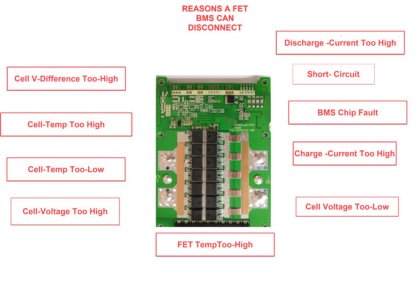
The advantages of Dual Bus are two fold. First the current flows through external relays away from the BMS rather than internally through the BMS via MOSFETS. Secondly, it avoids one major issue for most drop-ins which is the complete blackout and non-communicative pack caused by a BMS disconnect (which for a MOSFET BMS can happen for 10 reasons - below). Because load and charge circuits are separated in Dual Bus, if there is a high voltage disconnect (because of overcharging) this does not effect the availability of power. And, conversely, if there is a low voltage disconnect, the pack can still take a charge.

This isn't to secretly criticise other builds but just to put Dual Bus on the map.

Follow the first few pages of my build - linked in the footer - for more detail.


1697453022025.jpeg
 
Last edited:
Top