Building a lithium battery

Kelpie

Well-Known Member
Joined
15 May 2005
Messages
7,766
Location
Afloat
Visit site
After more than two years of excellent service from my DIY 271Ah LiFePO4 pack, I've decided to upgrade and build a second pack.
This time round the cells are slightly different, 280Ah with M8 studs instead of M6 threads.
I specified the same BMS- JBD 200A- but again it's slightly different, with reduced depth of heatsink fins and paired M5 threaded connections, instead of the single larger connections of the previous one.

Building the pack second time round is definitely faster and easier. To start with, I put the pack together along with an old spare BMS, and set it up with a 30A charger. Got a fair few Ah in before one of the cells hit 3.55v, at which point I stopped and put the cells in parallel, then resumed charging using a variable power supply set to 3.6v. I left it like that for a few hours, then reverted to 12v configuration and the bigger charger. This time everything was much better balanced and I was able to take all four cells up to 3.5v together.
Finally I put the cells back in parallel and carefully brought them up to 3.6v with the power supply.
Some people say you should balance at 3.65v but frankly I was running out of power and was keen to call it a day. Hopefully they'll be happy at that. I'm doing all of this using the inverter running off the previously built battery, and a good chunk of today's solar has gone in to the new battery instead of my actual house bank. There are some downsides to life at anchor without a generator.

Next step is to make up the end plates and threaded rod to physically hold the cells together. You don't want any movement between them damaging the studs. I'll mount the BMS on one of the end plates. Then a few cables to make up (easy with a £30 hydraulic crimping tool) and install.

A question for those in the know- the new BMS is designed to take two cables in each side. I think my options are to:
- run a pair of smaller cables, forming a Y, in to a single terminal at one end.
- run a pair of cables and stack the terminals
- ignore one of the connections and just use a single thick cable

I'm thinking the first option is likely the best, but I'm not all that happy about running small cables in parallel. However the individual cables would still be treated higher than the main fuse, so I guess it's ok?

And talking about fuses... I'm thinking of joining the two batteries at the fuse connector, using it as a bus bar. Is there any reason to also have individual fuses on each battery?

Final question. Presently, the MPPTs connect straight to the battery (on the positive side). If I leave that as-is, will I end up with one battery charging preferentially? It seems unlikely given that they're connected by heavy cable.
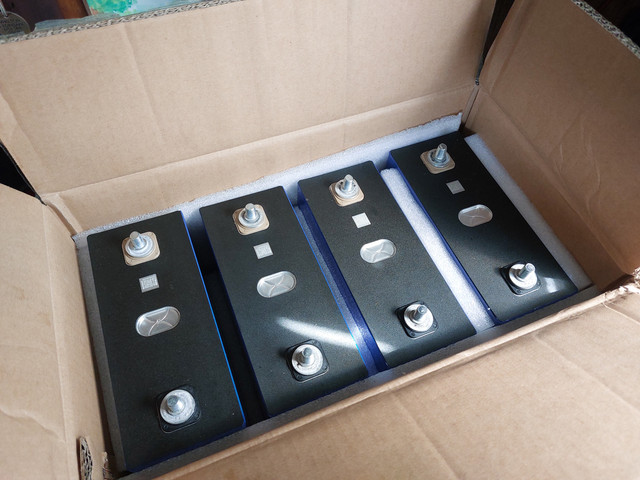

The cells upon arrival
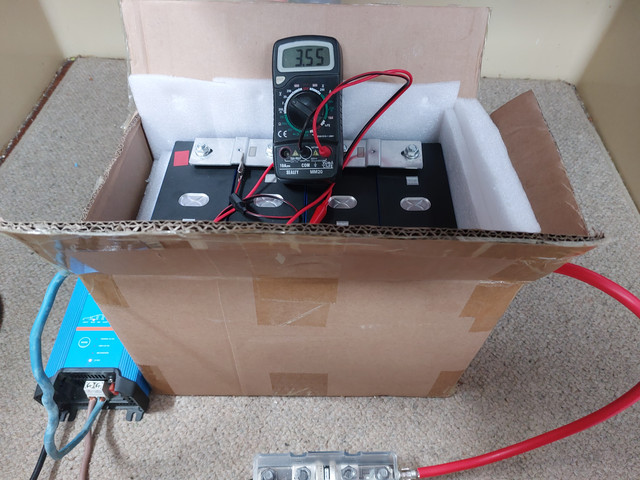

Charging as a 12v pack
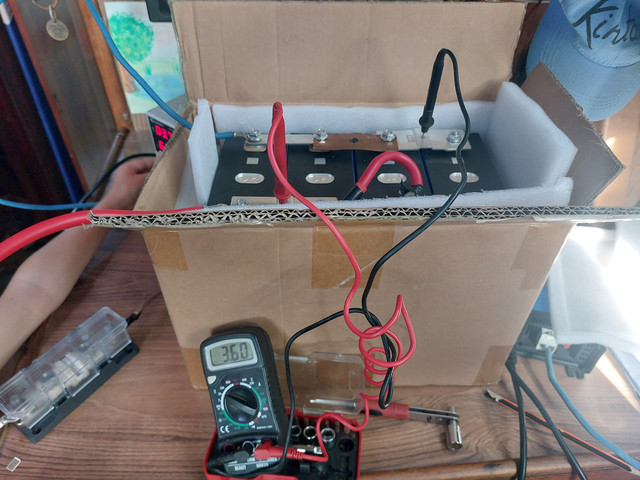

Final top balance in parallel
 
Thanks Kelpie for taking the time out to report all of this. I can assure you its all valuable and oddly readable - its interesting, but then I'm a motivated student.

Jonathan
 
Kelpie, The Digital Mermaid did a huge amount of work on battery connections which might be worth a watch if you haven't seen. There is more than one video on the subject too.

My two join at a battery master switch but can't see why the fuse holder can't be used to join two batteries as well as act as a fuse. How about putting the MPPT pos cable on that as well?

I suspect that even being really careful to ensure the battery leads will be the same length and really good connections, the two batteries will charge and discharge slightly differently. However, they will come together again with a good charge. Ours do, and I don't worry about it. It probably happens with lead acid too, only no one measures it.


After more than two years of excellent service from my DIY 271Ah LiFePO4 pack, I've decided to upgrade and build a second pack.
This time round the cells are slightly different, 280Ah with M8 studs instead of M6 threads.
I specified the same BMS- JBD 200A- but again it's slightly different, with reduced depth of heatsink fins and paired M5 threaded connections, instead of the single larger connections of the previous one.

Building the pack second time round is definitely faster and easier. To start with, I put the pack together along with an old spare BMS, and set it up with a 30A charger. Got a fair few Ah in before one of the cells hit 3.55v, at which point I stopped and put the cells in parallel, then resumed charging using a variable power supply set to 3.6v. I left it like that for a few hours, then reverted to 12v configuration and the bigger charger. This time everything was much better balanced and I was able to take all four cells up to 3.5v together.
Finally I put the cells back in parallel and carefully brought them up to 3.6v with the power supply.
Some people say you should balance at 3.65v but frankly I was running out of power and was keen to call it a day. Hopefully they'll be happy at that. I'm doing all of this using the inverter running off the previously built battery, and a good chunk of today's solar has gone in to the new battery instead of my actual house bank. There are some downsides to life at anchor without a generator.

Next step is to make up the end plates and threaded rod to physically hold the cells together. You don't want any movement between them damaging the studs. I'll mount the BMS on one of the end plates. Then a few cables to make up (easy with a £30 hydraulic crimping tool) and install.

A question for those in the know- the new BMS is designed to take two cables in each side. I think my options are to:
- run a pair of smaller cables, forming a Y, in to a single terminal at one end.
- run a pair of cables and stack the terminals
- ignore one of the connections and just use a single thick cable

I'm thinking the first option is likely the best, but I'm not all that happy about running small cables in parallel. However the individual cables would still be treated higher than the main fuse, so I guess it's ok?

And talking about fuses... I'm thinking of joining the two batteries at the fuse connector, using it as a bus bar. Is there any reason to also have individual fuses on each battery?

Final question. Presently, the MPPTs connect straight to the battery (on the positive side). If I leave that as-is, will I end up with one battery charging preferentially? It seems unlikely given that they're connected by heavy cable.


The cells upon arrival


Charging as a 12v pack


Final top balance in parallel
Always fun to read about a new build. One small point: it used to be said that charging to 3.65 volts was needed once to chemically prime the cells to get full capacity so, if true, that is the other less obvious reason for top balancing to 3.65 volts per cell. Also a common arrangement for two packs on parallel is to have an MRBF on each and then a Class T where they combine.
 
Last edited:
Kelpie - your original battery bank gave you stalwart service - so why are you building a new one?

On the basis that a lead battery is only useful to 50% of its rated capacity but a lithium can safely use, say 80%. you had a battery bank (or still have a battery bank) equivalent to 400amp/hrs of Lead. You are now going to double that.

This suggests your usage is huge and if you use that huge number, sufficient to need to double the battery bank - what is your ability to replenish.

My idea of a 200amp/hr lithium looks parsimonious.....

Jonathan
 
Prices of off-the-shelf drop in LiFePO4 seem to be falling into tempting territory.
Probably worth a separate thread.
 
Kelpie - your original battery bank gave you stalwart service - so why are you building a new one?

On the basis that a lead battery is only useful to 50% of its rated capacity but a lithium can safely use, say 80%. you had a battery bank (or still have a battery bank) equivalent to 400amp/hrs of Lead. You are now going to double that.

This suggests your usage is huge and if you use that huge number, sufficient to need to double the battery bank - what is your ability to replenish.

My idea of a 200amp/hr lithium looks parsimonious.....

Jonathan
I'm usually back to 100% by 3pm, and sometimes 2pm. So I could charge a larger bank.
On cloudy days, however, I pretty rapidly have to revert to gas cooking, which is a pain because of how much it heats up the boat.
I expect that with the extra battery capacity, we will almost never need to cook on gas again. At least, until we return to Scotland 😁
The other factor is the current draw- when using the air fryer and one ring on the hob, we're at 180A, plus whatever else is running. That's a lot of current for a 200A BMS. With the second battery, the load will be shared/halved.
 
Always fun to read about a new build. One small point: it used to be said that charging to 3.65 volts was needed once to chemically prime the cells to get full capacity so, if true, that is the other less obvious reason for top balancing to 3.65 volts per cell. Also a common arrangement for two packs on parallel is to have an MRBF on each and then a Class T where they combine.
I've seen a few references to 3.6v and thought I would give it a go. I won't need every last Ah out of this bank. But I'll keep an eye on things and if I have to re-do the top balance, I will. I had to rebalance my original pack one after a few months of use.

On fusing...
Current arrangement is a 225A Class T. Cables are 70mm². I don't intend to change the fuse or any of the cables after it. So the master fuse will be appropriate for each battery individually.
I actually bought a nifty MRBF fuse bar, which would make combining the two batteries quite easy, but it's all extra connections and I'm not sure I see the point. I'm also getting really tight for space on the bulkhead where this would be bolted. I'm not sure that all the extra connections and tight turns are a good idea.
 
Kelpie, The Digital Mermaid did a huge amount of work on battery connections which might be worth a watch if you haven't seen. There is more than one video on the subject too.

My two join at a battery master switch but can't see why the fuse holder can't be used to join two batteries as well as act as a fuse. How about putting the MPPT pos cable on that as well?

I suspect that even being really careful to ensure the battery leads will be the same length and really good connections, the two batteries will charge and discharge slightly differently. However, they will come together again with a good charge. Ours do, and I don't worry about it. It probably happens with lead acid too, only no one measures it.


Well she certainly doesn't seem to worry about using several smaller cables in parallel.
Maybe I will go for the Y-lead approach, to join the two connections on the BMS to the single connections on the battery and shunt.

The point about all the cable lengths being equal is interesting. I guess that is the ideal. But the two batteries are already shortly different, and not as different as in a hybrid system. With their own BMSs I don't think there's a serious problem, but at the same time I'm hoping to do a decent job of this.
It's tempting to reduce the amount of rewiring I have to do through the system, of course.
 
Love reading another LifePo4 thread….

When I made mine I spent a while ensuring all the cables where the same. After two years very little deviation. Mine where identical parts wise.

For yours, as the parts are different, I would not worry and if you see one deviating allot just swap them round.
 
I'm usually back to 100% by 3pm, and sometimes 2pm. So I could charge a larger bank.
On cloudy days, however, I pretty rapidly have to revert to gas cooking, which is a pain because of how much it heats up the boat.
I expect that with the extra battery capacity, we will almost never need to cook on gas again. At least, until we return to Scotland 😁
The other factor is the current draw- when using the air fryer and one ring on the hob, we're at 180A, plus whatever else is running. That's a lot of current for a 200A BMS. With the second battery, the load will be shared/halved.
OK, understand.

Your major motivation seems to be the current draw and having checked the current draw on our air fryer only a couple of days ago (because we had to buy a new one) I was wondering about current draw. Air fryers have improved (but not in terms of current draw). They used to be sold (here at least) as a circular unit, one early one we had looked like a space ship and another like Darth Vador's helmet. Now they are sold as cubic units which pack much better. We now have 2 old units looking for a good home and we tossed out the more recent cubic one that failed and replaced with a new cubic unit - these are currently used at home - they draw too much for the existing lead battery bank.

But I am now re-thinking the idea of a 200a/hr Lithium and think we will go 2 x 200amp/hr lithium.
Prices of off-the-shelf drop in LiFePO4 seem to be falling into tempting territory.
Probably worth a separate thread.

I'm on a mail shot and was offered yesterday 200amp/hr, Lithium, internal management at A$700 (with a free battery work light!). That's ex store all tax paid. Picking up from the store is not onerous, other side of Sydney. Our sales tax is 10% and the currency conversion is as near to 2:1 as you can get. For a sort of comparison in the same mail shot they were offering a 98amp/hr AGM for A$200 (they did not offer a 200a/hr AGM). I don't recall being offered anything bigger than 200amp/hrs for Lithium and everything I see is drop in, internal management.

Kelpie has not quoted prices, or I missed it.

I have noted that Geem is very anti internal management - which means building your own as Geem, Poey and Kelpie have done, are doing.

I'm not at a stage when I'm buying so I have not searched around for a better deal.

I'd be surprised if drop in battery prices are not similar in the UK.

Jonathan

Rather than a separate thread I'd prefer everything on a few threads - otherwise you have to pull out lots of threads to find the answers.
 
Reading today that EV batteries are likely to fall in price by around 40% in the next 3/4 years and no doubt similar falls will happen in batteries suitable for our use. However this does not automatically mean that lithium will be the best choice for leisure boat users many of which cannot take advantage of their 2 major properties - longer life through greater number of cycles and smaller size/weight for given usable capacity. Most people simply don't use their boats enough nor have any problem with space/size to justify the still substantial premium over even the better end of conventional batteries.

This changes of course, if like Kelpie and others you need the extra capacity and cycling because you live aboard full time and/or you make a conscious decision to run more of your boat systems on electric, particularly cooking or adding freezer, watermaker etc. that are electric power hungry.
 
Best prices I've seen in the UK are things like Renogy 50Ah 12V for £180, but personally I was wondering about smaller, like 20 or 30Ah, which are either side of £100.

It seems to me that 30Ah which won't be damaged if you don't manage to recharge it soon, and can be recharged in an hour of engine running, might be a useful addition to a boat like mine, where a big limitation is generating capacity in Autumn. Maybe I'd replace the 110Ah lead/acid like for like when it expires and augment it with 20 or 40Ah of Lifepo4.
Having a portable pack would also be of value.
In my view it's non-negotiable to have a house battery capable of starting the engine, lead acid is still the cheapest way to do that AFAIK.
 
Reading today that EV batteries are likely to fall in price by around 40% in the next 3/4 years and no doubt similar falls will happen in batteries suitable for our use. However this does not automatically mean that lithium will be the best choice for leisure boat users many of which cannot take advantage of their 2 major properties - longer life through greater number of cycles and smaller size/weight for given usable capacity. Most people simply don't use their boats enough nor have any problem with space/size to justify the still substantial premium over even the better end of conventional batteries.

This changes of course, if like Kelpie and others you need the extra capacity and cycling because you live aboard full time and/or you make a conscious decision to run more of your boat systems on electric, particularly cooking or adding freezer, watermaker etc. that are electric power hungry.
The other real advantage of Lithium is fast charging. As far as I can tell, you can charge a drop-in Lifepo4 battery from 10% to 90% in about an hour. Compared to a lead/acid requiring at best several hours and wanting to then be float charged to 100% for long life.
For a user like me, that's a big gain, motoring into the harbour and up the river will go a long way to replenishing from an evening's hear use and a day's fridge use, from say a 30Ah LifePo4. That's just over £100, so similar money to doubling the Lead/acid house bank and more flexible in use. I could also take it home to charge if that was convenient. It's a different world from those wanting to run air fryers and washing machines. I cook with gas at home and gas for the boat is not near the top of 'things I'd like to spend less on'.

Off-season boating without shore power.

Looking further ahead, a trolling motor and a bigger Lifepo4 is perhaps on the cards. That battery could be multi-function, as mostly it needs to be sized for peak current not capacity.

What I need to know more about is whether the internal BMS is really going to be OK charged from an alternator? And how to deal with the load side, which might be as simple as having two alternate 12V sockets to plug my fridge into.

Drop-in batteries are AFAIK substantially dearer than EV batteries, which are about $100/kWh factory gate?
A separate market which may develop differently from the domestic multi-kwh market?


At this point, I'm mostly concerned to upgrade the wiring on the boat in such a way that future flexibility is preserved.
 
This changes of course, if like Kelpie and others you need the extra capacity and cycling because you live aboard full time and/or you make a conscious decision to run more of your boat systems on electric, particularly cooking or adding freezer, watermaker etc. that are electric power hungry.
Prices have certainly dropped 40% over the past 3 or 4 years. Buying drop ins, also meant a 5 year warranty for not that much more than importing cells and BMS when I was shopping. For us the ability to draw large amounts of power was the main reason for switching to LFP. We use the kettle a lot and a second fridge / freezer nice to have in addition to induction cooking particularly during this summers heat waves.

B27, you shouldn't connect an alternator directly to a LFP battery or you risk the alternator over heating particularly at lower engine revs and when the BMS shuts down because the battery is full destroying the diodes in the alternator.

Several options available. DC>DC charger between engine start battery and LFP. Expensive after market external alternator controller. Add lead acid to the LFP battery and use a long wire to create resistance between alternator and hybrid bank. Alternator protector like the Sterling widget.

We went for the DC>DC charger and hybrid route because the alternator isn't the main domestic bank charging source, solar is. Other options perfectly valid.
 

Attachments

  • Melting the Ganache.JPG
    Melting the Ganache.JPG
    1.9 MB · Views: 5
Your major motivation seems to be the current draw
That's a factor, but it's secondary to the extra storage. At the moment we're fully charged by 2pm on a good day, but if the next day is poor, we're cooking on gas by dinner time to ensure that there's enough power left for the fridge and freezer. I hope that doubling the capacity will smooth out the peaks and troughs.


I'm on a mail shot and was offered yesterday 200amp/hr, Lithium, internal management at A$700 (with a free battery work light!). That's ex store all tax paid. Picking up from the store is not onerous, other side of Sydney. Our sales tax is 10% and the currency conversion is as near to 2:1 as you can get. For a sort of comparison in the same mail shot they were offering a 98amp/hr AGM for A$200 (they did not offer a 200a/hr AGM).
Given that lithium gives twice the usable capacity, you'd need to spend $800 on AGMs. Lithium is the cheaper option.

Kelpie has not quoted prices, or I missed it.
Apologies. The new battery cost US$548 for the cells, BMS, and delivery to Miami. Getting them in to Grenada cost a further $126. So that worked out a bit more than my first pack, which cost around £450 delivered to the UK (it was actually only £407 but when the BBC 200A BMS became available, I upgraded).
 
Reading today that EV batteries are likely to fall in price by around 40% in the next 3/4 years and no doubt similar falls will happen in batteries suitable for our use. However this does not automatically mean that lithium will be the best choice for leisure boat users many of which cannot take advantage of their 2 major properties - longer life through greater number of cycles and smaller size/weight for given usable capacity. Most people simply don't use their boats enough nor have any problem with space/size to justify the still substantial premium over even the better end of conventional batteries.

This changes of course, if like Kelpie and others you need the extra capacity and cycling because you live aboard full time and/or you make a conscious decision to run more of your boat systems on electric, particularly cooking or adding freezer, watermaker etc. that are electric power hungry.
Lithium is more expensive than basic leisure batteries, but it's no longer more expensive than the premium lead acid like Trojans or AGMs.

It's probably not worth the hassle to change if you've been getting five years out of £100 leisure batteries.
 
Lithium is more expensive than basic leisure batteries, but it's no longer more expensive than the premium lead acid like Trojans or AGMs.

It's probably not worth the hassle to change if you've been getting five years out of £100 leisure batteries.
The obvious time to change is when your current battery bank needs to be replaced.

Just out of interest:

What is the acceptance by the major boat builders to lithium, is it mainstream at boat shows or considered an exotic?

Jonathan
 
Top