PeteCooper
Well-Known Member
I would try and have a look at popular dinghies where the mast can be wood or alloy - the Mirror springs to mind. See what there dimensions are and that might give you some kind of rough ratio.


I would try and have a look at popular dinghies where the mast can be wood or alloy - the Mirror springs to mind. See what there dimensions are and that might give you some kind of rough ratio.
For the mast B&B specify 2 sections of aluminium tube and a wooden top section.
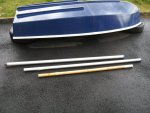
The sections specified are: 2m 50mm 1.7mm wall 6061 T6 tube, 2m 45mm 1.7mm wall 6061 T6 tube and a wooden top section. I got some sections like this from a rigger - I think they are used for spinnaker poles.
I then selected 2 of the least knotty pine sections from the local builders merchants, epoxied them together and rounded them to fit inside the smaller section.
Enjoy the build,
Conor
Apologies for resurrecting a very ancient thread! However, I thought I'd report that I have completed this project, at long last, and the dinghy was launched in (hopefully) its final form last weekend. I did try it earlier, but managed to capsize it by not realizing that water could get trapped under the thwarts, resulting in her being a bit unstable. I have now filled the space under the thwarts with closed-cell foam!
The boat rows and tows very well. Rowing is FAR easier than with a rubber dinghy, much better run between strokes and carries way better. A modification I did was to put two parallel skegs at the stern rather than a single one, and she keeps her direction very well, while remaining easy to turn. I rowed her a mile or so, and it wasn't a strain (though my thighs are feeling it today!). SHe towed behind a friend's boat very steadily.
So, despite it taking FAR longer than I intended, a result!
Congrats on finishing!
You've got me worried though: I've got the plans for a Richard Woods Duo dinghy, that I plan to start soon.
http://www.fyneboatkits.co.uk/plans/sailing/duo-dinghy/
It'll be my first such project, and I've got no real woodworking skills at all.
Hoping to be finished in time for a sail this year.
Well, the good news is that I have little in the way of woodworking skills, and I managed - learning along the way, quite often! The reason for the long build time was a) I was working in my unheated garage, so couldn't do epoxy work in the winter and b) various other projects got in the way! A friend with a table saw came in handy - to make the gunwhales, I bought a substantial plank of Iroko from my local hardwood suppliers and he helped me to cut two suitable strips from it. Cutting the plywood panels was tricky; it's not particularly easy following the long, gentle curves! But stich and glue is a pretty forgiving construction method. You have the advantage over me in that I used "free" plans to make mine, so I didn't have full-size drawings, and there are known issues with the plans - see above!
I did a practice run on rolls of brown paper! I measured offsets from the plans (getting them into a drawing program on a PC will help, if you have a PDF version of the plans), and then used a long batten to make fair curves between the fixed points.Thanks .... good to hear from another novice.
Slight correction, though: plans for the Duo aren't full size, so scaling will be an early challenge.
I did a practice run on rolls of brown paper! I measured offsets from the plans (getting them into a drawing program on a PC will help, if you have a PDF version of the plans), and then used a long batten to make fair curves between the fixed points.
I'm sure you'll have thought of this, but clamping two sheets of ply together and cutting both sides at once ensures the two sides are symmetrical and halves the cutting!