Bruce anchors; so bad?

I have a CQR which works very well, I also bought a 15 kg Bruce copy, which works very well too, however, my concern with the Bruce copy is the structural integrity of the cast and the quality of the metal; there is no way for me to know whether the shaft will snap under high loading.

Because of this uncertainty, i am planning to replace it with a "modern" design well known name anchor.
 
I have a CQR which works very well, I also bought a 15 kg Bruce copy, which works very well too, however, my concern with the Bruce copy is the structural integrity of the cast and the quality of the metal; there is no way for me to know whether the shaft will snap under high loading.

Because of this uncertainty, i am planning to replace it with a "modern" design well known name anchor.

i have a gen 15kg bruce for a reasonable cost
 
Great to read a post where people like bruces. My genuine 15kg bruce has dragged once in over 300 nights at anchor - and in the weedy med too. Yes it can be difficult to get in through the weed, but once in - it stays in. Only problem I have had is on mud bottoms it can be difficult to break out! - a problem I am happy to endure. Each to his own.
 
Knowingly buying a fake anchor strikes me as a similar view to life as that which the late Steve Irwin enjoyed..." this is the most dangerous animal in the world; now if I poke it with a stick..." :rolleyes:
 
Fakes?

I do not think they are fakes as such, Bruce decided not to continue to make small boat anchors a long time ago and one of the makers of these copies is Lewmar, not a company all of us would associate with fakes. I am not sure they are all equal to the lewmar version but it is a company I would have confidence in. Manson also make them in stainless steel. The owners of those Scandanavian superyachts that you see sporting those oh so shiny stainless steel versions would be appalled to be accused of wearing fake bling.
 
I genuinely wonder if there is a significant difference in the holding power of two identical anchors, one in shiny stainless steel, and the other in comparatively rough galvanising. Does the shiny one slide through the mud?
 
I genuinely wonder if there is a significant difference in the holding power of two identical anchors, one in shiny stainless steel, and the other in comparatively rough galvanising. Does the shiny one slide through the mud?

I am not sure whether it slides better in the mud; but definitely it looks good on the deck
 
Oh goody, an anchor thread!!!!!!!

I am also a Bruce supporter but only the genuine Scottish variety. It held in all conditions except in eel grass at Pollensa in 40knots. Mind you everybody else was dragging and we stopped after I let out a further 40metres of chain in 5m depth!!!!
 
Reading some of the threads on anchors, Bruce seems to get pretty poor report with Rocna, Delta etc being the favourites.

I have had a 35lb Bruce for years on my 30' medium displacement long keeler. I anchor a lot and have used it in up to F8. Only once has it failed to set first time and drag, when the bottom was foul and it picked up some debris. I have 35m 8mm chain and 65m anchorplait.

So have I just been lucky? I'm no engineer, but the compound curved shape and substantial casting looks extremely strong compared to the flat shank jointed onto fluke of a modern design. I cant ignore the test results in which the Bruce never seems to fare well, but my own experience has been very good.

I was reading about this as I have just bought a Fortress as a kedge. It seems very well made and if you believe the torrent of advertising testimonials that came with it, its absolutely the best anchor in the world. But to me it looks very flimsy compared to a good cast anchor. Folded alloy all fixed together with nuts and bolts. It looks ideal as a light kedge which is what I want it for, but it looks like it would bend if it came under real load.

Colin

In French tests the Bruce was criticised for not being very good at resetting after pulling say on a turn of tide.

The Fortress was commended but if by excess strain, a fluke was bent by even as little as 1 cm then it lost virtually all its effectiveness.

Among French nautical journalists, the Spade is generally the highest rated.
 
Last edited:
Pal has a 37 Fortress on a 12 tonne schooner and yes it has bent one fluke a bit. Fortress give a no quibble lifetime guarantee so he can have a new fluke if he wants. And he anchors , usually around Scilly, for maybe three months per summer.

He should take advantage of it then. A bent fluke renders the anchor useless according to French reports.
 
The new generation anchors are much better than the old anchors. A single dive around a busy anchorage will clearly show the difference.
The main weakness of the Bruce is in weed and to a lesser extent hard sand. It also doesn’t seem to "scale" well with large anchors (say over 25KG) working much better than the same design in the smaller versions.
Its strengths are good storage on the bow roller, strong construction (as you noted). When it does drag it drags reasonably slowly and although, in difficult surfaces, it does not set well it usually achieves some sort of set, so it is reasonably reliable in moderate winds (say 35 K), but it is a poor performer in strong winds on a more difficult surface.

If you anchor a lot IMHO it is worth an upgrade, but the fact the Bruce has served you well indicates you are anchoring on sea beds where the Bruce anchor works well.

Despite all the recent press anchors rarely bend. I have never bent one(and I anchor over 300 days a year) and although I have met boats that have bent anchors it is certainly not common even mixing with cruising folk like myself that anchor a lot.
The Fortress anchor will bend much easier than all the other designs, but you are still very unlikely to bend one. If you do they give a no questions asked guarantee which works very well in practice (they will post you out a replacement part immediately)

The light ones were tested to destruction in this French report. In fact the Fortess (the light one) had the highest straight line resistance of any anchor - more than 3000kg force before breaking out IIRC. However it bent in the effort and could not be used thereafter.
 
In French tests the Bruce was criticised for not being very good at resetting after pulling say on a turn of tide.

The Fortress was commended but if by excess strain, a fluke was bent by even as little as 1 cm then it lost virtually all its effectiveness.

Hmmm . . . this is the opposite of the usual test results. Usually the Bruce is excellent at resetting after a veer, and the fortress not so well. However, the fortress is pretty much unequalled at "straight line holding power/kg anchor in mud and sand" and perhaps that's what you mean it was commended for.

As previously discussed in the thread, its hard to generalize test results about bruce designs because the bigger ones do MUCH better than the smaller ones. Testing 15kg (Which is a very common size in these sorts of tests) and smaller bruce designs is pretty much a waste of time because they will do poorly, while the 50kg models will do quite well.

We have been RTW twice, primarily using bruce designs (most recently the Ray), using a 20kg on our first boat and a 50kg on the current boat, and have had smashing success with them. In two trips around we only could not get it to set and hold once - in Albany (SW Australia), where no anchor known will set (we and a couple other boats with us tried essentially every design available) because it has sand so hard the locals drive on the beach and leave no tracks at all. It was like trying to anchor on a flat cement parking lot. We in fact have had more trouble with the holding/setting of a 'next gen' anchor we carry than with the bruce design.

Among French nautical journalists, the Spade is generally the highest rated.
Yes, a good anchor, but perhaps not the best managed business - poor distribution in many places.

.
 
Last edited:
We inherited a 66lb Bruce(?) with our new boat but until we get to the USA have no idea if it is any good or not, although the boat spent 3 months or so earlier this year anchored in the Bahamas, Exumas an Abacos on it. We have no idea if it is a genuine Bruce or a cheap copy, how do you tell? Nor do we have any real feel for if we can trust it or not. My inclination is to change it as part of the 'just bought a new boat have presents to buy for it' phase and probably go for a 70lb or even 88lb Delta. I don't want a Rottener because apart from anything else the roll bar designs make fitting difficult or expensive as we have an in plank roller. Manson has the same roll bar problem and the Spade prices in the USA make my eyes water down my legs. The Delta choice is because I really loved the one we had on our last boat, plus the prices in the USA allow us to go two sizes up from the normal recommendation and still be quids (greenbacks) in over a standard size Spade or a Manson plus modifications to the plank bow roller.

We will be anchoring a lot, in the ICW and out in the Bahamas and associated islands, later farther into the Caribbean islands and/or northwards up to Chesapeake and perhaps beyond to the NE States. I'm open to comments!

Oh the boat BTW is a 47ft 'fast trawler' as in semi-displacement high windage mobo which will be our live aboard home from next spring. Currently has a 66lb Bruce 'ish, and a 45lb Danforth. plus a small FX-11 Fortress.
 
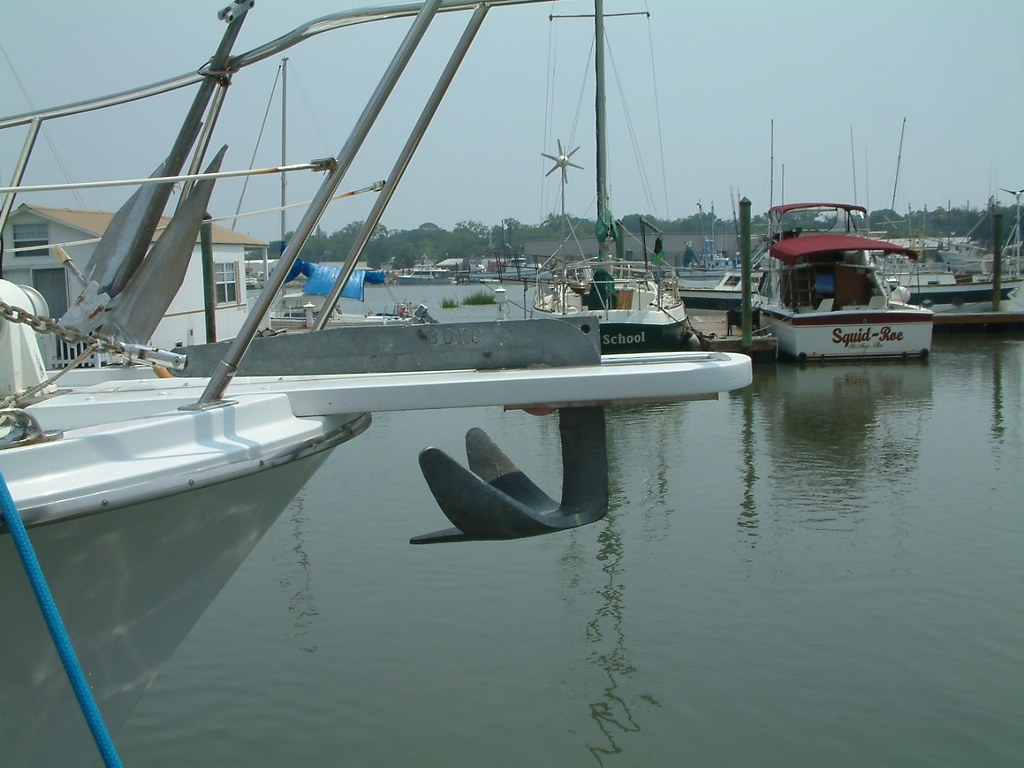
Bruce cast their name and the weight into the sides of the shank, I think Lewmar call theirs 'the claw' but I might be wrong about that.
 
Bruce cast their name and the weight into the sides of the shank, I think Lewmar call theirs 'the claw' but I might be wrong about that.

It just says '30KG' on it I think.

6328543707_71eb41ff32_b.jpg
 
We have a 20kg (44lb) Bruce and 40M of 8mm chain and our boat has a displ of around 7 tons and haven't had much of a problem with it... we always take our time anchoring as to make sure it's set before the drinks come out:)
 
Top